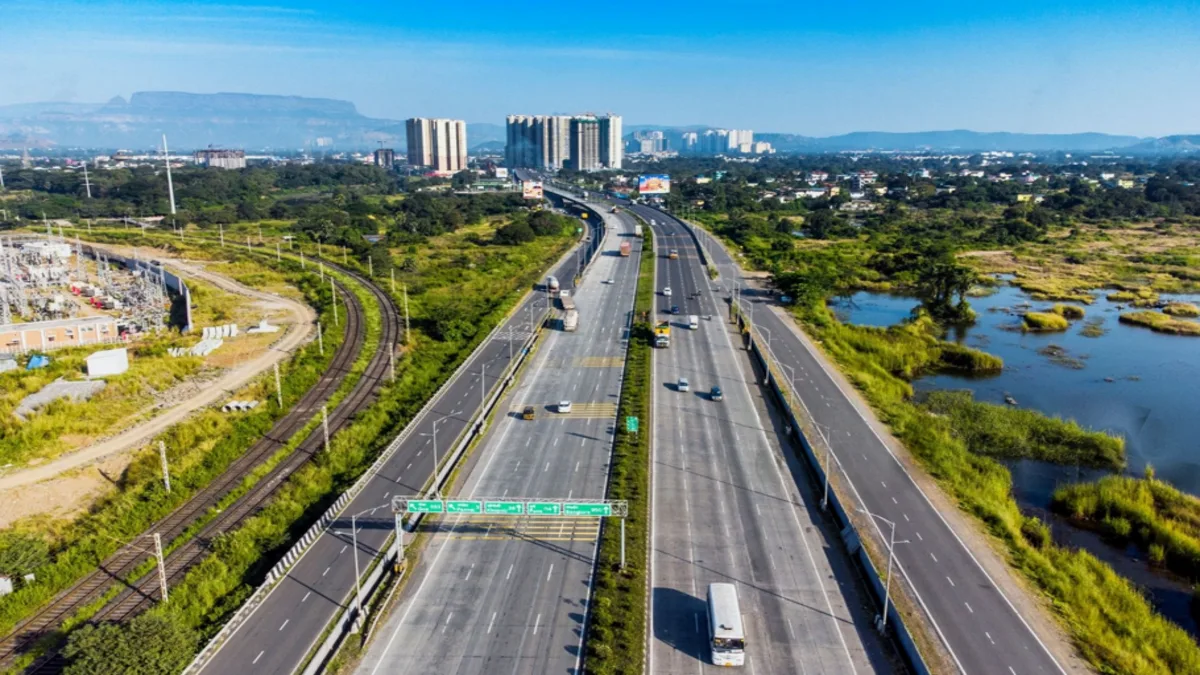
Bharat Introduced a Common Design Code for Its 50,000 km High-Speed Corridor
Bharat lost 1,77,175 lives in 4,87,707 road accidents in 2024, according to the Ministry of Road Transport and Highways. National Highways alone accounted for 36.6 per cent of those deaths. The National Highways Authority of India (NHAI) released its first comprehensive guidelines for planning and designing access-controlled high-speed National Highways other than Expressways.
The rulebook will govern every upcoming four and six lane greenfield and brownfield corridor of this kind, it comes as the Centre plans 50,000 km of access-controlled high-speed corridors under the Viksit Bharat 2047 roadmap. The move sounds technical. Its consequences will be felt by every truck driver, family traveller and exporter who uses these roads in the decades ahead.
Until now Expressways had their own specifications, but high-speed access-controlled National Highways did not. Detailed Project Reports (DPRs) for such corridors therefore followed varying standards. The new guidelines replace this patchwork with one uniform set of technical and safety provisions. Lane configuration will now follow detailed traffic assessment. A corridor carrying up to 15,000 vehicles will be a four-lane highway with four-lane structures on a 60-metre width.
Where traffic is between 15,000 and 25,000 vehicles, the road will remain four-lane but its structures will be built for six lanes, on a 70-metre width. Corridors handling 25,000 to 40,000 vehicles will be six-lane with six-lane structures, also on 70 metres.
Entry and exit will be tightly managed. Interchanges with ramps will come up only where the corridor meets Expressways, National Highways, State Highways and busy arterial roads or where it connects major traffic generators such as ports, airports, Multi-Modal Logistics Parks (MMLP) industrial areas and major tourist destinations.
Drivers will get advance notification of every exit and entry so they can change lanes calmly instead of braking at the last second. A one-metre-high boundary wall along the outer edge will keep out encroachments, unauthorised access and stray cattle.
Four clear reasons stand out. First one is regulatory gap. A network built to a common vision cannot be designed to different rulebooks. Differences between DPR meant uneven road widths, inconsistent interchange planning and varying safety features from one project to the next. For a highway user, that meant never quite knowing what to expect. Second is the safety toll. Highways carry a disproportionate share of Bharat Road deaths. In 2024, National Highways and Expressways recorded 1,50,958 accidents, or 31 per cent of the total and 64,772 fatalities.
Much of this happens where high-speed traffic meets the unexpected: a tractor entering from a village road, a pedestrian crossing, or cattle wandering onto the carriageway. Two-wheeler riders made up 46.2 per cent of all road deaths that year and pedestrians another 20.6 per cent and both are most exposed when they share space with fast traffic.
Access control removes these conflict points by design. The evidence is already visible. On the access-controlled Bengaluru–Mysuru Expressway, road deaths fell from 188 in 2023 to 56 in 2024 and held at 57 in 2025, once safety fixes and enforcement took hold.
Third one is building 50,000 km of high-speed corridors without a shared template would multiply inconsistencies, delays and cost overruns. A single standard speeds up DPR preparation, simplifies approvals and lets contractors and engineers work to familiar specifications.
Fourth is the cost of moving goods. A study by NCAER for the Department for Promotion of Industry and Internal Trade (DPIIT) placed Indian logistics cost at 7.97 per cent of GDP in 2023-24.
The same study found road freight costs ₹11.03 per tonne-km, excluding first and last mile charges. Faster is the uninterrupted corridors that link directly to ports and logistics parks can push that number down, making Indian goods more competitive at home and abroad.
Standards age quickly when they are written only for present traffic. These appear designed with tomorrow in mind. The most telling provision is the middle tier. A four-lane road with six-lane structures on a 70-metre width means bridges, flyovers and underpasses will already be ready when traffic grows.
Widening will then need no fresh land acquisition and no demolition of structures, saving public money and sparing commuters years of construction chaos. The link between lane count and measured traffic volume also ensures that capacity follows demand rather than guesswork.
The focus on interchanges near MMLPs, ports and airports ties the guidelines to the wider logic of PM Gati Shakti, where roads, rail, waterways and air cargo are planned as one system. As manufacturing grows and new logistics parks come up, the highways feeding them will already be built to the right standard.
A few questions remain for implementation. Securing 60 to 70 metres of land is never easy in a densely populated country. Villages on either side of a walled corridor will need enough underpasses and service connections so that the new road does not cut communities apart.
A one-metre wall will stop most stray cattle and casual crossings, but it will need regular maintenance and firm enforcement against breaches. How these are handled on the ground will decide how well the rulebook works.
For the ordinary traveller, the answer is likely yes, on three counts. Safer journeys come first. Fewer uncontrolled entry points, clear exit signs and a physical barrier against animals directly target the causes of many highway crashes. Every life saved is a family spared.
Faster and more predictable travel follows. Uninterrupted movement lowers fuel consumption, cuts travel time and reduces wear on vehicles. For a truck operator, predictable transit times mean more trips a month and lower costs, savings that eventually reach the consumer.
Direct interchanges at major tourist destinations will also make pilgrimage and leisure travel smoother, bringing more visitors and earnings to the towns and small businesses around them. Finally, the guidelines give a sense of uniformity to the national network.
A driver moving from Gujarat to Odisha should find the same lane discipline, the same signage logic and the same safety features. That consistency is a hallmark of world-class highway systems, and Bharat is now writing it into its own rulebook.
Great roads are not built on concrete alone; they rest on sound standards. By filling a long-standing gap between ordinary National Highways and Expressways, NHAI has given Bharat’s next generation of corridors a common foundation. If land, local access and enforcement are managed with the same care, these high-speed highways can carry the country safely and swiftly towards its Viksit Bharat goals.
