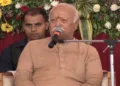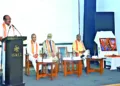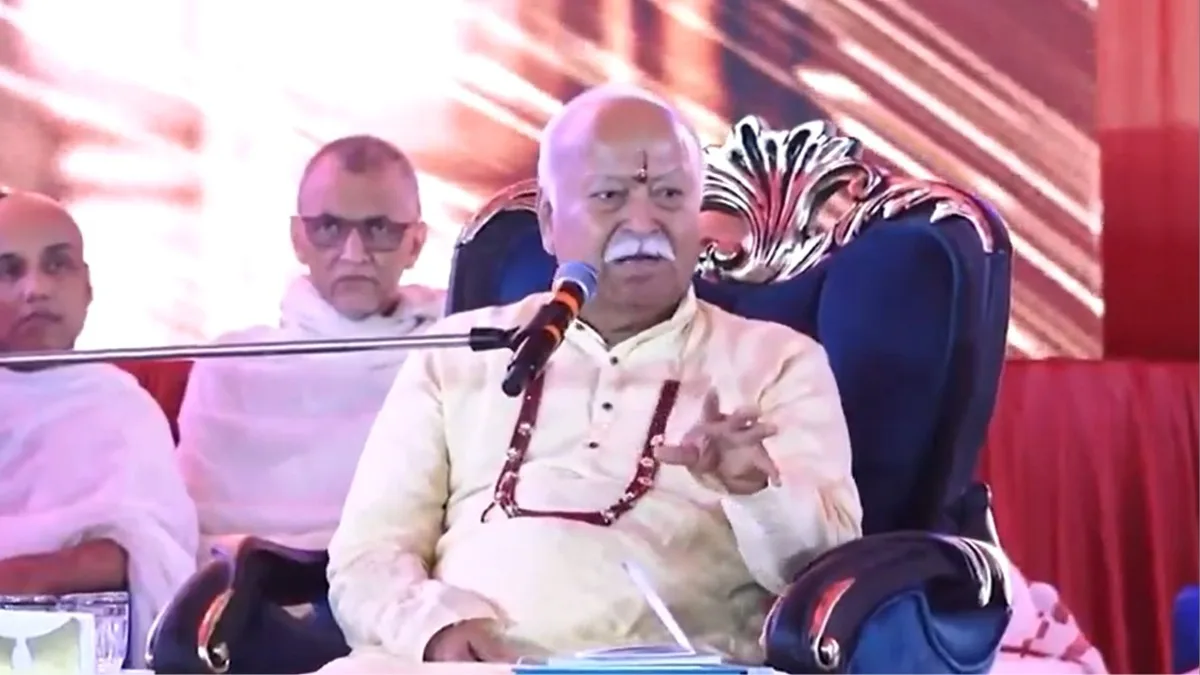
BORIVALI: “Our nation exists for Dharma. In our tradition, the nation and Dharma are inseparable. The purpose of the nation is to uphold Dharma, while Dharma sustains and strengthens the nation. Both are interdependent; if one exists, so does the other, and if one ceases to exist, the other cannot survive either. If the nation becomes weak, Dharma will be endangered, and if the practice of Dharma weakens, the nation will decline. Therefore, it is our duty to ensure that both progress together in harmony,” said RSS Sarsanghchalak Dr Mohan Bhagwat while addressing the 14th National Convention of the All India Vihar Seva Group in Borivali, Mumbai on October 2, 2026.
Dr Mohan Bhagwat emphasised that complete dedication to a noble cause brings fulfilment to human life. He highlighted the importance of protecting saints, preserving Bharat’s spiritual, cultural knowledge and strengthening cooperation, describing such service as both national and religious work.
Beginning his address with salutations to Param Shraddheya Gurudev Ratna Sundar Sureshwar Ji Maharaj, the sadhvis, munis and other attendees, Dr Bhagwat explained the power of samarpan (dedication) through a story of a devoted disciple.
He narrated the story of an uneducated disciple who was assigned physical work, including fetching water and cleaning, by his Guru. While other disciples engaged in study and spiritual practices, he dedicated himself to serving his Guru. Recognising the physical demands of his work, the Guru provided him with a measure of gram and jaggery every day.
When the other disciples became envious of the special provision, the Guru announced a pilgrimage during which those accompanying him would attain liberation. One disciple, however, had to remain behind to look after the ashram. The disciples collectively chose the uneducated disciple, believing he would miss the opportunity for liberation.
Accepting the Guru’s instructions without hesitation, the disciple continued his duties. As part of his daily worship, he prepared food offerings for Bhagwan Ram and waited for the deity to partake of them before eating himself. When the offering remained untouched for several days, he insisted that the Bhagwan Ram either accept the food or he would give up his own life rather than eat without the deity’s blessing. Moved by his unwavering devotion, Bhagwan Ram appeared along with Lakshman, Bharat, Sita Mata and Hanuman ji and accepted the offering. The disciple subsequently persuaded Sita Mata to prepare better food, Lakshman to undertake night watch duties and Hanuman to help fetch water, explaining the difficulties of managing the ashram alone.
On another occasion, when he prepared halwa, the disciple became distressed at the thought that his Guru had not tasted it. Bhagwan Ram arranged for Hanuman ji to take him to the Guru with the offering. When the Guru asked how he had arrived, the disciple explained that he had come with the Bhgawan’s permission and needed to return promptly to his duties. The incident revealed to the other disciples the power of his complete dedication, through which he had attained the divine presence.
Dr Bhagwat said that dedication to a noble, divine and pure cause could transform human life into heaven. He observed that those who had been called to undertake such work were fortunate, as finding an opportunity to serve such a cause required the spiritual merit of many lifetimes.
Highlighting Bharat’s spiritual heritage, Dr Bhagwat said that the country possessed an immense treasury of knowledge that the world needed today. Recalling his visits to New York, Toronto and London, he said he had spoken about Bharat and observed that people across the world were seeking answers to the challenges confronting humanity.
He referred to the dilemmas arising from development and environmental protection, individual freedom and the breakdown of families, as well as religious faith and increasing conflicts. He noted that societies were struggling to reconcile individual aspirations with collective welfare and that excessive religious rigidity could lead to disputes and violence.
Dr Bhagwat said that the world is looking towards Bharat because of its historical experience of sharing knowledge and the path to peace and harmony without conquering other countries, converting people or attacking other traditions. He emphasised that Bharat’s traditional wisdom offered a way to reconcile seemingly conflicting aspects of human life and promote collective progress.
Referring to the Ekatmata Stotra recited in the Sangh, he highlighted Bharat’s vast knowledge tradition, encompassing the four Vedas, Puranas, Upanishads, Ramayana, Mahabharata, Bhagavad Gita, various philosophical traditions, Jain Agamas, Tripitaka, Guru Granth Sahib and the teachings of saints. He said this knowledge must be imbibed in the heart and preserved through the lives and teachings of those who practise it.
“One is not merely protecting a single life. One is protecting the secure future of the entire human race,” Dr Bhagwat said, emphasising the importance of safeguarding the lives of saints and spiritual practitioners who preserve this knowledge through their conduct and teachings.
He assured the gathering that RSS swayamsevaks would extend assistance wherever required to facilitate the work and security of Jain saints. He encouraged the attendees to maintain regular contact with local Sangh workers, inform them about their travel plans and communicate their requirements in advance so that necessary arrangements could be made.
Explaining the Sangh’s approach to service, Dr Bhagwat said that direct local contact would enable swayamsevaks to respond promptly, without waiting for instructions from higher levels. He said swayamsevaks are committed to supporting those engaged in preserving Bharat’s spiritual heritage and that helping such individuals was itself a matter of good fortune.
Emphasising the principle of universal welfare, he said Bharat’s approach was not limited to the maximum good of the maximum number of people, but sought the welfare of everyone. He referred to the ideals of Sarve Bhavantu Sukhinah and Sarva Mangala, explaining that the suffering of even a few could ultimately affect the happiness of the larger society.
He observed that Bharat’s nationhood had been shaped not merely by kings but also by renunciates and people who travelled on foot, spreading spiritual knowledge and values. Referring to the Shramana and Brahmin traditions, he said these traditions had contributed to the making of the nation and the preservation of its knowledge.
According to Dr Bhagwat, dharma is the path through which human life could be organised to contribute to the welfare of the world. While different traditions followed different paths according to time, place and circumstances, humanity and brotherhood remained the higher principles sustaining all life.
He cited the example of Rishabhdev, who imparted the principles of Asi, Masi and Krishi, relating spiritual wisdom to everyday human activity. He said that individual effort and achievement should contribute not only to personal welfare but also to the well-being of society and the world.
Dr Bhagwat reiterated that the purpose of the nation was to uphold dharma, while dharma contributed to the preservation and sustenance of the nation. He said that when the nation weakened, dharma faced challenges, and when the practice of dharma weakened, the nation also declined. Therefore, both needed to progress together.
He described the efforts of householders, students and young people who devoted their time to preserving Bharat’s spiritual knowledge as both national service and religious service.
Speaking about the spirit of voluntary service, Dr Bhagwat said that millions of RSS swayamsevaks devoted their time and resources to national work without expecting anything in return. He said that meeting others engaged in similar selfless service reinforced the confidence that those working for good causes were not alone.
He added that the presence and guidance of Gurudev provided inspiration, while witnessing the dedication of the attendees strengthened his confidence that religion and goodness remained alive in society, despite various challenges.
Concluding his address, Dr Bhagwat said that he had not come to deliver a lecture, as Gurudev’s guidance was sufficient, but to witness and encourage the spirit of dedication and service.
Expressing gratitude to Gurudev and the attendees, he said that the gathering had provided him with renewed enthusiasm and confidence in the strength of people committed to serving society and the nation. He concluded by thanking everyone present.