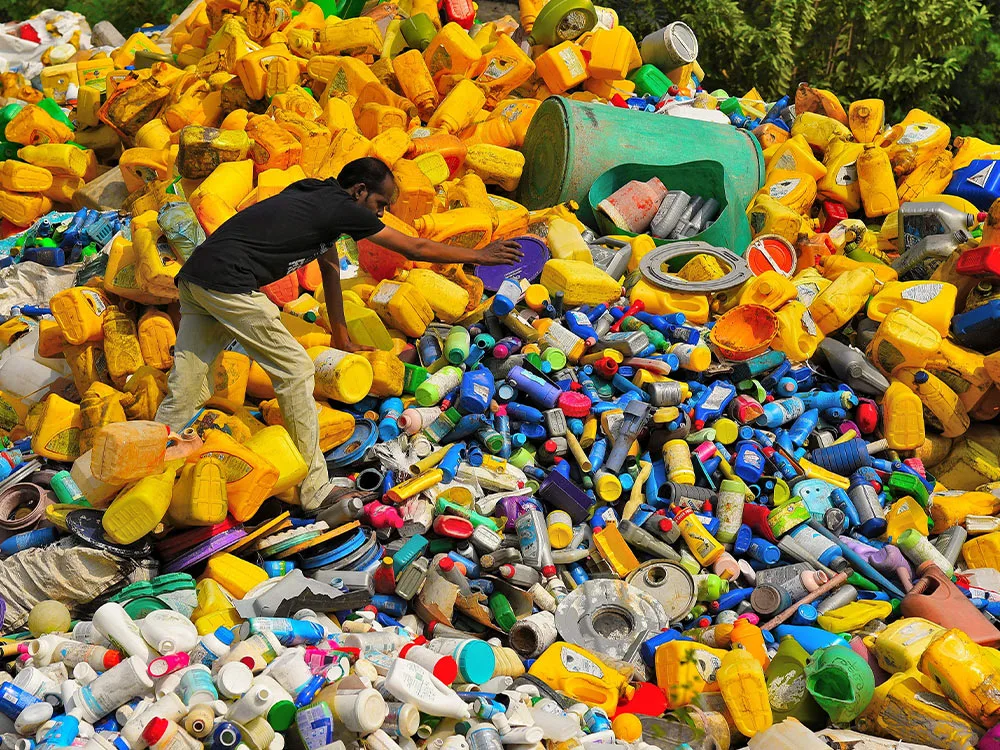
A representative image
For years, plastic bags were an almost invisible part of everyday life in Indian markets. A customer would buy vegetables, groceries or other goods, and a plastic bag would often be handed over without a second thought. Once it served its immediate purpose, it usually ended up in a household bin, on a roadside or in a landfill.
That pattern is slowly changing.
Across Indian cities and towns, efforts to deal with plastic waste are increasingly moving beyond simply reducing consumption. The focus is now also on reuse, collection, segregation, recycling and finding productive uses for plastic that would otherwise be discarded.
The change has been supported by tighter regulations as well as improvements in municipal waste-management systems. The Swachh Bharat Mission, launched on October 2, 2014, placed greater emphasis on cleanliness, waste collection, segregation and scientific waste management. The ban on identified single-use plastic items came into effect on July 1, 2022, adding another layer to efforts to reduce plastic pollution.
But regulations alone cannot change everyday habits. For that, cities have increasingly turned to local campaigns, community groups, municipal bodies, self-help groups and innovative collection systems.
The result is a growing number of experiments across the country in which plastic is being treated not simply as something to be thrown away, but as material that can be avoided, reused, recovered and, in some cases, converted into something useful.
Markets are among the places where single-use plastic can quickly pile up. Thousands of shoppers and vendors interact every day, and packaging is often used for only a few minutes before being discarded.
In Tamil Nadu’s Tiruchirappalli, or Trichy, the municipal corporation tried to address this problem by taking its plastic-reduction campaign directly to farmers’ markets.
In 2022, the city corporation launched an initiative covering three markets — Tennur, K.K. Nagar and Woraiyur. Around 220 vendors were brought into the campaign, which focused on explaining the environmental impact of single-use plastic and encouraging both shopkeepers and customers to switch to reusable alternatives.
One of the most visible parts of the campaign was the “ThunippaiThiruvizhai”, or Cloth-Bag Festival. The idea was simple: encourage shoppers to carry cloth bags instead of depending on disposable plastic bags every time they visited the market.
The initiative produced measurable results. The Tennur market avoided around 2,200 kg of single-use plastic in one year. K.K. Nagar avoided another 620 kg in four months, while Woraiyur avoided 300 kg over six months.
The numbers show how a relatively simple intervention can make a difference when it is introduced at a place where plastic consumption is particularly high.
The Trichy experience also underlines an important part of waste management: alternatives have to be convenient. Asking consumers to stop using plastic is easier when they have access to affordable and practical substitutes.
In Maharashtra, the town of Vita has experimented with another way of making reusable bags easily available.
The Nagar Parishad installed five machines known as “Thaila ATMs” at busy locations. Designed along the lines of vending machines, the units allow shoppers to obtain cotton bags by inserting a coin or note.
The idea addresses one of the common reasons people continue to use disposable bags: convenience. A shopper who arrives without a reusable bag does not necessarily have to buy another plastic bag. Instead, a reusable cotton bag can be obtained from the machine.
The system also uses GSM technology to monitor bag availability remotely. When stocks fall below a specified level, the municipal council can receive an alert and arrange for replenishment.
The initiative has another dimension. The bags are stitched by women associated with local Self-Help Groups, linking the effort to livelihood opportunities within the community.
Around 6,000 bags have been sold through the initiative, while the weekly market has recorded sales of nearly 200 bags in a single day.
Vita’s experience shows that plastic reduction can be combined with local enterprise. Instead of treating the replacement of plastic bags only as an environmental issue, the initiative creates a small economic ecosystem around the production and distribution of reusable alternatives.
Other parts of Maharashtra have also taken different approaches. In Indapur, authorities seized 25 kg of plastic bags and imposed a fine of Rs 90,000. At the same time, community initiatives have focused on increasing the availability of alternatives.
A Self-Help Group in Wardha distributed 17,000 paper bags, while cloth and jute bags have been promoted as options that can be used repeatedly.
Together, these efforts illustrate the combination of enforcement and behavioural change needed to reduce dependence on single-use plastic.
The Andaman and Nicobar Islands have taken a different approach by giving households a direct incentive to return used plastic milk pouches.
Instead of throwing away the pouches after use, residents are encouraged to take them to designated collection points. In return, they can receive rewards such as fresh milk or discounts.
The programme was implemented in collaboration with the Andaman and Nicobar Islands Integrated Development Corporation Limited and the Sri Vijaya Puram Municipal Council.
Awareness campaigns were conducted alongside the collection programme to explain the importance of responsible disposal and recycling.
By November 2024, the initiative had collected 17,600 milk pouches. Participating residents received 352 litres of milk as rewards.
The numbers offer an interesting insight into how incentives can change waste-collection habits. A plastic pouch that would otherwise have little or no value for a household becomes something worth returning when a tangible benefit is attached to it.
The larger idea is to create a habit in which households see waste collection as part of the consumption cycle rather than something that begins and ends with throwing an item into a bin.
In Bengaluru, the focus has been on recovering plastic from the waste stream and connecting the process with livelihoods.
Under the United Nations Development Programme’s Project Prithvi, a Material Recovery Facility known as Swachhata Kendra was established in 2019 for Safai Saathis.
The facility provides a space where collected plastic can be sorted and processed instead of being sent directly for disposal. Plastic is shredded and baled before being supplied to recyclers.
The centre has also demonstrated the connection between waste management and livelihoods. Managed by social organisation Hasiru Dala, the facility provided employment to 76 Safai Saathis during the COVID-19 pandemic.
Safai Saathis play an important role in India’s waste-management ecosystem, particularly in the collection and sorting of recyclable materials. Bringing their work into organised recovery systems can create a more structured pathway for materials that would otherwise be lost in mixed waste.
The recovered plastic from the facility can eventually be used in products such as roads, agricultural water pipes and furniture.
This changes the journey of plastic. Instead of moving directly from a household or commercial establishment to a dumpsite, it can enter a recovery chain where its material value is retained.
Not all plastic is equally easy to recycle.
Multilayered plastic, or MLP, is among the more difficult forms of plastic waste to process. It is commonly found in everyday packaging such as chips packets, chocolate and biscuit wrappers and shampoo sachets.
These packages combine different materials, including plastic, paper and aluminium. Separating the different layers can be technically difficult and expensive, which makes conventional recycling challenging.
Patiala has attempted to address this problem through a Plastic Recycling Facility supported through corporate social responsibility funding.
At the facility, low-value plastic is first sorted, cleaned and shredded into flakes. These flakes are then subjected to hot and cold pressing to produce chipboards.
The resulting material can be used for furniture, roofing and temporary shelters. It is also designed to offer resistance to water and termites.
The facility has a capacity to process 10 tonnes of plastic waste a day and produces around 75 to 100 chipboards.
The significance of the model lies in its attempt to find a productive use for material that has traditionally been difficult to recycle. Instead of sending multilayered packaging to a landfill, the facility converts it into a material that can be used in construction and other applications.
The experiences of Trichy, Vita, the Andaman and Nicobar Islands, Bengaluru and Patiala are different, but they are connected by a common idea.
The first step is to reduce unnecessary plastic use. The next is to encourage reuse wherever possible. Materials that are discarded need to be collected separately so that recyclable plastic does not get mixed with wet waste or other materials. Once collected, it can be sorted, processed and sent to recyclers or converted into new products.
This creates a chain that can be broadly understood as reduce, reuse, return, recover and recreate.
The approach also changes the way cities think about waste. Instead of seeing waste management purely as a sanitation exercise, it becomes part of a larger resource-management system.
A cloth bag that replaces hundreds of disposable bags reduces waste at the source. A milk-pouch buy-back programme brings used packaging back into the collection system. A material recovery facility separates plastic and prepares it for recycling. A specialised facility for multilayered plastic creates a new use for material that might otherwise have no viable recovery route.
Each intervention addresses a different stage of the plastic problem.
Government regulations and municipal systems can establish the framework, but much of the success of plastic-management initiatives depends on public participation.
Consumers have to carry reusable bags, segregate waste and return recyclable materials. Vendors have to reduce their dependence on disposable packaging. Municipal workers have to ensure that segregated waste remains separated and reaches appropriate facilities.
Community organisations and Self-Help Groups can also become part of the solution by producing alternatives, organising collection drives or creating livelihoods around recycling.
The examples from different parts of India show that there is no single solution to the plastic problem. A large city may need sophisticated material recovery facilities, while a smaller town may benefit from simple reusable-bag machines or a local collection programme.
What matters is creating a system suited to local conditions while keeping the larger objective of reducing plastic pollution in view.
The Swachh Bharat Mission has played an important role in strengthening India’s waste-management systems since its launch in 2014.
Over time, the focus has expanded from visible cleanliness to issues such as door-to-door waste collection, source segregation, waste processing and material recovery.
The prohibition of identified single-use plastic items from July 2022 added another policy intervention aimed at reducing plastic waste.
But the experience of Indian cities shows that enforcement works best when it is accompanied by practical alternatives. A consumer can be asked to avoid a plastic bag, but providing an affordable reusable bag makes that change easier. Similarly, asking households to segregate waste becomes more meaningful when there is an organised system capable of collecting and processing the segregated material.
The emerging approach is therefore increasingly focused on the complete life cycle of plastic rather than simply its disposal.
The initiatives emerging across Indian cities and communities point towards a gradual change in the country’s plastic story.
In Trichy, markets have become centres for reducing plastic consumption. In Vita, reusable bags are being made available through vending-style machines while creating work for women’s Self-Help Groups. In the Andaman and Nicobar Islands, households are being encouraged to return milk pouches through a reward-based system. Bengaluru is connecting plastic recovery with recycling and livelihoods. Patiala is attempting to convert difficult multilayered plastic into chipboards.
The scale and methods differ, but the underlying principle remains similar: plastic does not necessarily have to end its journey in a landfill.
Some plastic can be avoided altogether. Some can be reused. Some can be collected and recycled. And material that is difficult to recycle can sometimes be converted into new products through specialised processes.
As India continues to strengthen its waste-management systems, these local experiments offer examples of how communities can participate in creating a more circular approach to plastic.
The challenge ahead is to make such systems reliable, affordable and scalable. Waste segregation has to become a routine practice, collection systems have to work consistently, recycling facilities need a steady supply of material and markets need to exist for products made from recovered plastic.
The emerging story, therefore, is no longer simply about banning plastic or cleaning up plastic waste after it has been discarded. It is increasingly about changing what happens before, during and after consumption.
From a cloth bag carried to a market to a discarded wrapper transformed into a chipboard, the journey reflects a larger shift in thinking. What was once treated as useless waste is increasingly being viewed as a resource that can be reduced, reused, recovered and put back into productive use.
For India’s cities, that could become an important part of the next chapter in the country’s waste-management journey.
