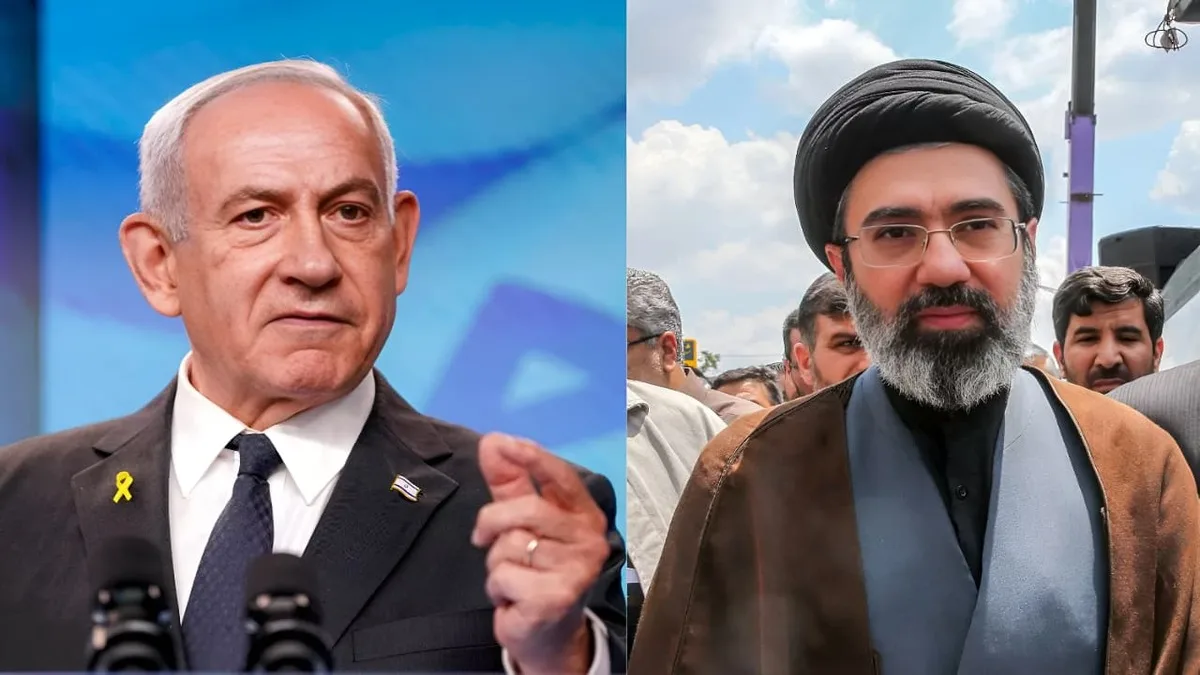
Israeli Prime Minister Benjamin Netanyahu (Left) and Iran's religious leader Mojtaba Khamenei (Right)
TEL AVIV/TEHRAN: Israeli officials have warned that Israeli attacks on Iran could resume, with Israeli intelligence reportedly detecting efforts by Tehran to revive and activate its Iran nuclear program.
According to a report by Saudi state-owned outlet Al Hadath, an Israeli official said Israel believes renewed strikes are only a matter of time if Tehran crosses what Israel considers its red lines. The official said Israel is prepared both defensively and offensively for a renewed confrontation with Iran and for possible escalation on other fronts.
The warning comes amid reports that Iran is attempting to restore elements of its Iran nuclear program following earlier Israeli and US military action. The Israeli official told Al Hadath that intelligence assessments indicate preparations to reactivate the programme, while Israeli reports have alleged that Iran is transferring remaining nuclear-related activities to Jabal al-Fas, near the Natanz nuclear facility.
The official said Israeli attacks could again target nuclear facilities and other sites associated with the programme, regardless of whether the United States participates.
The Israeli official also linked the prospect of renewed Israeli attacks to mounting economic pressure on Tehran. According to the report, sanctions imposed on Iranian-linked entities are creating economic and political pressure inside Iran, contributing to internal divisions and domestic difficulties.
The official warned that such pressure could encourage the Iranian leadership to respond militarily across the region, including against Israel. The official further argued that regime change would be necessary to ensure that Iran does not become a nuclear-armed state.
The official said Israel’s October 27 elections would not determine decisions concerning Israeli attacks against Iran. He also claimed that sanctions imposed by the Trump administration were producing stronger effects than expected and suggested that the Iranian regime could face collapse sooner than previously anticipated.
These assessments were presented by the Israeli official to Al Hadath and represent the Israeli side’s assessment of developments in Tehran.
At the same time, the Israeli official expressed scepticism about the ongoing U.S.-Iran talk, saying Israel sees limited value in the diplomatic contacts because of what it described as Tehran’s delays and its expectation that political developments in Washington and Jerusalem could prevent further military action.
The official’s comments came as American and Iranian representatives resumed mediated contacts at the United Nations General Assembly in New York.
Iranian Foreign Minister Abbas Araghchi and US envoys Steve Witkoff and Jared Kushner communicated through mediators during the UN General Assembly, marking the first such high-level contact since an interim ceasefire collapsed in July.
President Donald Trump described the discussions as productive and said there was momentum towards a possible agreement, while Witkoff characterised the engagement as mediated talks involving shuttling between the two delegations.
However, the U.S.-Iran talk has not produced an agreement. The main disputes include the future of the Strait of Hormuz, sanctions, military pressure and the conditions for resuming broader negotiations over Iran’s nuclear activities.
Iran has proposed reopening the strategic waterway and restarting negotiations under specified conditions, while the US has maintained pressure on Tehran. Recent reporting indicates that the two sides remain far apart over how to end the conflict and resolve the wider disputes surrounding Iran’s nuclear programme and regional military posture.
With the Iran nuclear program remaining at the centre of the confrontation, the Israeli warning adds another layer of uncertainty to the stalled U.S.-Iran talk. Israel’s stated readiness for renewed Israeli attacks, combined with unresolved diplomatic disputes, leaves the possibility of further military escalation alongside continuing efforts to reach a negotiated settlement.
