Reports claiming that traders across India will observe a nationwide ‘No UPI Day’ on October 2 are misleading, according to the Confederation of All India Traders (CAIT). The national traders’ body has clarified that it has made no announcement to boycott UPI payments on that day.
CAIT said it continues to support the digital payments ecosystem and has no connection with the proposed ‘No UPI Day’ protest being attributed to the organisation.
What did CAIT actually say?
CAIT has categorically rejected reports suggesting that it had decided to stop accepting UPI payments on October 2.
The organisation said it had not passed any proposal to boycott UPI or observe a ‘No UPI Day’. It also said that reports circulating in its name were false.
At the same time, CAIT acknowledged that some regional or local traders’ organisations may independently organise protests against the proposed Merchant Discount Rate (MDR) charges on UPI transactions.
Such local or regional decisions, however, should not be treated as the official position of CAIT.
The organisation has also appealed to media organisations and the public to verify such claims through official sources before attributing them to CAIT.
The Confederation of All India Traders (CAIT) has officially clarified that it has not given any call for “No UPI Day”, nor has it announced, endorsed, or decided to participate in such an observance. CAIT has stated that any such attribution is factually incorrect.
Citizens… https://t.co/XPYNudTqYT
— DFS (@DFS_India) September 27, 2026
Why did reports of ‘No UPI Day’ emerge?
Reports circulating in recent days claimed that traders and shopkeepers across the country would stop accepting UPI payments on October 2 to protest a proposed 0.4 per cent charge on certain UPI transactions above Rs 2,000.
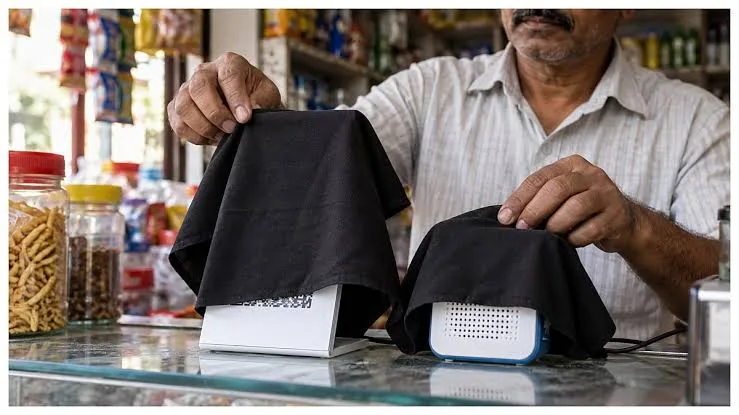
The reports said participating traders would cover UPI QR codes, scanners, sound boxes and other digital payment equipment with black cloth as a symbolic protest.
The reported protest was linked to opposition from sections of the trading community to the proposed MDR charges.
However, the claim that CAIT itself had called for a nationwide ‘No UPI Day’ is false, based on the organisation’s clarification.
Maharashtra traders’ body had announced protest
The confusion appears to have partly arisen from statements made by regional traders’ organisations.
Ravindra Mangave, president of the Maharashtra Chamber of Commerce, Industry and Agriculture (MACCIA), had reportedly said that the proposed movement would not be confined to Maharashtra and that more than 500 traders’ organisations from across the country would participate.
That claim concerns a proposed traders’ movement and does not establish that CAIT had announced a nationwide UPI boycott.
Therefore, the two developments need to be distinguished: regional traders’ groups may participate in a protest, while CAIT has denied calling for or supporting a nationwide ‘No UPI Day’.
What is the dispute over UPI charges?
The proposed charges have become a point of concern among sections of the trading community because many retail businesses operate on relatively low margins.
Trader organisations opposing the charges have argued that additional transaction costs could increase their expenses and discourage the use of digital payments.
They have also argued that UPI has helped reduce dependence on cash and that businesses adopting digital payments should not face additional financial burdens.
The organisations have called for reconsideration of the proposed charges and have indicated that protests could be intensified if their concerns are not addressed.
What are the reported new MDR rules?
The proposed framework cited in reports includes different treatment for merchants depending on their monthly UPI collections and the value of individual transactions.
1. 0.4 per cent charge for large merchants: Merchants collecting more than Rs 1 lakh a month through person-to-merchant UPI transactions would be charged 0.4 per cent plus GST on eligible payments above Rs 2,000.
2. No charge for smaller merchants: Merchants whose monthly UPI collections remain at or below Rs 1 lakh would not face the charge, even if an individual payment exceeds Rs 2,000.
3. Three-month category rule: If a merchant crosses Rs 1 lakh in UPI collections for three consecutive months, the merchant could be moved into the large-merchant category.
4. Payments up to Rs 2,000: Large merchants would not be charged the MDR on individual UPI payments of Rs 2,000 or less.
5. Maximum charge: For transactions of Rs 75,000 or more, the reported maximum MDR would be Rs 300 plus GST.
6. Transaction-wise threshold: The Rs 2,000 threshold would apply to each individual payment rather than the merchant’s total sales for the day.
7. Specific sectors: Merchants in sectors such as petrol pumps, railways, bill payments, telecom, insurance and education have been reported to face a flat Rs 5 charge instead of the 0.4 per cent rate on eligible transactions.
8. Comparison with cards: The proposed UPI MDR remains lower than commonly charged merchant fees on credit and debit card transactions, according to the figures cited in reports.
What is MDR?
Merchant Discount Rate (MDR) is a fee charged to merchants for processing digital payments through payment networks and service providers.
The fee is generally paid by the merchant rather than the customer and is intended to cover costs associated with payment processing and the digital payments infrastructure.
Verdict: Misleading
CAIT has explicitly denied announcing or supporting a nationwide ‘No UPI Day’ and said that reports attributing such a decision to the organisation are false. The claim should therefore not be presented as a CAIT-led nationwide UPI boycott.