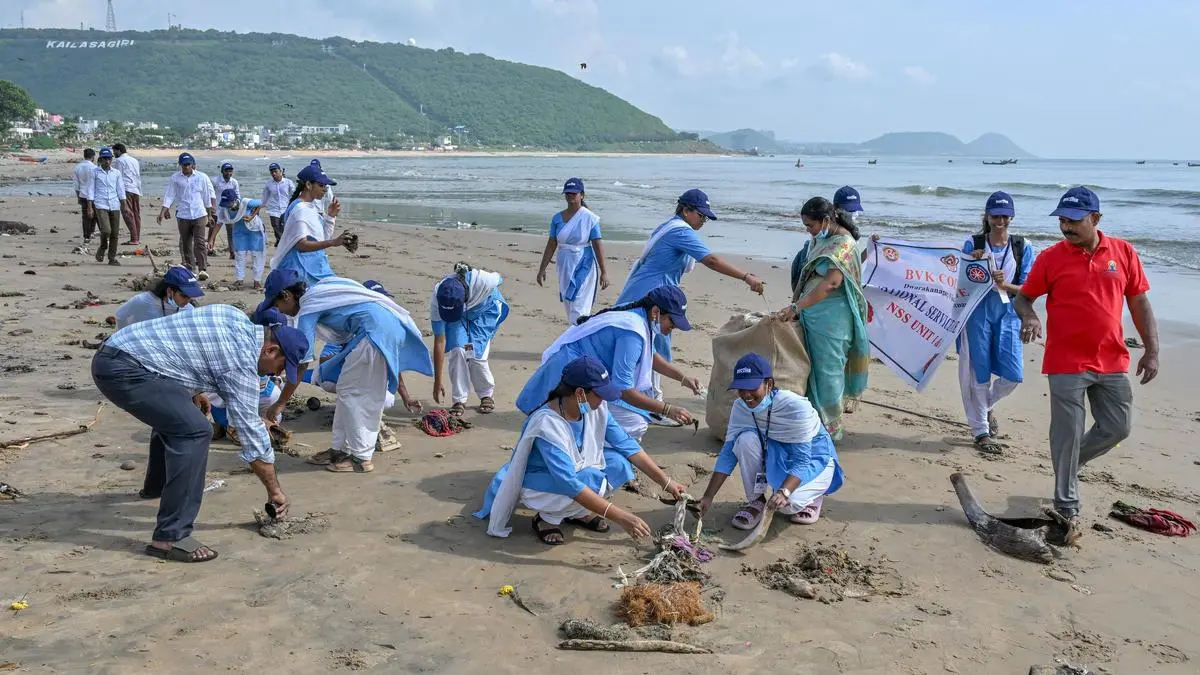
The fifth edition of the Swachh Sagar Surakshit Sagar campaign has recorded participation from 15 lakh people who took the Ocean Conservation Pledge as part of a nationwide effort to promote cleaner coastlines and safer seas.
The campaign was held from September 12 to 19 and included coastal clean-up activities at 231 locations across 13 States and Union Territories.
The initiative brought together people from different sections of society, including citizens, students, coastal communities, volunteers, government agencies and scientific institutions.
The campaign was reviewed by Union Minister of State for Science and Technology and Earth Sciences Dr Jitendra Singh during the Monthly Review Meeting of Scientific Ministries and Departments in New Delhi.
The scale of participation was highlighted as an example of how scientific and environmental initiatives can involve the public directly.
Coastal clean-up drives held across 231 locations
The campaign focused on improving the condition of India’s coastal areas through direct public participation.
Clean-up activities were conducted at 231 locations, covering coastal areas across 13 States and Union Territories. Volunteers and participating organisations took part in activities aimed at removing waste and creating greater awareness about the need to protect marine and coastal ecosystems.
The campaign also sought to connect environmental conservation with everyday public behaviour. The large number of Ocean Conservation Pledges was intended to encourage people to recognise their role in reducing pollution and protecting marine resources.
For coastal communities in particular, the health of the marine environment has a direct connection with livelihoods and local economic activity.
Students, communities and scientific institutions join campaign
One of the important features of the campaign was the participation of different groups rather than limiting the initiative to government agencies.
Students and young volunteers participated alongside coastal communities, scientific institutions and government organisations.
Such participation can help bring environmental issues closer to communities that interact directly with coastal and marine ecosystems.
The campaign also provided scientific institutions with an opportunity to engage with citizens and communicate the importance of ocean conservation in a more accessible manner.
The Ministry of Earth Sciences has been involved in programmes related to India’s oceans, marine resources, weather and climate systems. Public participation campaigns such as Swachh Sagar Surakshit Sagar provide an additional platform for communicating these issues outside scientific and government institutions.
Jitendra Singh calls for greater coordination among science departments
While reviewing the campaign, Dr Jitendra Singh also stressed the need for greater coordination among the country’s Science Ministries and Departments.
He called for scientific institutions to work with greater synergy and visibility and highlighted the importance of creating city-based scientific clusters.
The idea is to bring together scientific institutions and other stakeholders working in related areas so that their expertise and resources can be used more effectively.
According to the Minister, stronger institutional coordination can also improve the way scientific achievements are communicated to the public.
Government wants science achievements to reach citizens faster
The review meeting also focused on science communication and public outreach.
Dr Jitendra Singh emphasised that major achievements in science, technology and innovation should be communicated to citizens in a timely and accessible manner.
Scientific research can often involve complex subjects, making effective communication important for ensuring that people understand how new technologies and discoveries relate to their lives.
The government is therefore looking at ways to strengthen communication across various Science Ministries and Departments.
The approach includes greater use of digital platforms and short-form content to make scientific developments easier for the public to understand.
Digital library of scientific achievements under review
The meeting also reviewed the proposed Digital Library of Scientific Achievements, which is planned as a common repository for videos and other communication material showcasing the work of India’s scientific institutions.
The proposed digital library is intended to bring scientific achievements and institutional work together on a common platform.
CSIR-NIScPR is working as the nodal institution for developing the institutional mechanism and implementation framework for the initiative.
The concerned Ministries and Departments are also working on the modalities for participation and resource sharing.
The proposed repository could provide a central source of information about India’s scientific and technological achievements and make such material easier to access for researchers, students, media organisations and the wider public.
Science ministries expanding digital outreach
The meeting also reviewed ongoing digital outreach initiatives of several scientific departments and organisations.
These include the Department of Science and Technology, Department of Biotechnology, Department of Scientific and Industrial Research, Council of Scientific and Industrial Research (CSIR) and the Ministry of Earth Sciences.
The initiatives include short-form digital content highlighting significant scientific and technological achievements.
The focus on shorter digital formats reflects the changing way people consume information, particularly on social media and other online platforms.
The government is seeking to use these platforms to increase public awareness about scientific research, innovation and technology being developed in India.
‘Vigyan Ki Baat’ to highlight quantum technology
Dr Jitendra Singh also reviewed the progress of ‘Vigyan Ki Baat’, a monthly lecture series launched by the Department of Science and Technology to showcase the work of India’s autonomous scientific institutions.
The second edition of the programme is scheduled for September 26, 2026.
The upcoming session will feature the Director of the S.N. Bose National Centre for Basic Sciences and will focus on developments in foundational physical sciences and quantum technology.
Quantum technology has emerged as an important area of scientific research because of its potential applications in computing, communication, sensing and other advanced technologies.
The lecture series is intended to provide a regular platform where researchers and scientific institutions can explain developments in cutting-edge areas and discuss their relevance to India.
First ‘Vigyan Ki Baat’ edition attracted 7,500 participants
The inaugural edition of ‘Vigyan Ki Baat’ was held on August 29 and attracted more than 7,500 participants from academia, research organisations and industry.
The participation reflected interest among researchers, students and industry representatives in understanding developments emerging from India’s scientific institutions.
The monthly series is designed to create a continuing channel between scientific institutions and the wider research and innovation ecosystem.
It also aims to highlight how scientific research can contribute to national development and technological capabilities.
CSIR@85 and ESTIC-2026 preparations reviewed
The meeting also reviewed preparations for CSIR@85, including the programme scheduled for September 25.
The meeting also took stock of preparations and updates related to ESTIC-2026.
Discussions focused on programme preparedness, coordination between participating organisations and the effective communication of the achievements of India’s scientific institutions.
The review is part of the government’s effort to ensure that major scientific programmes are supported by coordinated planning and communication.
Dr Jitendra Singh also called for stronger inter- and intra-ministerial coordination through thematic interactions and cluster-based engagements.
The Minister stressed the importance of regular interaction among the communication teams of different scientific Ministries and Departments.
Better coordination could help avoid duplication, improve the sharing of resources and ensure that important scientific developments reach citizens through a more unified communication system.
The emphasis on coordination also extends to scientific institutions working in similar or complementary areas.
Making science more visible and accessible
The government has increasingly focused on making scientific achievements more visible to the public.
The latest review brought together environmental outreach through the Swachh Sagar campaign, digital science communication, the proposed Digital Library of Scientific Achievements and the ‘Vigyan Ki Baat’ lecture series.
These initiatives have different objectives but share a common focus on connecting scientific institutions and their work with citizens.
In the case of Swachh Sagar Surakshit Sagar, this connection takes the form of direct public participation in coastal conservation. In digital outreach initiatives, the focus is on communicating scientific achievements through accessible content.
Public participation remains central to ocean conservation
The 15 lakh Ocean Conservation Pledges recorded during the latest Swachh Sagar Surakshit Sagar campaign highlight the scale of public participation achieved during the week-long campaign.
The clean-up activities at 231 locations across 13 States and Union Territories brought environmental awareness directly to coastal communities and volunteers.
The campaign also underlined the broader role of public participation in protecting India’s marine environment. Cleaner beaches and coastal areas require not only periodic clean-up drives but also sustained awareness about waste disposal, pollution reduction and responsible use of marine and coastal resources.
The Centre’s latest review has therefore placed the Swachh Sagar campaign alongside broader efforts to strengthen scientific outreach and public engagement.
The focus, according to the Ministry, is to make India’s scientific achievements more visible while encouraging citizens to participate directly in initiatives linked to environmental protection, technology and national scientific development.