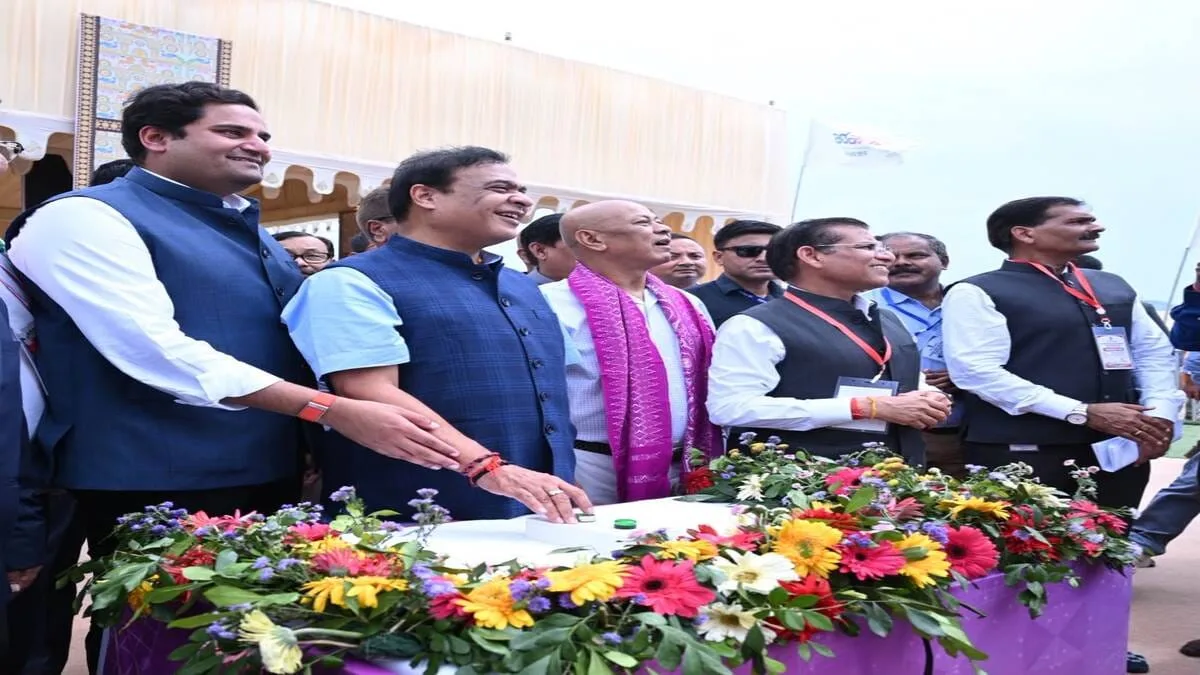
GUWAHATI: Assam’s transformation from a state better known for its tea gardens and oil fields into an emerging industrial hub took a significant step forward on September 20th, as Chief Minister Dr Himanta Biswa Sarma laid the foundation stone for Adani Power Limited’s 3,200 MW Ultra-Supercritical Thermal Power Plant at Chapar in Dhubri district. The much-awaited power project not only aims to end the electricity deficit of the developing state, but also to make it an energy surplus state of the region.
The project, coming with an investment of close to 48,000 crore, is among the largest single investments the state has ever seen by any private sector conglomerate and it is only the latest in a string of big-ticket projects that are reshaping Assam’s economic map.
A mega project for Adani Power
The Chapar plant of the Adani group will house four units of 800 MW each, built using ultra-supercritical technology that promises higher efficiency and stronger environmental safeguards than conventional thermal plants. In the next 4 years, the project will reshape the energy sector of the state and also boost employment opportunities for thousands of people. The plant is expected to be commissioned by December 2030.
The scale of employment the project is expected to generate stands out. Officials estimate close to 20,000 jobs during the construction phase alone, with another 5,000 permanent jobs once the plant becomes operational. Beyond direct employment, the project is also likely to open doors for local contractors, transport operators and suppliers who could become part of Adani’s vendor network in the state.
Laying the foundation stone, a jubilant CM Sarma described the project as a direct outcome of the confidence built through the Advantage Assam Investor Summit 2.0. Terming it one of the largest single investments the state has attracted till date, he pointed out that beyond jobs, the state stands to gain through higher economic activity and increased SGST collections, while local businesses get a chance to plug into the new industrial ecosystem taking shape around the plant.
Jeet Adani, Director at the Adani Group, who attended the ceremony, called it the start of an important new chapter for Assam, one that would bring reliable and affordable power to homes, businesses and industries in the state. He also spoke of Assam’s geography giving it the potential to become something of a “battery” for India’s future energy needs, a reference to the state’s location and resource base that could power growth well beyond its own borders.
Part of a much larger investment story
The Chapar thermal plant is only one piece of a wider 63,000-crore power sector commitment the Adani Group has made in Assam. The remaining amount, close to 15,000 crore, is earmarked for two Pumped Storage Plants with a combined capacity of 2,700 MW, being developed through Adani Green Energy. Separately, Adani Energy Solutions is already working on smart metering projects to modernise the state’s power distribution network.
Across sectors, the Adani Group’s total commitment to Assam now exceeds 80,000 crore, spanning power, aviation and cement. On the aviation side, Terminal 2 at Guwahati’s Lokapriya Gopinath Bordoloi International Airport became operational in February this year, giving the state’s main airport a significant capacity boost. The group’s Adani Foundation has also been active on the ground, reaching more than 8,000 flood-affected families in Sivasagar and Dhemaji with essential supplies, and running welfare programmes across 19 villages in Kamrup Rural district.
Assam’s growing pull for big investors
What makes the Adani announcement notable is that it does not stand alone. Assam has, over the past couple of years, steadily built a reputation as a destination for large industrial investments that would once have gone almost exclusively to India’s traditional manufacturing states.
The most prominent example remains the Tata Group’s semiconductor assembly and test facility coming up at Jagiroad in Morigaon district. Announced with an investment of around 27,000 crore, the plant is billed as India’s largest semiconductor facility and is expected to create tens of thousands of jobs once fully operational, with commercial production targeted to begin this year. For a state that had no presence in electronics manufacturing until recently, the project has been seen as a marker of how far Assam’s industrial ambitions have travelled.
Seen together, the semiconductor project and the Adani Group’s power, aviation and cement investments point to a pattern of global and national conglomerates increasingly viewing Assam not just as a market, but as a manufacturing and energy base for the wider Northeast and beyond. For a state government keen to position Assam as the region’s emerging energy and industrial hub, projects like the Chapar thermal plant offer both the economic heft and the symbolism it has been chasing.