India’s electronics manufacturing sector has expanded significantly over the past decade.
According to government data, electronics production increased from Rs 1.9 lakh crore in 2014-15 to Rs 13.11 lakh crore in 2025-26. During the same period, electronics exports rose from more than Rs 38,000 crore to Rs 4.24 lakh crore.
The government is now focusing on the next stage of this growth by increasing domestic manufacturing of the components that go into electronic products.
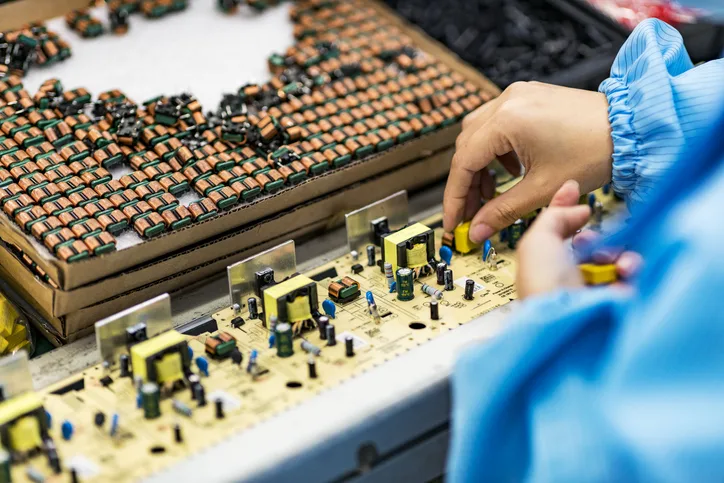
Components such as printed circuit boards, display and camera modules, connectors, capacitors, lithium-ion cells and rare-earth magnets are important for smartphones, automobiles, telecom equipment, healthcare devices and industrial systems.
Several of these products and materials have traditionally depended significantly on imports.
ECMS to strengthen domestic supply chain
The Electronics Component Manufacturing Scheme (ECMS) has been designed to address these gaps.
The scheme supports manufacturing across components, sub-assemblies, supply-chain products and related capital goods. The objective is to increase domestic value addition and create a stronger supply chain within the country.
The move is also aimed at making Indian electronics manufacturing more resilient by reducing dependence on imported components.
As domestic component capacity expands, manufacturers could source a larger share of their requirements within India. This would also support companies seeking to integrate India more deeply into global electronics supply chains.
ECMS outlay increased to Rs 40,000 crore
The ECMS was notified on April 8, 2025, with an initial financial outlay of Rs 22,919 crore.
The scheme has a six-year tenure, including an optional one-year gestation period. Its capital expenditure incentive is available for five years.
The scale of the scheme was subsequently increased. The Union Budget 2026-27 raised the ECMS outlay to Rs 40,000 crore, providing additional support for component manufacturing.
The scheme has already resulted in projects across the country.
As of August 2026, 106 projects had been approved across 15 States, covering 30 electronic product domains. These projects involve an approved investment of Rs 69,548 crore.
Production has already started at 38 approved plants, while another 16 projects are at advanced stages of construction or machinery installation.
The approved projects are expected to generate Rs 5.34 lakh crore in production and create 74,628 direct jobs and around 2.5 lakh indirect jobs.
Domestic capacity expands across key components
The government has said ECMS is helping expand domestic capacity for several critical electronics components and materials.
In some product categories, production capacity has reached or exceeded domestic demand.
The focus on components is significant because electronics manufacturing involves several stages. Assembly of finished products is only one part of the supply chain. Components, raw materials, sub-assemblies, design and manufacturing equipment are also required to build a complete ecosystem.
Increasing production at these levels could help Indian manufacturers increase the domestic value contained in finished electronic products.
Semiconductor push gets fresh momentum
Component manufacturing is being supported by a parallel push to develop India’s semiconductor ecosystem.
The semiconductor sector received renewed attention during SEMICON India 2026, inaugurated by Prime Minister Narendra Modi at Yashobhoomi in New Delhi on September 17.
The three-day event, held from September 17 to 19, carried the theme “Silicon to Systems: Building the Ecosystem.” It brought together industry leaders, policymakers, investors, academics and start-ups.
The government’s semiconductor strategy covers areas including semiconductor fabrication, packaging, testing and chip design.
The Rs 76,000 crore Semicon 1.0 programme established the broader policy framework for semiconductor and display manufacturing. In July 2026, the government approved Semicon 2.0 with an outlay of Rs 1,27,500 crore to expand the country’s semiconductor ecosystem.
The semiconductor programme and ECMS are therefore part of the broader effort to build manufacturing capabilities across different layers of the electronics industry.
ECMS part of wider electronics policy
The government’s electronics strategy also includes several other schemes.
The National Policy on Electronics 2019 aims to establish India as a global hub for Electronics System Design and Manufacturing, including development of core components.
The Production Linked Incentive scheme for Large Scale Electronics Manufacturing provides performance-linked incentives of 4 percent to 6 percent on incremental sales for eligible segments.
The Scheme for Promotion of Manufacturing of Electronic Components and Semiconductors (SPECS) provided a 25 percent capital expenditure incentive for eligible electronic components, semiconductor and display fabrication units, specialised sub-assemblies and capital goods.
The government has also introduced Modified Electronics Manufacturing Clusters 2.0, which supports manufacturing infrastructure, common facilities and plug-and-play facilities.
For the IT hardware sector, the government has introduced the PLI Scheme for IT Hardware, with the second phase aimed at strengthening domestic production and reducing import dependence.
Other measures include the Electronics Manufacturing Clusters scheme, the Phased Manufacturing Programme and the Electronics Development Fund.
India targets $500 billion electronics manufacturing by 2030
The government is targeting a much larger electronics manufacturing ecosystem by the end of the decade.
India has set a target of $500 billion in domestic electronics manufacturing by 2030, along with $150 billion in electronics exports.
The ECMS is expected to play an important role in achieving these targets by expanding domestic production of components and strengthening the supply chain.
The larger policy shift is from an electronics sector largely driven by assembly towards a broader ecosystem involving components, materials, sub-assemblies, semiconductor capabilities, design and manufacturing infrastructure.
With production and exports already increasing, the government is now seeking to build the component-level foundation required for India to become a larger participant in global electronics manufacturing and supply chains.