
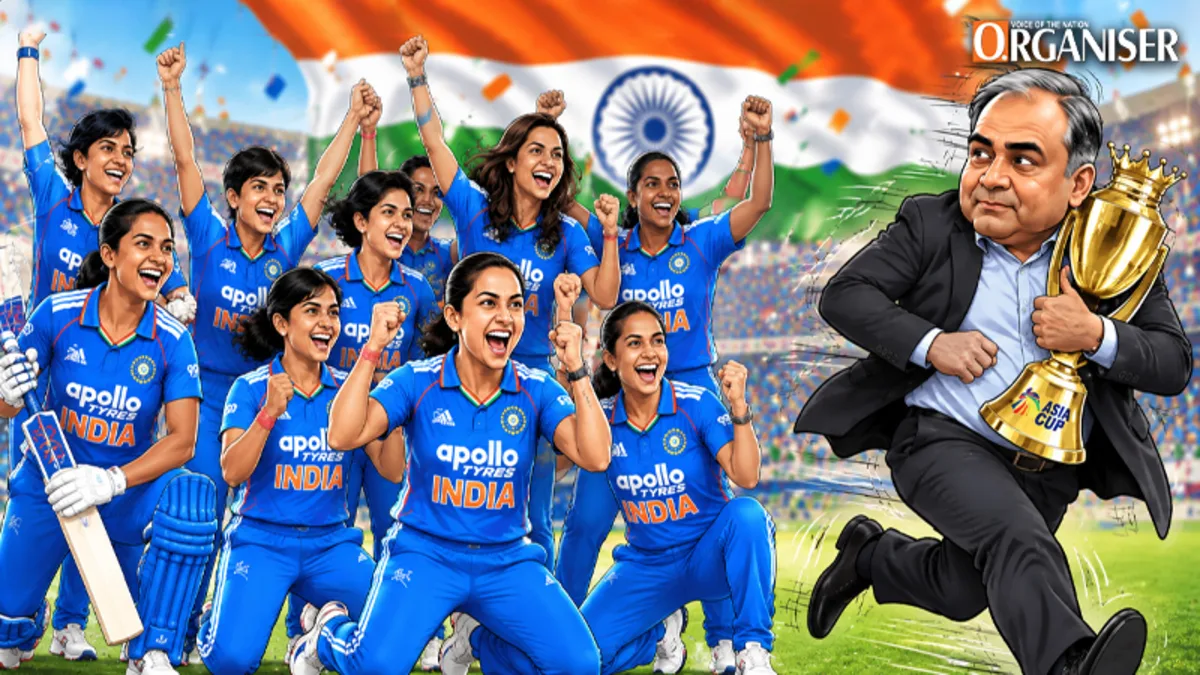
On September 13, 2026, India defeated Sri Lanka by 72 runs in the final of the Women’s Asia Cup to clinch its eighth title, but the post-match presentation once again turned into a controversy involving Asian Cricket Council (ACC) president, Pakistan Cricket Board (PCB) chairman Mohsin Naqvi, with the Indian women’s team choosing not to receive the trophy from him.
India produced a dominant all-round performance, posting 183/5 before bowling Sri Lanka out for 111 in 20 overs, with openers Shafali Verma and Smriti Mandhana laying the foundation through a record 129-run opening partnership. Shafali smashed 68 off 39 balls with nine fours and two sixes, while Mandhana scored 59 off 39 balls with five fours and three sixes. Sree Charani then returned figures of 4/20 to dismantle the Sri Lankan batting line-up and seal a comprehensive victory for India.
The trophy presentation, however, followed a script that had already been seen during last year’s men’s Asia Cup. Naqvi, who is also Pakistan’s Interior Minister, was present on the stage during the presentation ceremony and handed the runners-up cheque to Sri Lankan captain Chamari Athapaththu. However, when it was India’s turn, captain Harmanpreet Kaur and her teammates did not come to the stage to receive their medals or the trophy from Naqvi.
Harmanpreet had already spoken to the broadcasters after the victory but did not follow Athapaththu to the presentation area. The broadcast subsequently returned to the post-match studio, while there were no visuals of the Indian team holding the trophy amid the usual celebrations and fireworks. Before the formal presentation began, the Indian team had remained in its own huddle, where head coach Amol Muzumdar addressed the players, while BCCI secretary Devajit Saikia and vice-president Rajeev Shukla congratulated the team and presented the ‘Fielder of the Match’ medal to pacer Nandani Sharma.
The decision was not a sudden one. The Board of Control for Cricket in India (BCCI) had already communicated its position to the ACC before the final, and following India’s victory, Muzumdar made it clear that the team stood by the decision. “That stand has been taken by BCCI and we stand by it,” Muzumdar said, adding that for the Indian team the tournament was over and being declared champions was sufficient. “It was on the big board that India are the champions of Asia Cup 2026. This tournament is officially over for us. We are happy that we are the champions,” he said. In other words, the Indian team did not need a ceremony involving Naqvi to establish what the scoreboard had already established, India were the champions of Asia.
The episode immediately brought back memories of the men’s Asia Cup final last year, when India had also refused to receive the trophy from Naqvi following its victory over Pakistan. The controversy came against the backdrop of heightened tensions after the Pahalgam terror attack and India’s subsequent Operation Sindoor against Pakistan-sponsored terrorism.
During that tournament, Indian players and captain Suryakumar Yadav maintained their decision not to shake hands with Pakistan players, while India’s victories were dedicated to the Indian Armed Forces. That time also, the post-match proceedings were delayed for around 90 minutes, and after the stage was eventually prepared, an official removed the Asia Cup trophy from the raised dais and carried it away. India nevertheless celebrated its title on the stage, with Suryakumar even mimicking Rohit Sharma’s famous slow walk after the 2024 T20 World Cup triumph and lifting an imaginary trophy alongside his teammates.
The irony this time is difficult to miss. Pakistan could not win the Asia Cup, but once again a Pakistani cricket administrator managed to become one of the central figures in the tournament’s trophy story. Last year, India refused to take the trophy from Naqvi; the trophy was subsequently carried away. This year, before the final itself, the Indian board’s position was known, yet Naqvi was again present for the ceremony. The obvious question is: if the Indian team had already made its position clear, what exactly was expected to change after the final?
Pakistan may not be winning the Asia Cup against India, but it certainly appears unwilling to miss an opportunity to remain part of the story whenever India does.
The timing is particularly significant for Pakistan cricket, which has been facing considerable criticism over its performances and administration.
Notably, Naqvi holds several important positions at the same time, ACC president, PCB chairman and Pakistan’s Interior Minister, meaning that controversies involving India and Pakistan automatically give him visibility across both cricketing and political spaces.
Netizens, meanwhile, questioned Naqvi’s repeated presence at such ceremonies despite the Indian team’s position being known in advance. Some social-media users sarcastically remarked that while Pakistan has struggled to win the Asia Cup, its cricket administration appears determined to remain in the headlines whenever India lifts it.
Others viewed the episode through a political lens, suggesting that the repeated India-related controversies help Naqvi project himself before Pakistani audiences at a time when the country’s cricketing fortunes remain under scrutiny. Some users even linked his growing political visibility to speculation about his ambitions within Pakistan’s politics.
This is where the entire episode becomes almost comical. India keeps winning the trophies, while Pakistan keeps finding itself involved in the ceremonies surrounding those trophies. The Indian men’s team won last year’s Asia Cup final against Pakistan and the trophy presentation became a controversy. This year also, India’s women’s team defeated Sri Lanka and once again the trophy presentation became a controversy because of Naqvi. The common factor is not who won the cricket match, the scoreboard answers that question very clearly.