The Government of Odisha has recently issued new guidelines regarding the singing of Vande Mataram in schools, following a similar initiative in West Bengal to promote the national song as an expression of patriotism, cultural consciousness and national pride. Under the new arrangement, Vande Mataram will be sung first during the morning prayer assembly, followed by the National Anthem, Jana Gana Mana. According to the government guideline, the initiative is intended to cultivate patriotism, cultural consciousness and respect for national symbols among students.
In the history of India’s freedom struggle, there are certain words that have transcended the boundaries of slogans or songs and acquired the power to awaken the soul of a nation. Vande Mataram is one such eternal mantra. It is not merely a song of patriotism; it is a profound symbol of India’s cultural consciousness, spiritual worldview and an aspiration for freedom from external subjugation-political, cultural and intellectual. These two words once united millions of Indians and inspired them to make the supreme sacrifice for the nation.
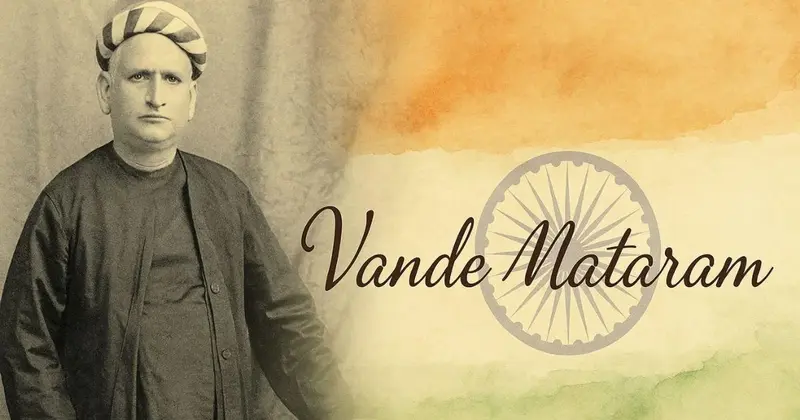
In the closing decades of the nineteenth century, when India was suffering not only from political subjugation under British rule but also from a deep sense of cultural inferiority, Bankim Chandra Chattopadhyay composed Vande Mataram. It was subsequently incorporated into his celebrated novel Anandamath. Bankim did not envision India merely as a geographical territory; he imagined her as a loving and powerful mother. This Mother embodied Lakshmi, the goddess of prosperity; Saraswati, the goddess of knowledge; and Durga, the embodiment of Shakti. This conception touched the Indian mind profoundly because the worship of the motherland as a divine mother has deep roots in India’s civilisational tradition.
During the anti-Partition of Bengal movement in 1905, Vande Mataram became one of the principal cries of India’s national awakening. Its echoes resounded in schools, colleges, public meetings, processions and among revolutionary groups. Recognising its mobilising power, the British authorities imposed restrictions on its public singing in various places. Yet the more the colonial government attempted to suppress it, the deeper people’s reverence for the mantra became. For the freedom fighters, it became a mantra that gave them the courage to overcome fear.
The true power of Vande Mataram lies in its philosophical meaning. In Indian culture, the motherland is not merely the land of one’s birth; she is the bearer of one’s life, culture, traditions and civilisation. To bow before the motherland, therefore, means taking a pledge to protect her nature, culture, languages, heritage and society. From this perspective, patriotism is not merely a political sentiment; it is also a moral responsibility.
Maharshi Sri Aurobindo did not regard Vande Mataram merely as a patriotic song; he described it as a national mantra. In the Indian tradition, a mantra is not merely something to be uttered—it possesses the power to awaken human consciousness. In Sri Aurobindo’s view, Vande Mataram awakened the dormant courage, self-confidence and spirit of sacrifice among the people of India. It transformed ordinary men and women into extraordinary bearers of courage and national purpose.
Every mantra has a corresponding dimension of action. The action-oriented expression of Vande Mataram was the Swadeshi Movement. If the nation is the Mother, then working for her economic prosperity and self-reliance becomes the duty of every child. Swadeshi, therefore, was not merely a movement to boycott foreign goods; it was a campaign for the revival of indigenous industries, agriculture, cottage industries, education and a self-reliant economy. The Swadeshi Movement taught Indians that political freedom could become truly enduring only when economic, cultural and intellectual freedom were secured as well.
In Indian philosophy, mantra and tantra are complementary. The mantra awakens consciousness, while tantra converts that consciousness into organised action. From this perspective, Vande Mataram was the mantra of Indian nationalism, while Swadeshi was its tantra. One created self-confidence in the mind of the nation; the other translated that confidence into the fields of industry, education, society and the economy.
Even decades after Independence, the message of Vande Mataram remains equally relevant. Atmanirbhar Bharat, the promotion of local production, cultural self-confidence, and the development of indigenous enterprise are contemporary expressions of the same underlying idea. The objective of modern Swadeshi is not isolation from the world but the strengthening of India’s civilisational identity, cultural confidence and economic capabilities while maintaining meaningful engagement with the global community.
Vande Mataram today is still more than a song; it remains an eternal mantra. It reminds us that the true strength of a nation lies not merely in its political independence, but in its cultural self-confidence, economic self-reliance and unwavering devotion to the motherland. Just as this mantra awakened the nation during the freedom struggle, it continues to serve as an inexhaustible source of inspiration for building a strong, prosperous, culturally conscious and Vishwaguru Bharat.
The recent directive issued by the Bharatiya Janata Party-led Government of Odisha, encouraging the singing of Vande Mataram in schools, is therefore a timely and welcome step towards strengthening national consciousness among the younger generation.