
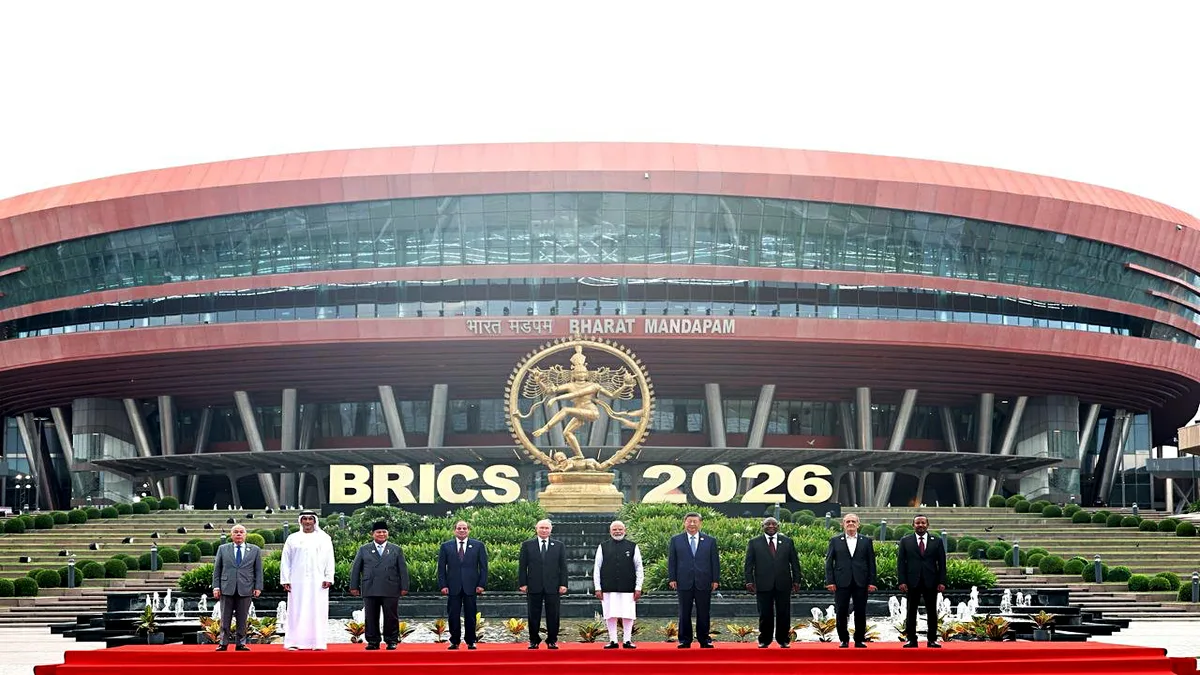
At twenty, BRICS has reached a defining moment. It has grown from a forum of emerging economies into a consequential grouping whose members represent a substantial share of the world’s population and economic activity. But size alone cannot secure its relevance. The challenge now is to turn collective weight into practical cooperation—and to ensure that a changing world order becomes more inclusive rather than merely different.
Prime Minister Narendra Modi’s opening remarks at the 18th BRICS Summit in New Delhi placed this challenge at the centre of India’s chairmanship. His message was both aspirational and practical: the next phase of BRICS must move “from voice to impact” and “from privilege to partnership”.
That is a useful way to understand India’s approach. The purpose of reform is not simply to rearrange seats at the global table. It is to make institutions more capable of responding to the needs of people who have too often been affected by decisions without having a meaningful role in shaping them.
A coming of age—with responsibilities
PM Modi described the twentieth anniversary as a moment of maturity and responsibility. The comparison was apt. BRICS has established its identity through dialogue, respect for differing perspectives and a commitment to consensus. It has also demonstrated that countries with different political systems and national priorities can still find areas of common purpose.
Yet consensus must not become an end in itself. The Prime Minister argued that BRICS must now translate its unity into concrete outcomes and develop an ambitious agenda for the next twenty years.
That requires strengthening the grouping’s own working methods. Since the BRICS chairmanship changes every year, initiatives risk losing momentum as priorities and leadership rotate. Modi therefore proposed a BRICS Continuity and Implementation Mechanism, with the Troika following up on initiatives and outcomes. A secure digital repository, recording decisions, responsible nodal points, timelines and implementation status, could help ensure that commitments survive beyond a single summit.
This is not a glamorous reform, but it may prove among the most consequential. Institutions earn credibility not only by making declarations, but by demonstrating that decisions are implemented.
From a pyramid of privilege to a platform of partnership
The Prime Minister’s sharpest critique concerned the architecture of global governance. He described it as a “pyramid of privilege”: power and decision-making concentrated at the top, while countries lower down bear the consequences of decisions they had little opportunity to shape.
His observation that the Global South is in the “front row” of global crises but the “back row” of decision-making captures a persistent imbalance. Developing countries are often among those most exposed to economic shocks, conflict, climate-related disruptions and technological change. Yet their representation in the institutions that set global rules and priorities has not kept pace with their changing role in the world.
India’s proposal to develop ten reforms for a BRICS Reform Roadmap by the next summit is therefore significant. The Prime Minister identified three guiding principles: representation, responsiveness and rule-making.
On representation, he called for reform of the United Nations Security Council, arguing that it can no longer be postponed. Text-based negotiations, he said, must be tied to a clear timeline and defined outcomes. He also called for financial institutions to reflect contemporary economic realities in their voting power, leadership positions and policy priorities.
The underlying principle is straightforward: countries that contribute significantly to global growth should have an appropriate role in shaping global economic governance.
Reform, however, will require sustained diplomacy. BRICS members do not necessarily share identical views on every institutional question. The grouping’s strength will depend on its ability to develop proposals that are ambitious, credible and capable of attracting wider support.
Humanity at the centre of global cooperation
The second principle, responsiveness, gives the agenda a distinctly human dimension. Global institutions, Modi argued, will command public confidence only when they can solve problems effectively. Their performance must be judged by the speed and scale of their response—and by whether assistance reaches people at the last mile.
His proposal for a Seafarers Emergency Support Network deserves particular attention.
Seafarers are indispensable to global trade, yet their contribution can become invisible when ships are at sea and international attention is elsewhere. In times of conflict or maritime disruption, they may face danger, uncertainty and separation from their families. The Prime Minister’s remarks at the BRICS Business Forum underscored the connection between secure sea lanes, open supply routes and the safety of seafarers. For India, whose citizens serve in the global maritime workforce, this is not an abstract concern.
The proposed network would connect the maritime authorities and missions of participating countries to facilitate distress alerts, medical assistance, communication with families and evacuation where necessary. It offers a practical example of what people-centred multilateralism can mean: cooperation that is visible not only in communiqués, but in the help available to a person in distress.
The proposal also recognises that maritime safety is inseparable from economic security. Global trade cannot progress reliably when ships, supply routes and the people who operate them are exposed to danger. Freedom of navigation and the protection of seafarers must therefore be treated as shared responsibilities, not concerns confined to individual countries.
Becoming rule-shapers, not rule-takers
The third principle—rule-making—looks towards the future. Artificial intelligence, cyberspace, outer space, biotechnology and critical technologies are creating new opportunities, but they are also generating rules that will shape access, security and development for decades.
The Global South must have a meaningful role in framing those rules. Otherwise, countries that are still building technological capacity may find themselves expected to follow frameworks designed without their participation.
Modi proposed that BRICS support young diplomats and policymakers from the Global South through negotiation skills, practical training and legal expertise. This is a constructive investment in future capacity. Participation in global rule-making requires not only political representation, but also the technical knowledge and negotiating confidence to influence complex agreements.
India’s offer to take the lead in this effort reflects an understanding that leadership can be exercised by building the capabilities of others. The summit’s message, as framed by the Prime Minister, is clear: if the future is shared, the right to shape it must also be shared.
BRICS at twenty has the opportunity to show that multilateralism can be more than a contest for influence. It can be a means of making institutions more accountable, cooperation more effective and development more humane.