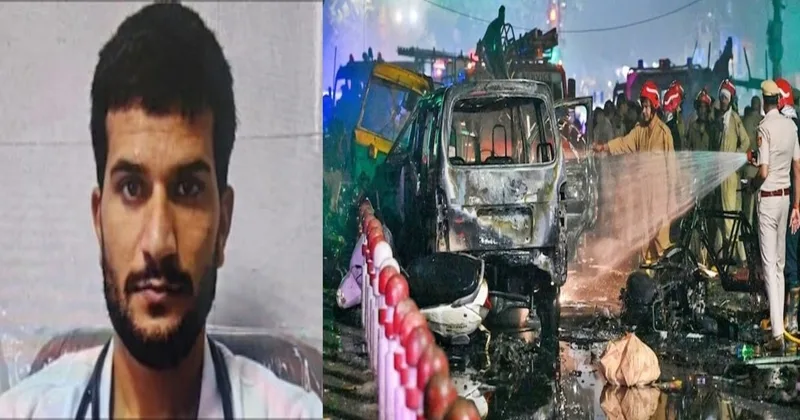
NEW DELHI: The Red Fort blast bomber, Umar-un-Nabi, had attempted to park his explosive-laden Hyundai i20 near Lal Mandir in Chandni Chowk shortly before carrying out the attack near the Red Fort, but heavy traffic and police presence forced him to change his plans, according to the National Investigation Agency (NIA) chargesheet.
CCTV footage cited by the NIA shows Umar attempting to park the vehicle at around 6.37 pm on November 10 last year. He subsequently took a U-turn and drove towards the Red Fort, where the vehicle exploded near Gate No. 4 at around 6.50 pm.
The details are part of the chargesheet recently filed by the NIA in connection with the Red Fort car blast. The agency has described the incident as the first reported vehicle-borne improvised explosive device (VBIED) attack in the national capital and detailed the planning, movement and execution of the attack.
Remote mechanism used to trigger IED
According to the chargesheet, the IED was detonated through a remote command mechanism fitted into one of Umar’s shoes. A metal piece attached to the heel of one shoe was recovered near the Hyundai i20 and tested positive for explosive-related substances, including TATP, potassium and ammonium nitrate.
The NIA also recovered biological evidence from the vehicle. A nasal-orifice swab found in the car matched the DNA profiles of Umar’s parents, helping investigators establish his identity as the bomber.
The agency said forensic examination of explosives recovered from Umar’s associates in Faridabad, in connection with the Nowgam blast in J&K, also detected the same chemical signatures. According to the NIA, the findings helped establish the existence of the terror module linked to the Red Fort attack.
Evidence about preparation and storage of explosives
The chargesheet also refers to evidence gathered during the investigation about how the module allegedly handled the explosives. Witnesses told investigators that Umar kept his room extremely cold and that a foul smell often emanated from it.
The NIA further stated that members of the module had purchased collapsible water bags and used them in connection with the storage of the prepared explosive material. The agency has also cited digital material recovered from the accused, including a PDF describing methods involving urea nitrate. Investigators said the material contained references to obtaining urea from urine.
Umar was on the run after police raids
The chargesheet states that Umar met an acquaintance behind Al Falah Hospital on October 30, after police raids had already begun targeting the module. He allegedly handed over his room key and asked the acquaintance to retrieve his shoes from an almirah. According to the NIA, Umar was visibly distressed at the time as J&K Police had begun closing in on members of the module.
While allegedly hiding at a house in Nuh, Umar also stored his urine in a polythene bag instead of disposing of it outside. The woman who owned the house reportedly noticed a foul smell and informed her husband, the chargesheet said.
Investigators also recovered a terror manual titled Lone Mujahid Pocket Book, which the NIA said had been published in Inspire, a magazine associated with Al-Qaeda in the Arabian Peninsula (AQAP).
The agency said the material contained operational information concerning explosives, weapons, vehicles, arson and covert activities, including sections dealing with TATP and remote mechanisms for IEDs.
The post-mortem reports of the victims, submitted by the hospital, attributed the deaths to the effects of a high-intensity blast wave, according to the chargesheet. The explosion killed 11 people and injured 29 others. The NIA said damage to nearby structures was assessed at around Rs 17.7 lakh by authorities including the Delhi Metro Rail Corporation (DMRC), Archaeological Survey of India (ASI) and Public Works Department (PWD).