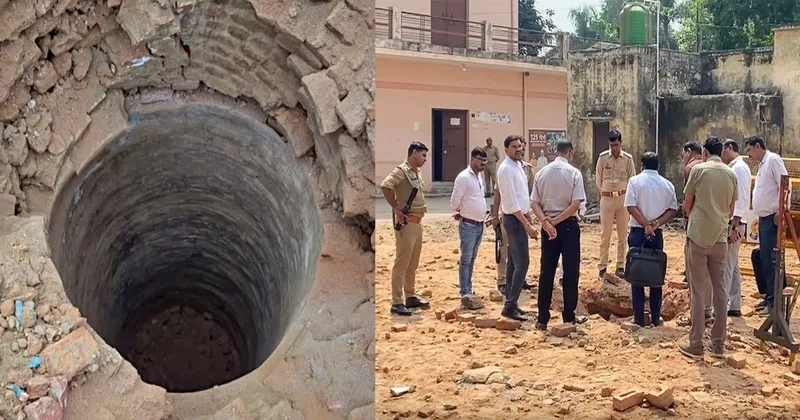
Saharanpur: A fresh historical mystery has emerged at the site of the mosque demolished inside the Saharanpur Collectorate premises after an Archaeological Survey of India (ASI) official descended nearly 20 feet into a concealed structure discovered beneath the demolished building. The structure, which appears to be an old well made of Lakhori bricks, is now being examined to determine its age, original purpose and possible historical context.
BIG BREAKING 🚨 ASI officials enter the MYSTERIOUS well discovered yesterday at the site where a mosque inside the Saharanpur Collectorate was demolished.
The well has been barricaded on all four sides.
ASI begins examining the hidden well found beneath the Saharanpur mosque… pic.twitter.com/FoekaBseYd
— News Algebra (@NewsAlgebraIND) September 7, 2026
The discovery was made on September 6, a day after the mosque was demolished following a court order. While clearing the demolition debris, workers encountered a hard slab beneath the rubble. After the slab was cut open, a deep structure was found underneath. The administration subsequently barricaded the area on all four sides and deployed heavy police security.
On September 7, ASI Assistant Archaeological Officer Manoj Kumar Yadav reached the site from Lucknow and entered the structure using a ladder. He reportedly spent around 10 minutes inside, examining its construction and interior. The preliminary assessment is that it resembles a well, although officials have cautioned that its exact identity cannot yet be conclusively established because the structure contains considerable debris.
An old structure hidden beneath the mosque
According to the archaeological assessment, the structure is approximately 20 feet deep and around three feet in diameter. It has been constructed using Lakhori bricks, thin bricks commonly associated with medieval and early-modern construction in northern India. Lime-surkhi mortar and traces of lime plaster were also observed inside.
The construction technique has led archaeologists to associate the structure broadly with the later medieval period. A preliminary assessment reported by sources places the structure at potentially around 200 to 250 years old, although its precise age will require further investigation.
The discovery is significant because the structure remained hidden beneath the mosque and came to light only after the building was demolished. Its presence has also revived questions about what existed at the site before the mosque was constructed, with claims that the location may have had an earlier Hindu religious association and that a Hindu temple could have stood there before the mosque was built. However, the ASI has not yet established any such connection. Archaeologists are now examining the structure’s age, construction and surrounding remains to determine its original purpose and whether it can provide clues about the site’s earlier history.
The discovery has naturally generated speculation about what existed at the location before the mosque was constructed.
Vikas Tyagi, the former Bajrang Dal convenor who had filed the complaint concerning the structure, has claimed that a temple may have existed at the site before the mosque. That claim has gained renewed attention following the discovery of an apparently old structure beneath the demolished building.
ASI and state archaeology officials are expected to examine the construction technique, brick dimensions, mortar, plaster and layers of soil surrounding the structure. Such evidence can help establish whether the well was constructed as an independent water source, whether it formed part of an older settlement and when it was eventually abandoned and covered.
The mosque stood within the Saharanpur Collectorate premises and was declared an unauthorised structure on government land by the city magistrate. The mosque management committee challenged the order, but the district court subsequently rejected its appeal. The demolition was carried out on September 5 after the court proceedings, with authorities maintaining that the action followed the prescribed legal process.
The city magistrate had also ordered compensation of approximately Rs 6.41 crore in connection with the encroachment and use of government land. The newly discovered structure could therefore add another layer to the debate over the history of the site. The most important aspect of the current investigation is that archaeologists have not yet attributed the structure to any particular religion.
The soil layers around the structure could also prove important. Different layers may reveal when the well was constructed, when it went out of use and whether the site was subsequently built over. For now, the ASI’s preliminary finding is that the structure resembles an old well-like construction made from Lakhori bricks. Its exact age, purpose and historical association remain under investigation.
The discovery has transformed what initially appeared to be a demolition site into a potential archaeological site of interest. What lay beneath the mosque remained hidden until the structure was brought down and the debris was cleared. Whether the concealed structure ultimately turns out to be simply an old water well or part of a larger historical complex remains to be established. Equally, claims about a possible earlier Hindu temple will have to await archaeological evidence.