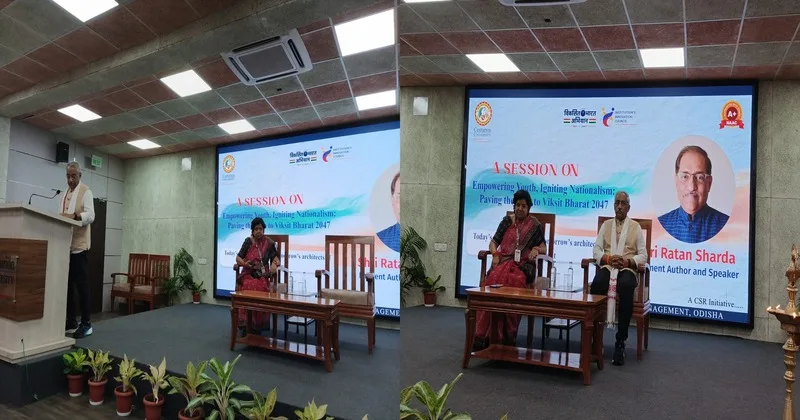
Bhubaneswar: Bharat is witnessing a profound shift in the aspirations and outlook of its younger generation, with youth increasingly seeking to excel on the global stage rather than merely participate, eminent author and speaker Ratan Sharda said at a session on “Empowering Youth, Igniting Nationalism: Paving the Path to Viksit Bharat 2047” at Centurion University, Bhubaneswar. The special session was organised at Centurion University in collaboration with the Loktantra Research Foundation. Centurion University Vice-Chancellor Prof. Supriya Patnaik was also present on the occasion.
Calling for a new generation that combines national pride with social responsibility, Sharda said nationalism should go beyond emotional attachment to the country and translate into responsible citizenship, ethical conduct, community participation and a willingness to contribute to nation-building. He said the confidence, skills and sense of responsibility of India’s youth would be crucial to shaping the country’s journey towards Viksit Bharat 2047.
Addressing students and participants, Sharda said the growing confidence of Bharat’s younger generation was visible across science, technology, sports and other fields. He argued that the change represented a broader transformation in national consciousness, with young Bharatiyas increasingly confident about India’s ability to compete with and lead the world.
From young scientists and engineers contributing to Bharat’s space programme to Bharatitya athletes achieving international success in squash, relay racing, rope skipping, hockey, archery and cricket, the aspiration, he said, had shifted from simply taking part to winning and becoming champions.
From Participation to the Aspiration to Lead
Sharda contrasted the confidence of today’s youth with the mindset prevalent among earlier generations.
He recalled a period when Bharatiyas were often encouraged to regard participation itself as an achievement. In cricket, for instance, even after a defeat, supporters would console themselves by saying that the team had “won the hearts of the people”.
According to Sharda, that attitude is increasingly giving way to a more ambitious outlook. Today’s generation wants to compete at the highest level, win championships and establish Bharat as a global leader.
He linked this transformation to a renewed sense of national pride and confidence among Bharat’s predominantly young population. The challenge, he said, is to channel this confidence into constructive national development.
From a Defeatist Mindset to National Confidence
For decades, Sharda argued, Bharat was frequently portrayed as a civilisation that had been repeatedly conquered, remained technologically backward and made limited contributions to global knowledge. Such a narrative, he said, affected the way generations of Bharatiyas perceived their own country.
Referring to historical and contemporary events, Sharda contrasted Bharat’s response to challenges in the past with what he described as a more assertive national posture today.
He cited the 1965 death of Gujarat Chief Minister Balwantrai Mehta after the aircraft carrying him was shot down by the Pakistani Air Force, arguing that the national response at the time reflected a different political and strategic environment.
He compared the episode with the international attention surrounding the capture and subsequent release of Indian Air Force pilot Abhinandan Varthaman, saying Bharat’s response demonstrated greater determination and national confidence.
Sharda also referred to India’s victory in the 1971 war and the subsequent release of around 93,000 Pakistani prisoners of war. At the same time, he highlighted the unresolved issue of Bharatiya prisoners of war, arguing that Bharat’s approach to national security had historically lacked the assertiveness seen in more recent years.
He said a similar transformation could be seen in Bharat’s response to terrorism. Earlier governments, he said, often relied on diplomatic dossiers and appeals to international organisations and foreign governments, whereas Bharat’s security response in recent years has become more assertive.
Reclaiming Bharat’s Historical Narrative
Sharda argued that national confidence cannot be separated from the manner in which history is taught.
He said Bharatiya students should be made more aware of the contributions of different kingdoms, dynasties, scientists, mathematicians, scholars and freedom fighters.
He cited the Kalinga dynasty, Chola Empire and Ahom rulers, along with tribal resistance movements against British rule, as examples of historical narratives that, in his view, deserve greater attention.
Bharat’s scientific and intellectual heritage was another major theme of his address. Referring to scholars such as Bhaskaracharya, Sushruta and Charaka, he said India’s contributions to mathematics, medicine, astronomy and science should be presented more comprehensively to younger generations.
For Sharda, knowledge of such achievements is important not simply for historical pride but for building confidence among young Indians.
Odisha’s Maritime Heritage and Bharat’s Global Connections
Sharda highlighted Odisha’s maritime traditions as an important part of Bharat’s wider civilisational and economic history.
Referring to Balijatra, he said the festival commemorates Odisha’s ancient maritime links with Bali and other parts of Southeast Asia. Favourable seasonal winds enabled Kalinga’s traders and sailors to undertake long-distance maritime journeys, establishing commercial and cultural connections across the region.
He argued that such traditions demonstrate that Bharat’s historical identity cannot be understood solely through the framework of colonial narratives.
India’s ancient trade routes, including the traditions associated with Uttarapatha and Dakshinapatha, were cited as evidence of extensive internal and external connectivity. These routes connected different regions of the subcontinent despite political boundaries separating various kingdoms.
Sharda also referred to cultural narratives in the Ramayana and Mahabharata, arguing that they reflected connections across geographically distant parts of the subcontinent.
Bharat as a Civilisational Nation
Sharda raised a central question during the session was whether Bharat should be understood only as a modern nation-state established on August 15, 1947, or as a civilisation with a much longer historical continuity.
Sharda argued that Bharat’s diverse languages, regions and political histories did not necessarily indicate civilisational fragmentation. Instead, he pointed to common cultural traditions, pilgrimage networks, philosophical ideas and social practices as evidence of an underlying civilisational unity.
He referred to the concept of Rashtra in ancient Bharatiya traditions and cited institutions such as Sabha and Samiti as examples of collective consultation and community participation.
He also referred to Kautilya’s political thought and ancient descriptions of Bharat extending from the Himalayas to the Hind Mahasagar.
Unity in Diversity and the Idea of Dharma
Bharat’s network of sacred places and pilgrimage traditions, Sharda said, offers another example of cultural connections transcending political boundaries.
The distribution of Jyotirlingas and Shakti Peethas across different parts of Bharat, as well as traditions involving the movement of sacred water between Rameswaram and Kashi, demonstrate, in his view, longstanding cultural links between different regions.
He also cited the Chola tradition of bringing Ganga water to Tamil Nadu as an example of the symbolic integration of Bharat’s geographical and cultural spaces.
The country’s festivals similarly reflect what he described as unity within diversity. Traditional new-year festivals may have different names across states, but many occur around similar periods and are associated with agricultural cycles, seasons and regional calendars.
Sharda also stressed the broader meaning of Dharma, saying it should not be understood merely as religion. In his interpretation, Dharma encompasses duty, fairness, responsibility and ethical conduct.
Spiritual Democracy and Social Harmony
Sharda described Bharat’s cultural approach as a form of “spiritual democracy”, in which diverse philosophical traditions, ideas and forms of worship can coexist.
He argued that Bharatiya civilisation has historically accommodated different spiritual paths and philosophical viewpoints without necessarily treating differences as threats.
The principle of unity in diversity, he said, rests on the recognition that people may follow different paths while sharing a common human and spiritual foundation.
According to Sharda, this capacity to accommodate diversity is one of the important strengths of Bharat’s civilisational tradition.
Living in Harmony with Nature
Environmental responsibility was another significant aspect of the session.
Sharda argued that traditional Bharatiya thought views human beings as an integral part of nature rather than as entities completely separate from it. Rivers, mountains, trees, animals and other elements of the natural environment have traditionally been treated with respect.
He referred to the Shanti Mantra as an expression of a broader conception of peace and coexistence encompassing human beings, animals, plants and the natural world.
Connecting these ideas with contemporary challenges, Sharda said climate change cannot be addressed only through international conferences and government policies. Individual consumption patterns also need to change.
Drawing on the ideas associated with Professor Chetan Solanki, he argued that the Earth has finite resources and that human consumption must remain within sustainable limits.
He urged individuals to ask whether they really need to purchase everything they desire, reduce plastic consumption, avoid wasting water and adopt more responsible consumption practices.
Collective Action Can Create Environmental Change
The Kumbh Mela in Prayagraj was cited as an example of how community participation can produce a significant environmental impact.
Sharda referred to initiatives involving the distribution of reusable steel plates and glasses among pilgrims through voluntary contributions and donations. Such measures, he said, helped reduce disposable waste and conserve resources.
The larger lesson, according to him, is that environmental protection does not always require complicated interventions. Small responsible actions, when adopted collectively by millions of people, can produce substantial results.
Education Must Move Beyond Degrees
The rapidly changing employment landscape, Sharda said, requires young people to rethink the relationship between education and careers.
A conventional degree in science, arts or management may no longer be sufficient to guarantee long-term career success. Young people must continuously acquire new skills and remain prepared to adapt to technological changes.
Artificial intelligence and other emerging technologies are transforming workplaces at unprecedented speed. Technologies and business models that once evolved over several years are now changing within months or even weeks.
Educational institutions, therefore, have a critical responsibility to equip students not only with academic qualifications but also with the ability to learn, unlearn and reskill throughout their careers.
Turning Uncertainty into Opportunity
Rapid technological change can create uncertainty, but Sharda urged young people not to respond to uncertainty with fear or frustration.
Instead, uncertainty should become an incentive to remain flexible, resilient and willing to learn.
The ability to acquire new skills, adapt to new technologies and change one’s approach will increasingly determine success in the emerging economy.
Sharda described the coming period as potentially a golden era for Bharat, with today’s youth positioned to benefit from the country’s economic and technological transformation.
However, he emphasised that national development cannot depend solely on government policies. Individual attitudes, social responsibility and community participation will also play a decisive role.
The session concluded with a broader message about the role of youth in shaping Bharat’s future.
The larger objective is to build an Bharat that is among the world’s leading nations by 2047. Such leadership, he argued, should encompass economic and technological strength as well as credibility, transparency, reliability and constructive engagement with the international community.