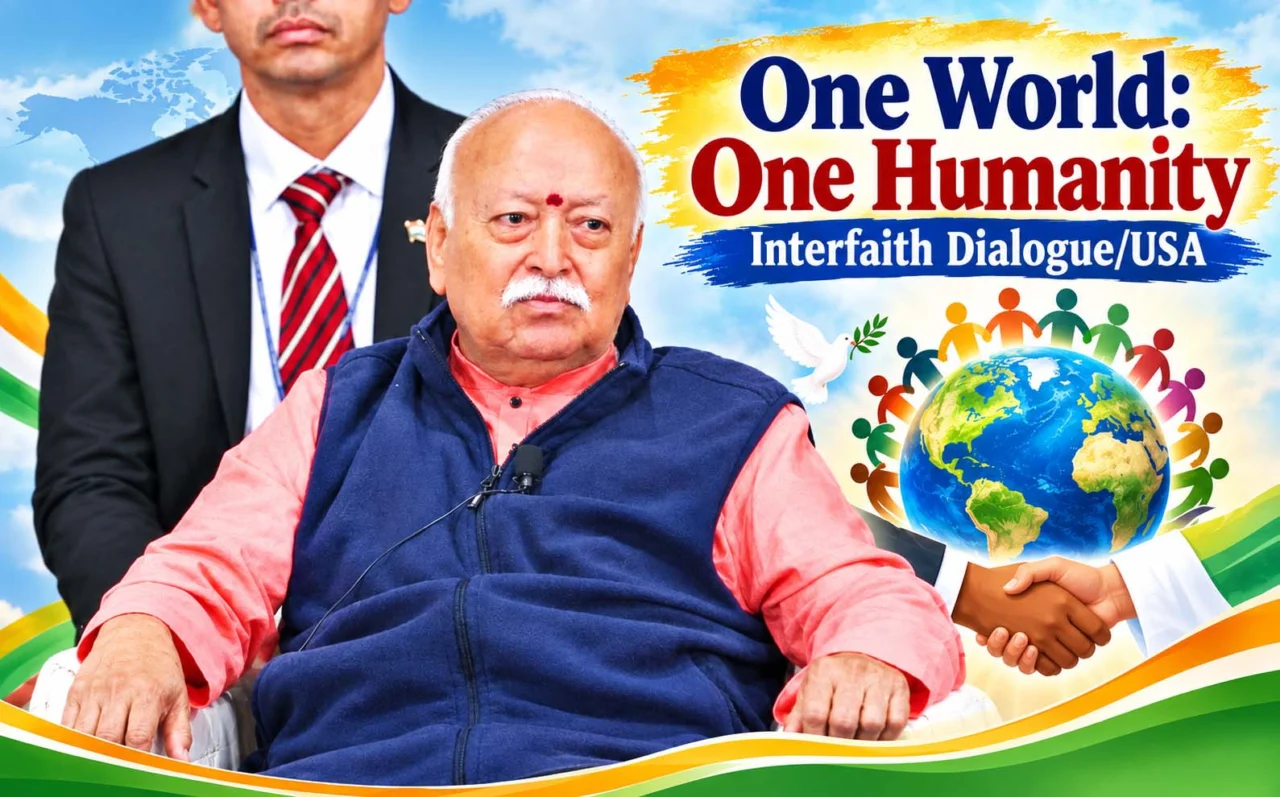
RSS Sarsanghchalak Dr Mohan Bhagwat delivering the keynote address at the interfaith dialogue ‘One World, One Humanity’ in New York on August 29, 2026
“Diversity is a decoration for our unity. It has to be accepted. It has to be respected. It has to be protected. As I protect my own specific nature, I have to protect others also,” said RSS Sarsanghchalak Dr Mohan Bhagwat in his keynote address at the interfaith dialogue ‘One World, One Humanity’ organised by the World Council of Religious Leaders at 1345 Avenue of the Americas, New York, on August 29, 2026.
Speaking about the journey of the RSS, Dr Bhagwat said, “Sangh started in 1925, and during the course of hundred years, we have created a place, a prestige for us in our own society. Today when I am talking this, people may ask, where were you all these years? You are talking these things today. We were there, but we were so minuscule, so neglected, that even if I would have come here to participate, I would have been rejected outside. Now we have some say in our own society.” Reflecting on the past, he added, “In spite of that baggage we can tell him — shed your baggage off. We have to live together.”
Dr Bhagwat described himself as neither a religious scholar nor a religious authority, but said he was working in society. He recalled the traditional understanding that religions may be different, but humanity is one. “I am not a religious scholar, nor a religious authority. But I am working in society. We traditionally say that religions might be different, but humanity is one. There are many religions, and in today’s world, religions are largely defined by rituals. And to bring in a religious discipline, and to create that path to divinity, this discipline of rituals is also necessary. But what for a religion is there? It is leading us to the truth,” he said.
Explaining the relationship between religious rituals and their purpose, Dr Bhagwat drew an analogy of a finger pointing towards a light. “So, if I indicate something to you, see there, that light, which is a little bit different. You will see my finger pointing, and then you will see the light. But if you ignore my finger, you will never see the light. The purpose is defeated,” he further said.
Narrating an anecdote from a discussion in Delhi in 2018, Dr Bhagwat recalled that Muslim participants had questioned him about the RSS’s position on Muslims in Bharat. “I had a discussion in Delhi in 2018, and Muslim brothers were also there, and they asked me first, You are a Hindu organisation. You say Hindu Rashtra. What about us Muslims? Would you drive us out? I said no. That is not Hindu Dharma. If any Hindu thinks that there should be no Muslim in Bharat, he is not a Hindu”.
He said that continued education of society was necessary to prevent distortions from emerging. “If we do not keep educating the society, then the deflections creep in, and somehow it happened in the course of history. I cannot point the moment. After that, our society, our country, was a target of foreign invasions, and so many things were lost,” he said.
Instead of “One World, One Humanity,” if we think that there should be only one religion, there comes the problem. We are not here to proclaim that there is only one religion which is sublime and great. Rather, we are here to understand one word: to have one humanity through different religions, understanding the common, essential principles that are hidden in all religions.
We are created to render something good to society and to practise good, thereby becoming liberated from all bondages, ignorance, limitations, and distorted things.
We are here to elevate ourselves towards absolute consciousness. This is the time for us to bring out all those common elements and make our younger generations understand them, so that they will value and respect all religions equally.
If all religions are to be respected, then we have to speak the language of our youth. At the same time, we have to teach and preach the teachings of our religions—all religions—in the language of modern science and modern technology, with which they can understand, respect, and practise them.
If that is done, so many misunderstandings are going to be dissipated and understood in their proper perspective.
This is the platform where we can bring together common philosophy and common principles, with which we can help our children and our youth understand and respect all religions.
Emphasising the dignity of every human being, Dr Bhagwat said there could be no fundamental difference between human beings. “Every human has dignity. There is no difference between human beings. Vidyavinaya-sampanne brahmane gavi hastini, Shuni chaiva shvapake cha panditah samadarshinah, those who know, they view equally a dog and a Vidvan Brahmin, a knowledgable person. Because all these are differences, which decorate the nature, and we have to go through it, so we have to mind that. But the reality which is always present is – we are one,” he said.
We have to find a way of living in peace because it is either we live in peace or we destroy ourselves. And I think, if religions cannot be part of the solution to this problem, who else will do it?
We should face serious issues so that we can live together as human beings. Our differences will no longer be as important as we think they are. And so, if religious bodies can put their house in order—and we should be able to do so because we now sincerely believe that we all have one God.
Don’t forget, there are many out there who do not agree with that. Many people do not believe that we have one God. Many of my own people, when I tell them this, say, “No, the God of the Muslim is different from the God of the Christian.” I say, “Well, that means you no longer believe in one God. And if you’re a Christian, you must believe in one God. If you’re a Muslim, you must believe in one God. And there cannot be more than one God. If it is one God, it is one God.”
Dr Bhagwat identified dialogue and service as two important steps towards this understanding. “Dialogue is the first step; service is another. We are serving and while serving, we don’t discriminate. We serve whoever is in need. One lakh thirty thousand small and large service projects our Swayamsevaks are running with the help of the society, and they serve everywhere. They serve equally without discrimination,” he said.
In the Jewish tradition, the foundational value of “we are all in this together” is taken from the creation story, the first chapter of the Torah, the Hebrew Bible. When we are told that humans are created b’tzelem Elohim, in the image of God, that means we must treat all human beings as children of God—a God who loves us and commands us to love our fellow human beings, as they too are godly.
I proudly embrace the particularism of every faith, including my own. Particularism is natural, even healthy. We should worry more about our own family than someone else’s family. But if particularism is an end unto itself and not a pathway to universalism, it has not achieved its full potential.
The Talmud teaches that kol Yisrael arevim zeh bazeh—all Jews are responsible one for the other. It’s a great start, but it cannot be the totality of what God ultimately wants of us, which is that all human beings are responsible one for the other.
When being a religious leader is expressed in its truest form, that is when we feel responsible for one another across faiths and other divides. And so, we religious leaders need to be the role models our people need and demonstrate for others how our next act can be the one act that will proverbially tip the scales in favour of a better humanity.
As a Jew, I can say that we are living in the most challenging moment for the Jewish people in our lifetimes. But I know that hate is an equal-opportunity offender. Today it may be directed at my people. Tomorrow it may be directed at yours.
He recalled an incident involving a plane collision in Dadri, Haryana, saying that both planes were from Arab countries and that most of the passengers were Muslims. Following the collision, he said, Swayamsevaks reached the site first and provided assistance. “All passengers were dead. Our Swayamsevaks recovered the bodies, arranged their funeral rites, and when their relatives came, helped them in identifying them. We don’t have the thought that they are Muslims,” he said.
No church can sing of salvation while ignoring the crisis outside its sanctuary, temple, mosque, synagogue, or sacred gathering place. No people can secure peace by denying another people the right to live, breathe, and flourish.
The waters around us are troubled. Hatred begins as a word, hardens into permission, and eventually becomes policies in the places where we live.
And by the time suffering reaches the evening news or social media, it has already entered somebody’s home, emptied somebody’s cupboard, closed somebody’s school, or snatched somebody’s child from our neighbourhood.
On this sea of history, distance is an illusion. What happens in one community does not remain in that community. What happens in one city does not remain in the city. And what happens in one country does not remain in the country.
Worship must enlarge our capacity to recognise the sacred in someone whose name, language, nationality, and religion differ from our own. And devotion must develop the moral courage needed to move one world and one humanity forward—from the good things that we say to the good things that we do.
Faith communities must build permanent tables of trust in our cities and our nations—tables where leaders can speak honestly with each other and disagree responsibly, and interrupt misinformation wherever it is, whether someone is spreading misinformation at your table, on television, or on social media.
This is not the hour for faith communities to debate who deserves a place in the boat. Human life is the credential. Sacred worth is the passport. Compassion is the law of the sea.
We are passengers, my brothers and sisters, on the same turbulent sea, breathing the same fragile air, entrusted with the same wounded earth. And either we learn to navigate these waters together, or history will record that we allowed our divisions to sink what our cooperation could have saved. One world is our inescapable reality. One humanity is our sacred responsibility.
Dr Bhagwat also referred to the emphasis placed by leaders and the Constitution on the unity of humanity. “The traditional thought of Bharat is: Unity of Humanity. All our leaders, at any point of time, have emphasised on that too. Our constitution that we got after independence emphasises on this. But that is not happening because politics has now become a game of self-interest. And where there is ‘me’ and ‘mine,’ there is no solution. ‘We’ and ‘ours’ is the solution,” he said.
He recalled an incident involving a plane collision in Dadri, Haryana, saying that both planes were from Arab countries and that most of the passengers were Muslims. Following the collision, he said, Swayamsevaks reached the site first and provided assistance
He called for efforts to begin at the level of society and for public opinion to shape political conduct. “We have to start from the society and build strength, so that we can influence politics also. Because politics today, especially in democracy, depends on the public opinion. If there is public opinion, then no politician will dare to go against it,” he said.
One does not have to erase the identity of another in order for the whole system to work. Each maintains its distinction while contributing to the whole. Therein, my respected brothers and sisters, is a universal logic for human life and progress.
It is a model for us. We do not have to become the same in order to work together. We do not have to become the same in order to cooperate. We can maintain our theological distinctions while sharing moral commitments. We can worship differently and still feed the hungry together, as we’re doing. We can have a different understanding of salvation and still protect a child together. We can have different scriptures and still stand together against hatred.
In fact, brothers and sisters, our differences may reveal why cooperation is necessary. No single religion, no single nation, no single institution or leader can solve the challenges confronting humanity alone.
The challenges facing humanity have crossed borders. We are in a prophetic picture right now where the world that started off as one has become one again. We are all under one roof, and we have crossed borders. Our houses of worship must become more than places where peace is preached. They must become centres from which peace is organised. Our interfaith relations must become more than ceremonial friendships. So let this gathering be remembered not simply for the people who assembled, but for the partnerships that continue.
Dr Bhagwat urged participants to act on the common position arrived at during the dialogue and to begin locally. “Therefore, I think after taking a common resolve today, we have to act in the society, and we have to act first locally. Whatever we decide to do today, we should start in our own country and create pockets of such selfless service, such atmosphere of unity, and this dialogue should continue,” he said.



