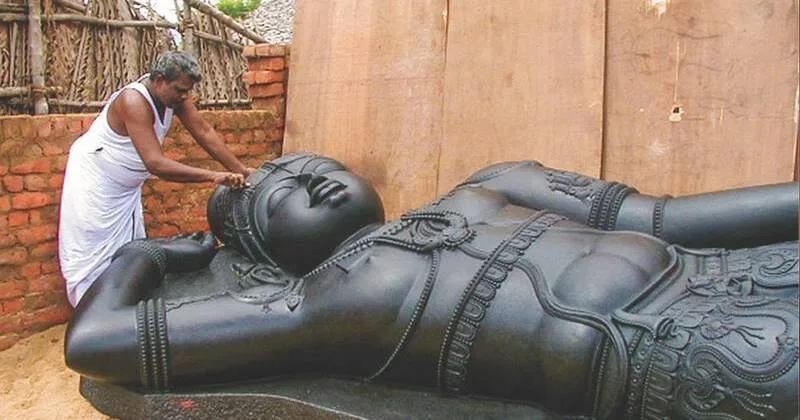
Perumal Sthapati is a master sculptor from Mamallapuram who has spent decades creating Hindu deities and temple sculptures in stone
Mahabalipuram: For more than five decades, the sound of a chisel striking stone has been at the heart of Perumal Sthapati’s life. Working from Mamallapuram, the historic stone-carving centre of Tamil Nadu, the master sculptor has dedicated his life to creating murtis of Hindu deities and intricate temple sculptures, keeping alive a traditional craft passed down through generations.
A highly regarded sthapati and stone sculptor, Perumal Sthapati has worked on Mandir and sculptures in India and abroad, creating images of deities including Bhagwan Ganesha, Bhagwan Murugan, Bhagwan Vishnu, Bhagwan Venkateswara and Maa Kali. His work can be found not only in Mandir across India but also in Hindu Mandir and cultural spaces in countries including the United Kingdom, Malaysia, Singapore, the United States, Sri Lanka and Fiji.
Perumal Sthapati was born in Thrissur, Kerala, in 1954. His father, Sundaram Acharya, was a stone carver who passed away when Perumal was only 15. The family was left in difficult financial circumstances, and Perumal eventually moved towards Mamallapuram, the ancient coastal town south of Chennai known for its extraordinary tradition of stone architecture and sculpture.
At the time, Mamallapuram was witnessing renewed activity in Mandir construction and stone carving. Traditional architect V. Ganapati Sthapati was bringing together skilled silpis and craftsmen from different parts of Tamil Nadu for major temple projects. It was here that Ganapati Sthapati noticed the young Perumal’s natural ability. Ganapati Sthapati’s words to him were simple but decisive: “You stay here with me.” Those words changed the course of Perumal’s life.
Under Ganapati Sthapati’s personal guidance, Perumal began learning the demanding discipline of traditional Indian stone sculpture. What initially began as an opportunity to earn a living gradually became a lifelong calling.
The relationship between Perumal Sthapati and V. Ganapati Sthapati was far more than that of a teacher and student. Ganapati Sthapati, one of the most influential traditional Mandir architects of modern India, became Perumal’s guru and mentor. Perumal spent decades learning from him, absorbing not merely the physical techniques of carving but also the discipline, proportions, iconography and spiritual approach associated with traditional Hindu sculpture.
Perumal has described how closely he learned to understand his guru’s expectations. He recalled that he could understand his guru’s “heart, taste, mind and expectations” and that Ganapati Sthapati could identify even the smallest error in a sculpture.
The training demanded complete dedication. There was little room for distraction. Perumal devoted himself to the craft, learning to translate the prescribed forms of Hindu iconography into stone while simultaneously developing his own extraordinary sensitivity as a sculptor. The bond continued until Ganapati Sthapati’s death in 2011.
Following the passing of his guru, Perumal became one of the trustees of the Vaastu Vedic Research Foundation in Mamallapuram, continuing the institutional and artistic legacy associated with his teacher. Ganapati Sthapati himself held Perumal in exceptionally high regard and described him as one of the greatest carvers in South India.
For Perumal Sthapati, carving a Hindu deity is not simply a matter of producing a statue. It is a process of intense concentration and internal visualisation. Explaining his approach to carving a Ganesha murti, Perumal has said that he becomes completely immersed in the image he is creating. The sculptor first visualises the form internally before attempting to reproduce that vision physically in stone.
This philosophy reflects an important principle of traditional Hindu sacred art: the murti is not treated as an ordinary decorative object. Its proportions, posture, gestures, ornaments and attributes are governed by an established iconographic tradition. The sculptor therefore has to combine technical mastery with knowledge of the traditional rules governing sacred imagery. Perumal’s philosophy is also reflected in the amount of time he is willing to spend on a single work. Rather than rushing to meet an arbitrary deadline, he has said that he continues working until he is satisfied with the final form.
Over the course of his career, Perumal Sthapati has created more than 80 murtis of Vinayaka and around 50 images of Venkateswara, apart from numerous sculptures of other Hindu deities. His body of work includes Bhagwan Ganesha, Bhagwan Murugan, Bhagwan Vishnu, Bhagwan Venkateswara, Maa Kali and other deities. He has also undertaken sculptures depicting prominent leaders and other figures. The scale of some of his works demonstrates the extraordinary patience required by traditional stone carving.
A five-foot Dwarapalaka, or temple guardian, can take approximately six months to complete. A three-foot murti can require around three months. An eight-foot standing Vishnu created for a temple in Hyderabad took approximately a year. Perhaps even more remarkable was an 18-foot reclining Ranganathar, on which Perumal spent five years.
These timelines illustrate why traditional temple sculpture is fundamentally different from mass-produced statuary. Every curve, ornament, expression and anatomical proportion has to emerge from a solid block of stone through thousands of deliberate cuts.
Although Perumal’s workshop is rooted in Mamallapuram, his sculptures have travelled far beyond India. His murtis are installed at Hindu temples and religious institutions in the United Kingdom, Malaysia, Singapore, the United States and other countries. His work includes murtis associated with the Lakshmi Narayana Mandir in London, Batu Caves and the Mariamman Mandir in Malaysia, as well as Murugan and Bhadrakali Mandirs in Singapore.
In the United States, his sculptures can be found in places including Chicago, New Jersey and Fiji-related Hindu institutions. For a Mandir in St. Louis, he created around 20 murtis. His reclining Vishnu is installed at the Siva-Vishnu Mandir in Maryland. He also created an eight-foot seated Buddha for Sri Lanka, demonstrating the breadth of his stone-carving expertise beyond Hindu iconography. For Perumal, these international projects also represent the journey of an ancient Indian artistic tradition into a global setting.
One of the notable chapters in Perumal Sthapati’s career was his association with the Iraivan Mandir in Hawaii. During the 1990s, he assisted with ornamental carving designs for the granite Mandir commissioned for the Kauai ashram of Satguru Sivaya Subramuniyaswami, founder of Hinduism Today.
Perumal worked on the project for more than a year during its initial stages, carving some of the intricate ornamental designs and demonstrating techniques to other silpis who continued the work. The project was particularly significant because of its commitment to traditional hand-carved granite temple architecture.
Perumal admired the patience and attention to detail demanded by the project. The temple’s extensive stonework reflected an approach in which craftsmanship, rather than speed, determined the pace of construction. For a traditional sculptor such as Perumal, such a project offered an opportunity to apply South India’s ancient stone-carving knowledge to a major temple being created thousands of kilometres away from India.
Perumal Sthapati’s contribution to traditional craftsmanship also received national recognition. He was presented the National Award for Master Craftsmanship by then President of India Dr A. P. J. Abdul Kalam. The award recognised his exceptional work in stone sculpture. His winning entry was an elaborate double-sided composition depicting Vishwakarma Siva on one side and Gayatri on the other, carved from green granite. The sculpture reportedly took approximately nine months of painstaking work.
The recognition was significant not only for Perumal personally but also for the traditional silpi community whose knowledge has historically been transmitted through apprenticeship and generations of practice. The artistic tradition associated with Perumal Sthapati continues through his professional work in temple architecture and sculpture.
Perumal Sthapati Associates describes itself as specialising in Hindu temple construction, temple architecture, stone work and Vastu consultation. The organisation operates with a team of experienced architects and designers and has undertaken temple-related projects in several parts of India.
Among its listed projects are the Sri Pushparadeshwarar Mandir at Gayaru near Redhills in Chennai, the entrance arch of Kuchipudi Natyakshetram in Andhra Pradesh, Sri Prasanna Venkateswara Mandir in Hyderabad, Sri Sarguneshwarar Mandir at Karuveli near Kumbakonam and the Silver Jubilee Entrance Arch at Kumaraguru College in Coimbatore.
Its work has extended across locations including Chennai, Kumbakonam, Mayavaram, Coimbatore, Thiruvannamalai, Sivagangai and Hyderabad.
The practice represents the combination of traditional craftsmanship and contemporary temple construction requirements, bringing together sthapatis, architects, designers and sculptors.
Even at the age of 60, when he was profiled by Hinduism Today in 2014, retirement was not part of his plans. His daily routine reflected the discipline that had defined his entire career. He would rise around 5 am, walk for an hour, have breakfast and travel to his workplace on a two-wheeler, reaching around 8 am. He would often remain at work until the evening. For him, stone carving was not merely a profession that ended when he left the workshop. He would continue thinking about the next day’s work even after returning home. If a murti did not take shape according to his expectations, he would feel deeply disappointed.
Perumal Sthapati’s story is ultimately about much more than one sculptor. It is the story of a traditional Indian craft surviving in an era of rapid technological and industrial change.
Mandir architecture and sacred sculpture require knowledge that cannot be acquired simply from books or machines. The understanding of stone, traditional measurements, iconography, proportions, ornamentation and the spiritual character of sacred imagery is built through years of apprenticeship. For Perumal, that apprenticeship began under one of India’s most celebrated traditional temple architects, V. Ganapati Sthapati. The guru’s lessons became the foundation of his life’s work, and Perumal in turn became a master who carried those lessons into thousands of hours of carving. From a young man who arrived in Mamallapuram without a clear plan to become a sculptor, he grew into a master craftsman whose murtis and temple sculptures travelled from South India to temples around the world. His story is therefore not merely about stone. It is about the transformation of stone into sacred form, the transmission of knowledge from guru to disciple, and the continuing survival of one of India’s oldest artistic traditions.
