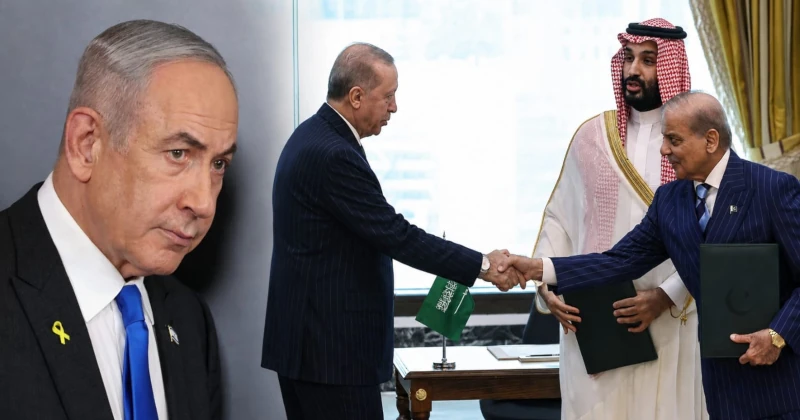
Israel-Greece defence cooperation deepens as the Achilles Shield project emerges alongside the Turkey-Pakistan-Saudi Mecca Pact.
New Delhi: Israel and Greece have formalised one of the largest defence export agreements in Israel’s history, signing a 3 billion Euro government-to-government deal to build a comprehensive, multi-layered national air-defence architecture for Greece under the Achilles Shield programme.
The agreement places Israeli air-defence technology at the centre of Greece’s long-term military modernisation and marks the largest defence export deal in the history of Israel-Greece relations. The timing is also significant, coming as a new security grouping involving Saudi Arabia, Turkey and Pakistan moves towards greater institutionalisation under the Mecca Joint Defence Agreement or Sunni NATO.
Under the Achilles Shield project, Israel will supply Greece with an integrated network built around David’s Sling, BARAK MX and SPYDER air-defence systems. The architecture will also include multi-mission radars produced by ELTA, a subsidiary of Israel Aerospace Industries, and a national command-and-control system designed to integrate different layers of air defence into a unified operational network.
A separate 26 million Euro agreement will provide Greece with Rafael’s Drone Dome counter-UAV system for the protection of strategic sites. Greek companies are also expected to participate as subcontractors, with industrial cooperation and technology transfer forming part of the wider government-to-government arrangement.
The deal represents a major step in the strategic relationship between Israel and Greece, which has expanded significantly over the past decade.
For Greece, the Achilles Shield programme is part of a wider effort to modernise its armed forces and strengthen protection against aircraft, drones, cruise missiles and ballistic threats. Israel’s experience in operating layered air-defence systems has become a major factor in the international demand for its defence technology.
The systems included in the Greek package have been designed to operate across different ranges and threat environments. David’s Sling is intended to address medium- and long-range threats, while BARAK MX and SPYDER provide additional layers of air and missile defence. The integration of radars and a centralised command-and-control structure is intended to provide Greece with a national system rather than a collection of separate platforms.
The agreement also reflects the strategic importance of the Eastern Mediterranean, where Greece and Turkey continue to pursue competing security priorities and major military modernisation programmes. Turkey, meanwhile, has sought to reduce its dependence on foreign military equipment by expanding its domestic defence industry and has developed the multibillion-dollar Steel Dome programme, a multi-layered air-defence network designed to counter aircraft, drones and missile threats. However, Turkey-made drones supplied to Pakistan were neutralised during India’s Operation Sindoor, raising questions about the battlefield performance of Turkish defence equipment.
However, the parallel development of Greece’s Israeli-backed Achilles Shield and Turkey’s Steel Dome could become an important element of the evolving military balance in the Eastern Mediterranean.
The Israel-Greece agreement has emerged alongside the rapid development of the Mecca Joint Defence Agreement involving Saudi Arabia, Turkey and Pakistan. The correct formal name is the Mecca Joint Defence Agreement, while recent reporting has also referred to the emerging framework as the Mecca Defence Alliance. Saudi Arabia, Turkey and Pakistan have agreed that an armed attack against one of the three countries would be regarded as an attack against all of them. The three states have also moved to establish a secretariat in Saudi Arabia to institutionalise cooperation under the agreement.
The collective-defence provision has led to the grouping being informally described as a Sunni NATO. The three-country arrangement brings Saudi Arabia, Turkey and Pakistan into a new framework for defence and security cooperation.
However, the alliance faced an early test shortly after the Mecca Joint Defence Agreement was signed on August 7, 2026. On August 9, the Houthis launched a drone attack on Saudi Arabia’s Jazan refinery, yet there was no publicly reported military response from Pakistan and Turkey in defence of Saudi Arabia.
Pakistan, Saudi Arabia and Turkey have stated that the Mecca Joint Defence Agreement is intended to strengthen collective deterrence and security cooperation, while the framework could potentially expand to include additional countries in the future.
The developments underline the emergence of increasingly structured defence partnerships across the Eastern Mediterranean and the wider West Asian region.
On one side, Israel and Greece are deepening a bilateral defence partnership through one of Israel’s biggest-ever defence export agreements, with Achilles Shield placing Israeli systems at the heart of Greece’s future national air-defence network.
At the same time, Saudi Arabia, Turkey and Pakistan are moving to give institutional form to their Mecca-based collective-defence framework. The emerging Sunni NATO grouping adds another layer to a changing regional security landscape shaped by expanding defence industries, air-defence requirements and new strategic partnerships.
