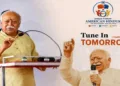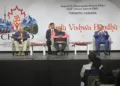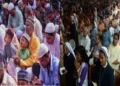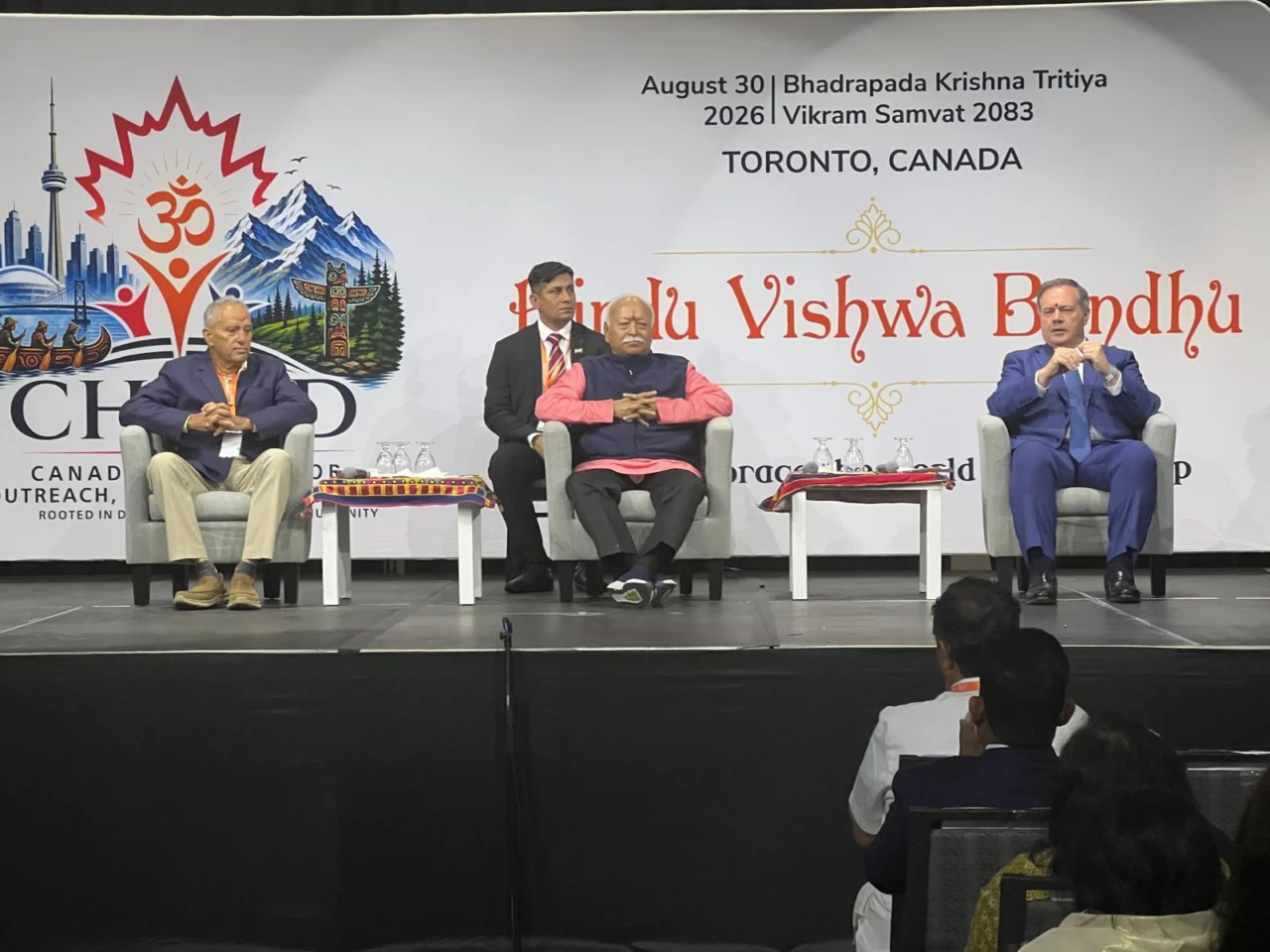
Toronto, Canada: “Those who are open-minded and knowledgeable embrace the concept of Vasudhaiva Kutumbakam-the belief that the entire earth is one family. While individuals in the material world may differ in body, shape, and complexion, in essence, we are all one. Therefore, serving others is our duty. We have gained this wisdom, which brings us enduring happiness and lasting contentment,” said RSS Sarsanghchalak Dr Mohan Bhagwat while addressing a massive gathering at the ‘Hindu Vishwa Bandhu – Embrace the World in Friendship’ event in Toronto, Canada.
He emphasised Bharat’s intrinsic culture of global helpfulness and unity, declaring that Bharat’s tradition has always viewed diversity as a natural form of unity.
The event, organised by Canadian Hindus for Outreach, Relations and Dialogue (CHORD), kicked off with cultural performances, including traditional folk songs rendered by members of the Indian diaspora.
Reflecting on Bharat’s core ethos, Dr Bhagwat highlighted the universal nature of the Hindu worldview.
“Whenever Bharat has been asked for help anywhere in the world, it has never refused and it extends a helping hand even without even being asked. This is our tradition, the DNA of Bharat. That is why you may have heard the saying–‘If Hindus awaken, the world awakens,'” he said.
He further explained how Bharat spiritual heritage fosters oneness across humanity and nature.
“They regard both the animate and the inanimate as their own… They have been taught to see unity in diversity. That is why diversity never poses a problem for unity in India; our tradition teaches us that not only is there unity in diversity, but diversity itself is a form of unity,” added Dr Mohan Bhagwat.
Dr Bhagwat called on the global community to embrace the ancient philosophy of Vasudhaiva Kutumbakam, the understanding that the entire world is one interconnected family.
He emphasised that true enlightenment lies in looking past external differences to recognise the underlying spiritual unity of humanity.
He also noted how “Bharat” by the nature of its character, became a vishwaguru and not a mahashakti.
“One may call Bharat a superpower at that time, but it was not a superpower. It served the world. By its own character, it became Vishnu Guru, not Mahashakti. So the rise of Bharat means more united, more emancipated humanity,” he said.
Dr Bhagwat recalled historical and modern examples of Bharat stepping up during international humanitarian crises. Recalling the plight of Polish refugees during the 2nd World War, he noted how the Maharaja of Jamnagar offered them refuge and protection until they could safely return home.
“There are so many instances; it is still continuing,” Dr Bhagwat said, referring to Bharat’s tradition of extending assistance during crises.
Underscoring Bharat’s civilisational tradition of helping others, he said the country never refused assistance when people in distress sought its help and often extended help without being asked. “This is the tradition. This is the DNA of Bharat,” he said.
Pointing to modern conflict evacuations in the Middle East, he highlighted how Bharatiya military transport aircraft rescued not only Bharatiya citizens but also nationals from seven other countries trapped in the war zone.
“When, some years back in the Middle East war, people were trapped, the military planes of Bharat went there and rescued not only Bharatiya citizens; citizens of seven countries were rescued from there by Bharatiya,” he said.
He noted that Muslims, Christians, Jews, and Parsis have historically found peaceful refuge and knowledge in Bharat without fear of persecution. “Anywhere in the world, if someone was persecuted, he got asylum in Bharat only,” he said.
He recalled how the forefathers had the goal to impart knowledge and civilizational values to the world and said, “We did it. Long back, when there were no roads, no boats, no aeroplanes, no motor vehicles, only bullock carts and horses– our ancestors have gone in the regions from Mexico to Siberia, giving them all knowledge. On foot they crossed the Himalayas, went to China, went to Siberia, Mongolia. By small boats they went to Southeast Asia… What did they do? They conquered no country; they converted nobody. Wherever they went, they gave knowledge- astrology, Ayurveda. They imparted the civilizational values.”
Defining the essence of Hindu philosophy, Dr Bhagwat clarified that the identity transcends narrow linguistic or religious boundaries. “When I say Hindu, the word Hindu cannot be defined by any specific language, through any specific worship, or through any living style,” he said, adding that Hindus “respect all” and “accept all”.
Dr Bhagwat also called for embracing diversity while recognising the underlying unity of humanity. “We have to serve, accept, respect this diversity because it is an expression of unity. It beautifies it. It is the decoration. We celebrate it,” he said.
He said Bharat’s ancient ethos recognises diversity as natural while regarding unity as the fundamental reality. “Nature, expression of reality, is diverse. Diversity is natural. Unity is the reality. That is the ancient ethos of Bharat,” he added.
The event also featured prominent Canadian leaders, including former Canadian Defence Minister and former Premier of Alberta, Jason Kenney.
Speaking to the energetic crowd, Kenney lauded the growing momentum in bilateral relations between the two countries. “It is so wonderful to see renewed momentum in the Canada-India relationship that will be represented by the second visit of Prime Minister Modi to Canada later this year,” he said.
Ahead of his visit, members of the Hindu diaspora across Canada gathered in Toronto with immense enthusiasm to welcome Dr Mohan Bhagwat, describing his visit as a landmark moment to promote peace, cultural values, and global harmony.
According to CHORD organiser Naresh Chavda, the gathering drew over 2,500 attendees representing eight provinces across Canada.
Rajinder Parsad of Hindu Sabha Temple, Greater Toronto Area (GTA), said Dr Bhagwat’s visit carried the message of Vasudhaiva Kutumbakam, or the world as one family.
“Dr Mohan Bhagwat’s visit has carried the message of Vasudhaiva Kutumbakam. We should bring the message of values of our culture to the world. We welcome Mohan Bhagwat ji,” Parsad said.
The visit comes as members of the Canadian Hindu diaspora gathered in large numbers for the event, with organisers highlighting the gathering as an occasion to celebrate community, cultural values and the broader message of friendship and harmony.