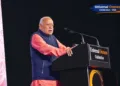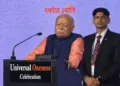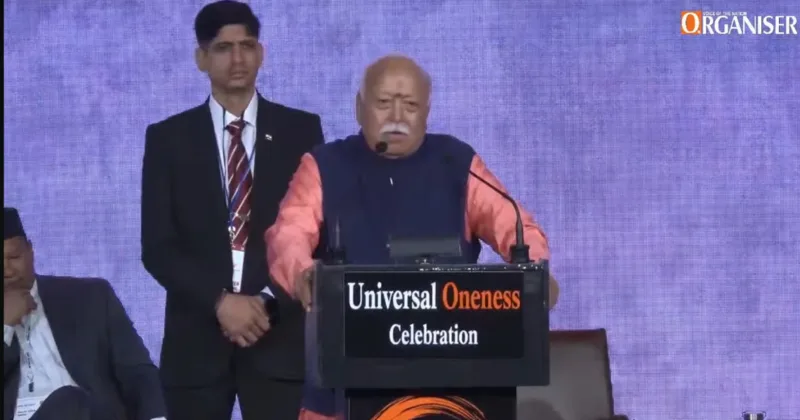
In an era defined by geopolitical fragmentation, deep-seated ideological entrenchment, and ecological peril, the search for a unifying global vocabulary has never been more urgent. At a recent gathering of over five thousand members of the Indian diaspora in New York, RSS Chief Dr. Mohan Bhagwat offered a compelling civilizational alternative. Grounded in the ancient Indian philosophy of Sanatana non-dualism, his address sought to reframe the global discourse on diversity. Rather than viewing pluralism as a mere political compromise or a transactional contract, Bhagwat presented “universal oneness” as an undeniable, ontological truth—a civilisational DNA capable of steering humanity away from its current trajectory of mutual destruction.
For global observers, the New York address marks a significant shift in India’s projection of its soft power. It transitions the discourse from defensive cultural preservation to an active, philosophical intervention in global affairs.
The Illusion of Division: The Neural Captivity of Truth
At the heart of the address was a profound epistemological warning: humanity is trapped by the limitations of its own perception. Drawing on a scientific analogy from his background as a veterinarian, Bhagwat noted that humans perceive at least seven primary colors, while canines possess dichromatic vision, seeing only shades of black, white, and a limited spectrum in between. To a dog, its two-toned world is an absolute, experiential truth. To a human, the seven-colored world is equally real.
The philosophical implication is clear: our sensory organs and mental software dictate our perception of reality. Most global conflicts arise when we mistake our localised, partial perspective for the absolute, universal truth. Pluralism, in this framework, is not merely about tolerating differences; it is about recognising that different cultures, religions, and ideologies are simply viewing the same ultimate reality through different sensory and cultural lenses.
This is where the Eastern concept of Dharma departs from the Western definition of “religion.” While religion often demands adherence to a specific dogma, Dharma represents the cosmic balance—the sustaining principle that holds society together. It is an equilibrium that harmonises the individual, the community, and the environment.
The Illusion of Consumption: The “Donut” Trap and Upanishadic Wisdom
To illustrate the modern crisis of consumerism and spiritual emptiness, Bhagwat deployed a brilliant synthesis of ancient Upanishadic lore and contemporary American culture. He introduced the “donut metaphor”: a person may love donuts, but by the fiftieth donut, satiety turns into revulsion, even though the donut itself has not changed. Material consumption can never yield permanent satisfaction because it addresses only the sensory apparatus, leaving the deeper consciousness starved.
This psychological reality was mirrored in his retelling of the Vedic legend of Indra and Virochana. The kings of the gods and demons, respectively, possessed unlimited material abundance but lacked inner peace. They sought the knowledge of the Atman (the soul) from the creator, Brahma. Virochana, representing the materialist, concluded that the physical body and its reflection were the ultimate self, leading to a philosophy of self-aggrandizement and domination. Indra, however, realised that the reflection was transient and vulnerable to decay. Through rigorous contemplation, he discovered the immortal, non-dual consciousness that underlies all existence.
Modern global governance remains largely “Virochanan”—driven by the materialist assumption that security, happiness, and peace can be secured through economic consumption and military dominance. Bhagwat’s address challenges this paradigm, suggesting that true global stability requires an “Indran” shift toward spiritual interconnectedness and self-restraint.
The Geopolitical Manifestation of Empathy
This philosophical non-dualism is not a passive, quietist doctrine; it demands active, visceral empathy. Bhagwat proposed a simple ethical experiment: try to eat a sumptuous meal while a starving person stares at your plate. No healthy human can do so without experiencing a pang of conscience. This innate discomfort proves that our individual well-being is inextricably bound to the well-being of the “Other.”
This visceral empathy has profound geopolitical implications. In traditional international relations, conflict resolution is often zero-sum, aimed at the physical or economic containment of the adversary. Bhagwat counterposed this with the classical Indian prayer: “Shatru buddhi vinashaya”—praying not for the destruction of the enemy, but for the dissolution of the hostile intellect itself. It is an extraordinarily sophisticated diplomatic posture that separates the human being from the hostile ideology, seeking transformation rather than elimination.
Furthermore, Bhagwat addressed the role of the Indian diaspora, particularly in the United States. He urged them to be exemplary citizens of their Karmabhumi (the land of action, America) while remaining anchored to the ethical values of their Janmabhumi (the land of birth, India). This dual loyalty is not a security risk but a diplomatic bridge, offering a model of harmonious integration that respects local civic duties while enriching the host nation with pluralistic spiritual values.
Restorative Ecology and the “Final Three Feet”
The address culminated in an urgent call for ecological restoration, framed through the RSS’s Panch Parivartan (Five Shifts) initiative. Citing Yuval Noah Harari’s Sapiens, Bhagwat reminded the audience that humanity rapidly ascended from the bottom of the food chain to the top, acting as an aggressive coloniser of nature rather than its custodian. The solution lies in shifting from a predatory “live and let live” model to an active “help others live” paradigm, recognising our ecological debt to the earth.
To those fatigued by the slow, painful progress of interfaith dialogue and global peace-building, Bhagwat offered the famous “final three feet” story from Reader’s Digest. A desperate, bankrupt man purchased a decommissioned mine that had been abandoned by a company frustrated after years of fruitless digging. He ordered his workers to dig just three feet further, and they struck one of the richest mineral veins in history.
The lesson for global diplomacy is one of untiring, generational perseverance. Structural changes in human consciousness do not happen overnight. In an era of instant gratification and rapid political cycles, civilizational transformations require a persistent commitment to dialogue and service, even when immediate results are invisible.
Ultimately, Dr. Mohan Bhagwat’s New York address offers a sophisticated, non-dogmatic framework for global coexistence. By weaving together cognitive science, Upanishadic parables, ecological consciousness, and practical ethics, he presented a vision where diversity is not a source of division, but a beautiful decoration of a singular, universal oneness. In a world fractured by tribalism, this ancient Eastern philosophy may well be the bridge we need to cross the chasm of polarisation.