
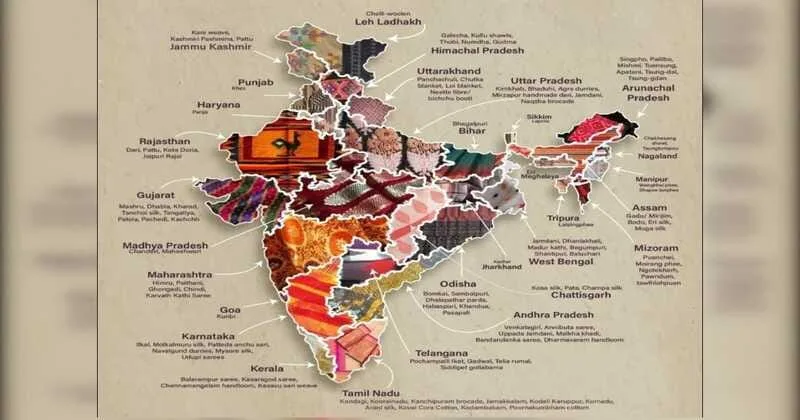
New Delhi: India’s textile heritage is as diverse as its landscapes, languages and traditions. Every region has developed its own distinctive fabrics, weaving techniques, embroidery styles and patterns, shaped by local history, climate, communities and cultural practices. From the intricate Kalamkari of Andhra Pradesh and Telangana to the luxurious Kanchipuram silk of Tamil Nadu, these textiles are not merely clothing; they are living expressions of India’s cultural identity.
Tamil Nadu – Kanchipuram Silk
Kanchipuram silk sarees are among India’s most celebrated traditional textiles. Woven in and around Kanchipuram, these sarees are known for their rich silk, vibrant colours and distinctive zari work. Traditional designs often feature temple borders, peacocks, paisleys, flowers and geometric patterns.
A notable feature of Kanchipuram sarees is the use of contrasting borders and pallus, which give them a distinctive appearance. Traditionally associated with weddings, festivals and religious ceremonies, these sarees are often preserved as family heirlooms and passed from one generation to another. The weaving tradition has also adapted to contemporary tastes, with designers introducing lighter fabrics, modern colour combinations and new motifs while retaining the traditional craftsmanship.
Andhra Pradesh and Telangana – Kalamkari
Kalamkari is a traditional textile art involving hand-drawn or block-printed designs on cotton or silk. The word comes from kalam, meaning pen, and kari, meaning work. The art traditionally depicts floral motifs, mythological stories, temple scenes and figures from Indian epics.
The Srikalahasti style is particularly associated with freehand drawing using a bamboo or date-palm pen, while the Machilipatnam tradition is known for block printing. Natural dyes have traditionally been an important part of the process, with colours derived from sources such as plants, minerals and other natural materials. Kalamkari has also moved beyond traditional sarees and textiles and is now widely used for dupattas, dress materials, home furnishings and contemporary fashion.
Kerala – Kasavu
Kerala’s iconic Kasavu saree is characterised by its simple white, cream or off-white body and distinctive golden border. Traditionally worn during festivals such as Onam and Vishu, Kasavu represents Kerala’s understated elegance.
The golden border, traditionally created using zari, provides a striking contrast against the plain fabric. The simplicity of the design makes the saree suitable for both ceremonial occasions and cultural celebrations. Today, the Kasavu tradition has expanded beyond the traditional saree and is reflected in set mundu, blouses, dresses, skirts, dupattas and other contemporary garments. It remains particularly prominent during Onam celebrations.
Karnataka – Mysore Silk and Ilkal
Mysore silk is renowned for its smooth texture, lustrous appearance and elegant simplicity. Produced in Karnataka, it is traditionally associated with high-quality silk and distinctive zari borders.
Ilkal sarees, traditionally woven in northern Karnataka, are recognised for their characteristic borders and pallu designs. A traditional feature is the Tope Teni technique, which helps connect the body of the saree with the pallu. Karnataka’s textile traditions demonstrate the variety of weaving cultures found within a single state. While Mysore silk is associated with refined silk sarees, Ilkal represents the rich handloom traditions of Karnataka’s weaving communities.
Gujarat – Bandhani and Patola
Bandhani, or tie-and-dye, is one of Gujarat’s most recognisable textile traditions. Small portions of fabric are tightly tied before dyeing, creating intricate patterns of dots and colourful designs. The process requires considerable precision because the tiny knots must be tied carefully to create the desired pattern. Traditional Bandhani is particularly associated with festive occasions, weddings and other celebrations. Patola, particularly the double-ikat Patola of Patan, represents a highly sophisticated weaving tradition. Both the warp and weft are resist-dyed before being woven together, producing remarkably precise patterns. Traditional motifs include geometric forms, flowers, parrots, elephants and other culturally significant designs.
Rajasthan – Bandhej and Leheriya
Rajasthan is famous for vibrant textiles that reflect its desert landscape and colourful cultural traditions. Bandhej uses tie-and-dye techniques to create dotted and patterned designs, while Leheriya produces distinctive wave-like patterns.
Leheriya is traditionally created by rolling and tying the fabric diagonally before dyeing it, resulting in flowing lines resembling waves. The technique is particularly associated with Rajasthan’s colourful festive clothing. Bright reds, yellows, pinks, greens and blues are commonly associated with Rajasthani textiles. These fabrics are widely used in sarees, odhnis, turbans, dupattas and other traditional garments.
Maharashtra – Paithani
The Paithani saree, traditionally associated with Paithan, is one of Maharashtra’s finest handwoven textiles. It is known for its silk base, zari work and distinctive motifs, especially peacocks, parrots, flowers and traditional geometric patterns. The pallu is often the centrepiece of a Paithani saree, featuring elaborate motifs woven using coloured silk and zari. The peacock design is particularly iconic and is strongly associated with the textile. Paithani sarees are traditionally worn during weddings, festivals and important family occasions. Their intricate craftsmanship and time-intensive weaving have helped establish them as prized heirlooms.
West Bengal – Tant, Jamdani and Baluchari
West Bengal has a rich handloom heritage. Tant sarees are lightweight cotton sarees suited to the region’s warm and humid climate. Their breathable fabric and simple elegance have made them a popular part of everyday and festive clothing.
Baluchari sarees are known for elaborate woven scenes, often inspired by mythology, history and everyday life. The pallu and borders may feature detailed figures and narrative motifs, effectively turning the saree into a woven storytelling canvas. The region is also associated with Jamdani, an intricate weaving tradition in which decorative motifs are created directly on the loom. Floral and geometric patterns are commonly incorporated into the fabric, requiring considerable skill and patience from the weaver.
Odisha – Sambalpuri and Bomkai
Sambalpuri sarees are among Odisha’s best-known textiles. They use the traditional ikat technique, in which threads are tie-dyed before weaving. This creates distinctive patterns that appear integrated into the fabric rather than simply printed on its surface.
Common motifs include the shankha (conch), chakra (wheel), flowers, animals and traditional geometric patterns. These motifs often have cultural and symbolic significance. Bomkai sarees, also known as Sonepuri sarees in some contexts, combine intricate motifs with traditional weaving techniques. Their detailed borders and pallus make them popular for festive and ceremonial occasions.
Assam – Muga and Mekhela Chador
Assam is famous for Muga silk, a naturally golden silk that is closely associated with the state. It is valued for its durability and distinctive golden sheen, which can become more pronounced with age and use.
The Mekhela Chador is the traditional attire of Assamese women and generally consists of two main pieces. It is commonly made from silk or cotton and often features motifs inspired by nature, flowers, animals and Assamese cultural traditions. Other Assamese silk traditions, including Eri and Pat silk, further demonstrate the region’s rich weaving heritage. These textiles remain an important part of Assamese festivals and cultural celebrations.
Jammu & Kashmir – Pashmina and Kashmiri Embroidery
Kashmir is renowned for luxurious Pashmina, produced from the fine undercoat of Himalayan goats. The fibre is exceptionally soft, warm and lightweight, making Pashmina shawls highly valued. The region is also famous for Kashida embroidery and Sozni work, which can be found on shawls, garments and other textiles. Intricate floral patterns and motifs inspired by Kashmir’s landscape are characteristic of these traditions. Kashmiri textile craftsmanship often draws inspiration from flowers, leaves, vines and the natural beauty of the valley. The detailed handwork can require considerable time and skill, making traditional embroidered shawls prized pieces of craftsmanship.
Himachal Pradesh – Kullu Shawls
Kullu shawls are known for colourful geometric borders and woollen fabrics suited to the Himalayan climate. Traditional designs often feature stripes, diamonds, zigzag patterns and other geometric forms. The shawls are valued not only for their warmth but also for their distinctive regional identity. Different colour combinations and patterns have evolved across weaving communities. Today, Kullu weaving is used for shawls, stoles, scarves and other woollen products, combining traditional motifs with contemporary designs.
Punjab – Phulkari
Phulkari, meaning “flower work,” is one of Punjab’s most distinctive embroidery traditions. Traditionally created on colourful fabrics, the embroidery uses silk thread to form vibrant floral and geometric patterns.
The embroidery was traditionally carried out by women and became closely connected with family traditions, celebrations and important milestones. Different styles of Phulkari developed over time, including elaborate forms created for special occasions.
The Phulkari dupatta remains an important part of Punjabi festive and wedding attire. Its bold colours and intricate embroidery have also made it popular in contemporary fashion.
Uttar Pradesh – Banarasi Silk and Chikankari
Banarasi silk, associated with Varanasi, is renowned for its rich silk fabric and intricate zari and brocade work. Designs frequently feature floral motifs, vines, paisleys and Mughal-inspired patterns. The weaving tradition has deep historical roots, and Banarasi sarees remain strongly associated with weddings and major celebrations. Their elaborate borders and pallus can contain highly detailed patterns created by skilled weavers.
Lucknow is famous for Chikankari, a delicate embroidery tradition traditionally associated with fine fabrics such as cotton and muslin. Its subtle floral patterns have made it popular across India and internationally. Chikankari includes a range of stitches and techniques, with floral vines, leaves and other delicate motifs commonly appearing across the fabric. It is now used not only on sarees but also on kurtas, dresses, dupattas and contemporary fashion.
Madhya Pradesh – Chanderi and Maheshwari
Chanderi fabric is known for its lightweight texture, transparency and elegant appearance. Chanderi sarees are traditionally woven using silk and cotton combinations and often feature delicate motifs. The fabric’s lightness makes it particularly suitable for warm weather. Traditional motifs include floral patterns, peacocks, geometric designs and other decorative elements.
Maheshwari sarees, associated with Maheshwar, are recognised for their distinctive borders and lightweight fabric. Their designs often include stripes, checks and traditional motifs. The weaving tradition has historically been closely connected with the town of Maheshwar and continues to support local artisan communities.
Chhattisgarh – Kosa Silk
Kosa silk, a variety of tussar silk associated with Chhattisgarh, has a natural texture and earthy appearance. It is used to create sarees, dress materials and other traditional garments. The fabric is often valued for its slightly textured surface and natural golden or muted tones. Traditional motifs may include flowers, geometric patterns and elements inspired by local culture. Kosa silk has also found a place in contemporary fashion, with designers using it for jackets, stoles, scarves and other modern garments while retaining its traditional character.
Northeast India – Distinctive Regional Weaves
The northeastern states possess some of India’s most distinctive textile traditions, with many communities maintaining their own weaving patterns and motifs.
Manipur is known for textiles such as Phanek and traditional handwoven fabrics. Nagaland has a strong tradition of shawl weaving, with patterns historically connected to tribal communities and cultural identity.
Mizoram is known for handwoven textiles featuring distinctive geometric patterns, while Meghalaya has traditions involving eri silk and other indigenous fibres. Arunachal Pradesh and Tripura also have diverse weaving traditions featuring locally developed patterns and techniques. These textiles are particularly important because their designs can communicate community identity, heritage and social traditions. In many northeastern communities, weaving is closely connected with cultural celebrations and the transmission of traditional knowledge between generations.
Bihar – Madhubani-Inspired Textiles and Bhagalpur Silk
Bihar has a rich textile heritage, particularly Bhagalpur silk, which is widely associated with the state’s silk-weaving tradition. Bhagalpur is often referred to as the “Silk City” because of its long association with silk production and weaving.
The state is also widely known for Madhubani painting, which has increasingly influenced contemporary textiles. Traditional paintings featuring animals, flowers, mythological figures and geometric patterns are now reproduced on sarees, dupattas and other fabrics. This combination of painting and textiles has allowed traditional Madhubani motifs to reach new audiences while giving artisans new avenues to preserve and adapt their craft.
Jharkhand – Tussar Silk
Jharkhand is one of India’s important regions for tussar silk production. The silk is valued for its natural texture, earthy appearance and golden tones. Traditional tribal motifs and contemporary designs are increasingly incorporated into handwoven tussar products, giving the textile a distinctly regional identity. Tussar-based products from the region include sarees, stoles, dress materials and home textiles. The craft also provides an important livelihood for many artisans and communities associated with silk production and weaving.
Goa – Kunbi Weave
Goa’s Kunbi saree is a traditional checked textile historically associated with the Kunbi community. Its simple red-and-white or red-and-black check patterns reflect Goa’s rural and indigenous heritage. The saree is known for its straightforward design and practical character. Unlike heavily ornamented textiles, the Kunbi weave demonstrates how simplicity can itself become a distinctive expression of regional identity. The textile has gained renewed attention as designers and cultural organisations work to preserve traditional Goan weaving. Contemporary adaptations have brought the characteristic checks into modern clothing and fashion collections.
The Living Heritage of Indian Textiles
India’s traditional clothing cannot be reduced to a single national style. Each region has developed textiles that respond to its environment, history and cultural traditions. A Kanchipuram saree tells a story through silk and zari. Kalamkari transforms fabric into a canvas for storytelling. Bandhani turns tiny tied knots into patterns, while Patola demonstrates extraordinary precision in weaving. Phulkari expresses Punjab’s vibrant embroidery traditions, Pashmina reflects the luxury of Himalayan fibre, and Sambalpuri carries Odisha’s distinctive ikat heritage.
Together, these traditions form a remarkable textile map of India. They preserve centuries-old skills while continuing to evolve through contemporary fashion. In an age of mass-produced clothing, India’s handlooms and traditional textiles remain a reminder that clothing can be more than something we wear—it can carry history, identity, craftsmanship and culture from one generation to the next.