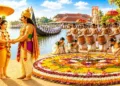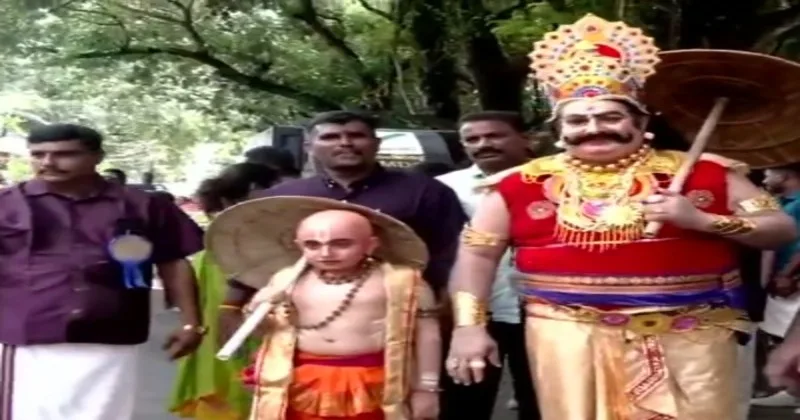
Onam is generally regarded as Keralam’s major harvest festival and an occasion associated with the memory of King Mahabali. Pookkalams are decorated in homes, Onam Sadya is prepared, boat races are held, and public life is filled with joy. Keralam Tourism also describes Onam as a harvest festival and an occasion associated with the traditions of Mahabali and Bhagwan Vamana. However, when Onam is understood from the perspective of Indian philosophy, an extremely profound thread connecting nature, food, prana, consciousness, surrender and the Supreme Reality becomes visible within it.
This thread extends from the Panchakosha concept of the Taittiriya Upanishad to the Trivikrama form of Vishnu described in the Rig Veda and the self-surrender of King Bali in the Shrimad Bhagavata. From this perspective, alongside being a celebration of the abundance of food, Onam also becomes a festival of gratitude towards the life-giving vital force and of surrender to that cosmic Reality which pervades the entire creation.
Reclaiming Onam: How Its Sanatana Roots Are Being Erased Through a Manufactured Mahabali-Vamana Narrative
Writes: @lekshmi_renjit https://t.co/NPArh9BSH7
— Organiser Weekly (@eOrganiser) August 24, 2026
Food: The First Foundation of Life
The Taittiriya Upanishad understands human existence in five levels. These are Annamaya, Pranamaya, Manomaya, Vijnanamaya and Anandamaya Kosha. This thought takes the human being from the gross physical body to the subtlest level of consciousness. In the Brahmanandavalli of the Taittiriya Upanishad, it is said: “Annad vai prajah prajayante. Atho annenaiva jivanti. Athainad api yanty antatah.” (Taittiriya Upanishad, Brahmanandavalli, 2.1.1)
The meaning is clear: living beings are born from food, sustain life through food and ultimately return to the same nature. In the Bhriguvalli of the Taittiriya Upanishad, this thought is taken further: “Annam Brahmeti vyajanat.” (Taittiriya Upanishad, Bhriguvalli, 3.2.1)
Here, food is made the subject of contemplation of Brahman. Food is an important stage in the seeker’s journey towards the knowledge of Brahman. The body is made from food, life is experienced through the body, and it is from this very life that the higher search for consciousness begins. In fact, it is here that the first spiritual meaning of Onam emerges. The crop in the field is the combined outcome of the earth, water, sun, seasons, seed and human labour; therefore, welcoming the new harvest is a cultural expression of gratitude towards nature.
From Food Towards Prana
The Bhriguvalli of the Taittiriya Upanishad makes prana the next step in the search for Brahman after food. It says, “Prano Brahmeti vyajanat. Pranaddhyeva khalv imani bhutani jayante. Pranena jatani jivanti.” (Taittiriya Upanishad, Bhriguvalli, 3.3.1). Here, philosophy takes an important direction. Food is the foundation of the body; prana gives life to that body. The experience of the Pranamaya Kosha takes place within the Annamaya Kosha; therefore, rather than viewing food and prana as separate compartments, Indian thought sees them as two interconnected levels of the continuous process of life.
Now, when this is connected with the festival of Onam, it becomes apparent that the food produced in the field is accumulated energy of nature. When human beings consume it, that very energy drives the activities of the body and prana. In this sense, the celebration of the harvest transforms into a celebration of life.
🌼 HAPPY ONAM 🌼
May the beautiful spirit of Onam fill every heart with happiness, harmony, prosperity, and positivity.
May the blessings of King Mahabali bring peace, abundance, success, and joy to every home.
Let this auspicious festival strengthen the bonds of family,… pic.twitter.com/pWVhm5ls3J
— अथर्व (@Talwar_1009) August 24, 2026
Bhagwan Vishnu: The Vedic Symbol of Cosmic Pervasiveness
To understand the second important aspect of Onam, it is necessary to pay attention to the Vedic form of Vishnu. The Vishnu Sukta of the Rig Veda refers to his Trivikrama form: “Idam Vishnur vi chakrame tredha ni dadhe padam.” (Rig Veda, Mandala 1, Sukta 22, Mantra 17). The following mantra refers to the three strides of Vishnu: “Trini pada vi chakrame Vishnur gopa adabhyah.” (Rig Veda, 1.22.18). In fact, these three strides of the Vedic Vishnu later became highly influential symbols in the Puranic tradition of Vamana and Trivikrama. In Sayana’s commentary, an interpretation of Vishnu’s three strides in relation to the earth, atmosphere and celestial realm is also found.
Therefore, it would be a grave mistake to regard the Bhagwan Vamana story merely as a tale of a donation of land between a king and a Brahmin boy, because, in the kind of narrative that is being attempted to be driven at present, this too is a matter of concern! In fact, this approach limits its Vedic context, whereas within it lies the idea of the all-pervasiveness of the cosmic Reality.
Mahabali and the Mystery of the Three Strides
The eighth Skandha of the Shrimad Bhagavata Mahapurana describes in detail the episode of Bhagwan Vamana and King Bali. Bali was an extremely powerful and generous king. Vamana asked him for three paces of land. Bali gave his word. Vamana assumed a cosmic form and measured all the available realms in two strides. There was now no space left for the third stride. This is the moment of liberation in the story, in which there is liberation of the body, inner attachment merges into Brahman. The individual reality disappears into the Supreme Reality; the moment has already vanished; the individual merges into the cosmic and becomes its very form.
In fact, in this story, Bali offered his head and said: “Padam tritiyam kuru shirshni me nijam.” (Shrimad Bhagavata Mahapurana, Skandha 8, Chapter 22, Shloka 2). This sentence became an extremely powerful symbol of self-surrender in Indian spiritual thought. Bali possessed wealth, land, power and prestige. All of it was gone in two strides. For the third stride, he offered his own head. In other words, after external possessions, he also surrendered his own ego.
🌼🌻 happy Onam 🌼🌻 pic.twitter.com/AByV23EO5L
— மாதொருபாகன் (@maathorubhagan) August 22, 2026
Bali’s Surrender and Vishnu’s Acceptance
Here, ‘Bali’ and his sentiment need to be understood in a broader sense. Those who view this episode merely in terms of charity may perhaps fail to gain much from this story. The spiritual aspect of the story is that when a human being regards his possessions as his ultimate truth, Bhagwan Vamana gives him the awareness of the cosmic Reality. The earth, sky and all the worlds exist within that Reality; before it, the ego of personal ownership becomes limited.
Bali moving his head forward is a symbol of this realisation. It is more than defeat; it is self-acceptance. He accepted that there was nothing in his possession that existed outside that cosmic Reality. For this reason, Bhagwan Vamana placing the third stride upon Bali’s head is not merely an incident of punishment. In the Bhagavata tradition, it is followed by the story of Bali being made the ruler of Sutala Loka and the Bhagwan becoming his doorkeeper. Surrender here becomes the gateway to grace.
Onam is an annual harvest and hindu festival celebrated in kerala and is traditionally associated with the legend of the benevolent asura king mahabali, who once ruled kerala, returning each year to visit his people✨️ pic.twitter.com/00FLMKq2HZ
— ई (@Indiamymuse) August 24, 2026
The Union of Food, Prana and Vishnu in Onam
It now becomes easier to understand the fundamental form of Onam. The harvest is a symbol of food. Food is the foundation of the body. Within the body, prana creates the movement of life. Indian thought connects the cosmic order behind prana and nature with the Supreme Reality; therefore, Onam Sadya is a collective expression of this food culture. Pookkalam is a celebration of the beauty of nature. Vallamkali expresses collective energy and the joy of life.
Thus, within Onam, a continuous relationship can be seen from the field to the home and from the body to consciousness. Food gives life, prana gives it movement, and spiritual contemplation leads the human being towards that wider Reality before which Bali offers his head.
From the Panchakosha to the Anandamaya Kosha
The journey of the Taittiriya Upanishad proceeds from Annamaya to Pranamaya, from Pranamaya to Manomaya, from Manomaya to Vijnanamaya and ultimately to Anandamaya Kosha. When this sequence is connected with the symbolic meaning of Onam, the external prosperity of the festival gradually points towards inner bliss. Food gives us the foundation of life. Prana gives movement to life. The mind experiences. Vijnana provides discernment, and bliss is the experience of that profound contentment in which an individual connects his existence with the wider truth. Thus, the Annamaya Kosha connects the human being with nature, the Pranamaya Kosha enables the experience of life, and self-surrender leads one towards that cosmic consciousness which the Vedic tradition remembers in terms of the expansiveness of Vishnu and the power of Trivikrama.
From this perspective, the story of Mahabali carries an important spiritual message within Onam. External grandeur does not make a human being great. Greatness manifests when a human being rises above his ego and accepts the sentiment of surrender before the cosmic Reality. Perhaps the deepest message of Onam is that respect for food is respect for life, respect for prana is respect for consciousness, and surrender of the ego is the human being’s journey towards the Supreme Reality.
Onam — where the religious clerics ignored!!
When young Muslim girls chose to ignore the diktats of religious clerics and joined the Onam celebrations with renewed vigour, Keralam witnessed something truly heartening.
Across campuses, the atmosphere has changed. Places that… pic.twitter.com/5zEzT7g7SN
— KVS HARIDAS 🇮🇳 (@keveeyes) August 24, 2026
Here, the story of Mahabali tells humanity that power and wealth are limited. The message of Bhagwan Vamana’s Trivikrama form is precisely that the boundaries of the world are small before the cosmic Reality. This is the spiritual dimension of Onam that weaves the golden ears of grain in the fields, the platter of Onam Sadya, the floral Pookkalam and Mahabali’s bowed head into a single philosophical thread. Here, the celebration exists both outside and within. There is abundance of food in the fields and a feeling of surrender within the inner self. It is this union of abundance and surrender that establishes Onam as a distinctive festival of the Hindu philosophy of life in India.