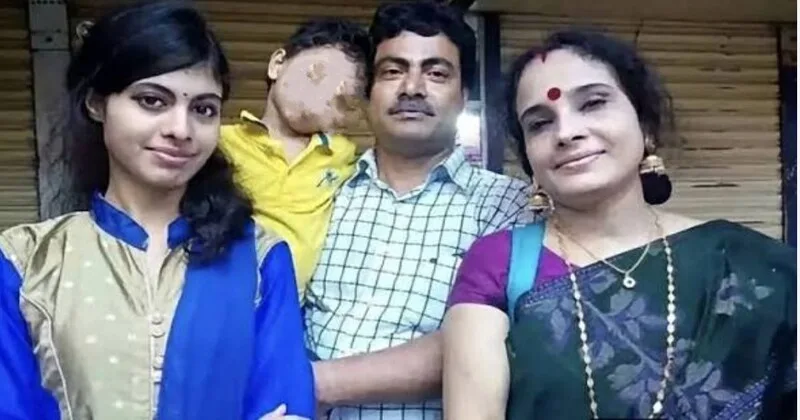
On the night of 22 August 2026, four members of a Hindu family were found brutally murdered inside their home in Machuapara, Rangpur.
The victims were retired Rangpur Zilla School teacher Ganapati Chakraborty, his wife Pritilata Chakraborty, their postgraduate daughter Agami Chakraborty, and their 12-year-old son Priyam Chakraborty. Their bodies were recovered from different parts of the house.
What followed was almost as disturbing as the murders themselves: within a very short period, police produced a complete explanation of the crime and arrested two young Hindu men from the same locality—Mugdha Das and Siddhartha Das, reportedly relatives.
The police narrative was straightforward.
The two young men allegedly went to a rooftop to consume yaba. Ganapati Chakraborty supposedly discovered them. According to the police account, the two then killed Ganapati, his wife and their two children, later ransacked the house, took gold and attempted to make the incident appear to be a robbery. (bdnews24.com)
The two accused subsequently made confessional statements before a magistrate under Section 164 of the Code of Criminal Procedure. Police said that because they had confessed, there was no need to seek remand. (bdnews24.com)
At first glance, the case appeared solved.
But it was not.
Because the more details emerged, the more questions appeared.
The Police Narrative
According to the latest police reconstruction, Siddhartha had allegedly been consuming yaba regularly. On the night of the incident, he and Mugdha reportedly consumed drugs and later moved towards Ganapati Chakraborty’s rooftop through an adjacent three-storey building. (Jagonews24)
The police claim that Ganapati discovered them.
The alleged reaction is extraordinary.
Two young men, supposedly caught consuming yaba, allegedly decided to kill the man who discovered them. Then, one by one, they allegedly killed his wife and two children.
The victims supposedly offered no meaningful resistance.
There was no sustained screaming.
No neighbour apparently intervened.
No immediate alarm was raised.
And according to the police narrative, after killing four people, the two young men remained inside the house for a considerable period.
They allegedly bathed.
They allegedly ate dates and cucumbers.
They allegedly consumed drugs again.
They allegedly searched the house.
They allegedly took gold.
They allegedly examined the gold using fire.
They allegedly damaged or displaced objects to make the crime look like a robbery.
And then they left after the dawn prayer.
This is the story the public has been asked to accept.
But a murder investigation is not a storytelling competition.
Every part of that story must be independently established by evidence.
The First Major Question: How Were Four People Killed So Quietly?
The central question remains unanswered:
How did two young men allegedly kill four people inside a family home without giving the victims sufficient opportunity to scream, resist or alert neighbours?
The police narrative requires four separate victims to be overcome by two attackers.
That does not make the story impossible.
But it makes the mechanics of the killings critically important.
Where are the signs of struggle?
What injuries did the victims sustain?
What injuries did the alleged attackers sustain?
What biological evidence exists?
What blood patterns were recovered?
Were fingerprints found?
Was DNA recovered?
Was there evidence of a struggle between the alleged perpetrators and victims?
These are not political questions.
They are elementary forensic questions.
The Burning of the Victims
An earlier Daily Star report stated that the faces of all four victims had been burned and quoted relatives who believed that a flammable substance had been used. (The Daily Star)
If this is established by forensic evidence, it fundamentally changes the nature of the investigation.
The question then becomes:
Where did the flammable substance come from?
Was it already present inside the house?
Or did the perpetrators bring it with them?
If they brought it with them, then the theory of a purely spontaneous killing becomes much harder to reconcile.
A man discovering two youths consuming yaba could potentially trigger an impulsive confrontation.
But carrying a flammable substance into a house and using it against multiple victims suggests preparation.
That distinction is critical.
More Disturbing Allegation Revealed
On August 25, a new and extremely serious allegation emerged in media coverage concerning the sexual abuse of the victims.
A report aired by Ekattor TV has reportedly raised allegations that the postgraduate daughter, Agami, was gang-raped before her murder and that the 12-year-old boy suffered genital mutilation.
If independently established, those allegations would introduce an entirely different dimension to the case.
They would fundamentally challenge the simplistic explanation that the four people were merely killed because a man discovered two youths consuming yaba.
However, this point requires particular caution.
Other reporting today has described a direct conflict over the forensic evidence. A video circulating on social media shows a morgue attendant claiming that semen was found on the bodies of Pritilata and Agami, while the forensic doctor reportedly said that sperm was not found in testing. (Ajkerpatrika)
Therefore, the sexual-violence allegation must be subjected to an independent forensic review.
If rape occurred, the evidence must establish it.
If it did not occur, that must also be established.
Either way, the truth cannot be determined by television narratives, social-media videos or police briefings.
It must be determined by forensic science.
The Second Major Question: Why Were These Two Young Men Arrested?
Mugdha Das and Siddhartha Das were arrested very quickly after the bodies were discovered.
They later gave confessional statements before a magistrate. (BSS)
But the most important question is not:
“Did they confess?”
The question is:
“What independent evidence led police to them before the confession?”
What was the first clue?
Who identified them?
What evidence placed them inside the house?
Were their fingerprints recovered?
Was their DNA recovered?
Were their clothes examined?
Were injuries found on their bodies consistent with the alleged struggle?
Were their phones located and examined?
Were their movements reconstructed through call-detail records or other digital evidence?
Was CCTV footage recovered from surrounding properties?
Was any weapon recovered?
Was the alleged flammable substance recovered?
Was the gold allegedly taken from the house recovered from them?
A confession can be an important piece of evidence.
But a confession should never become a substitute for the physical reconstruction of a quadruple murder.
The Electricity Question
The police narrative has itself changed in an important way.
The latest explanation is that the electricity was disconnected after the four murders, allegedly because Siddhartha feared that CCTV cameras might exist inside the house. Police say that while he was cutting the meter wires, a short circuit occurred and the entire house lost power. (bdnews24.com)
This raises another obvious question.
If the electricity was disconnected after the murders, then it cannot explain how the alleged attackers carried out the killings.
And if the suspects subsequently remained inside the house to bathe, eat, search for valuables and manipulate evidence, why deliberately create darkness?
The explanation may ultimately be perfectly legitimate.
But it must be established through physical evidence rather than simply accepted because it was provided by investigators.
Planned Crime or Spontaneous Crime?
This distinction is fundamental.
The police narrative suggests that the killings originated from an unexpected confrontation over yaba consumption.
But several reported elements potentially point towards preparation:
* alleged use of a flammable substance;
* multiple victims;
* alleged manipulation of the crime scene;
* alleged removal of valuables;
* alleged attempts to conceal evidence;
* alleged destruction or disabling of phones;
* and the subsequent cutting of the electricity connection.
If all of these facts are independently established, the crime would look substantially more organised than an impulsive reaction to being caught consuming drugs.
The investigation therefore needs to establish the sequence precisely.
What happened first?
What happened second?
What happened before the killings?
What happened afterward?
A timeline should be reconstructed from forensic, digital and physical evidence—not from assumptions.
The Joj Mia Question
This is where Bangladesh’s history becomes relevant.
The expression “Joj Mia” is not simply a person’s name in Bangladesh. It has become a symbol of a particular kind of investigation: the production of a convenient accused to explain a major crime before the full truth is established.
That history should make every serious investigator extremely cautious about relying on a confession as the central pillar of a case.
The question is not whether Mugdha and Siddhartha have confessed.
The question is:
Can their confessions be independently corroborated?
Can the physical evidence reproduce the sequence described in the confession?
Can the forensic evidence establish that they were present?
Can digital evidence establish their movements?
Can the alleged murder method be reconciled with the medical evidence?
Can every important detail of their statements be independently verified?
If yes, the case becomes stronger.
If not, the confession cannot reasonably be treated as the end of the investigation.
Why the Communal Dimension Cannot Be Ignored
The four victims were members of a Hindu family.
The two immediately presented as the perpetrators are also Hindu.
Some may therefore argue that the incident cannot be communal because Hindu youths have been arrested.
That reasoning is inadequate.
A communal crime does not cease to be communal merely because the first suspects presented by investigators belong to the same community as the victims.
Indeed, if the real objective of an organised attack were to conceal its communal character, presenting two local Hindu youths as drug-related killers could potentially provide a highly convenient alternative narrative.
This is why the possibility of a false-flag or scapegoating operation deserves investigation.
That does not establish that the ISI was involved.
There is currently no credible evidence establishing that the Pakistani intelligence agency directed this particular crime or the arrests.
But the allegation of an “ISI playbook” can be understood as a description of a broader alleged mechanism: a violent incident, a carefully constructed narrative, convenient suspects, rapid confessions, and a public encouraged to stop asking questions.
Whether such a mechanism exists in this case must be determined by evidence.
The Role of the Investigating and Forensic Chain
Another issue that deserves scrutiny is the institutional chain handling the case.
The original investigation was conducted by Inspector Milon Chatterjee of Kotwali Police Station. On August 25, the investigation was transferred to the Detective Branch, with Inspector Md Zinnat Ali appointed as the new Investigation Officer. DB Deputy Commissioner Sanatan Chakraborty confirmed the transfer, saying it was intended to facilitate a more intensive investigation and speedy charge sheet. (Jagonews24)
The change of investigating agency is itself significant.
It indicates that the investigation is still developing.
It also means that the new investigators should not merely inherit the original narrative.
They should independently test it.
Every piece of evidence should be re-examined.
Every statement should be cross-checked.
Every forensic conclusion should be independently verified.
And every alternative hypothesis should remain open until the evidence eliminates it.
The Forensic Contradiction Must Be Resolved
The conflicting accounts surrounding alleged sexual violence are particularly important.
On one side, media reporting has raised allegations of sexual violence and genital mutilation.
On the other side, the forensic account publicly attributed to the post-mortem examination has reportedly not established rape, and testing reportedly did not find sperm despite a morgue attendant’s claim. (Ajkerpatrika)
This is not a minor discrepancy.
It is a central forensic question.
If rape occurred, where is the forensic evidence?
If it did not occur, why did such allegations emerge?
Was the original post-mortem conducted adequately?
Were samples properly collected?
Were samples preserved?
Were laboratory tests comprehensive?
Was the chain of custody maintained?
Was a second independent forensic examination conducted?
A case involving four deaths, alleged burning, possible sexual violence and alleged mutilation cannot depend upon contradictory verbal accounts.
It requires an independent forensic audit.
What Must Be Investigated?
A genuinely independent investigation should establish at least the following:
1. The exact timeline of the murders.
2. The exact mechanism of death of each victim.
3. The sequence in which each victim was attacked.
4. Whether there were signs of struggle.
5. Whether the victims were restrained.
6. Whether the alleged perpetrators suffered injuries.
7. The source and nature of any flammable substance.
8. Whether the victims were sexually assaulted.
9. Whether genital mutilation occurred.
10. The complete post-mortem findings.
11. Independent re-examination of forensic samples.
12. DNA evidence from the crime scene.
13. Fingerprint evidence.
14. Blood and tissue evidence.
15. CCTV footage from surrounding properties.
16. Mobile-phone and call-detail records.
17. Location data of the accused and victims.
18. The exact time and sequence of the electricity disconnection.
19. The alleged robbery and recovery of gold.
20. Any evidence showing that the accused actually possessed the stolen property.
21. The source of the alleged yaba.
22. The identity of any alleged drug supplier.
23. The identity of every person who knew the family’s movements.
24. Any previous threats against the family.
25. Any property, financial or political motive.
26. Any communal motive.
27. Whether more than two perpetrators were involved.
28. Whether the alleged confessions were independently corroborated.
29. Whether the confessions contain verifiable details unknown to investigators beforehand.
30. Whether the original police narrative is consistent with the totality of the forensic evidence.
The Two Young Men Must Not Become the Investigation
There is a fundamental difference between investigating two suspects and building the entire investigation around two suspects.
Mugdha Das and Siddhartha Das may ultimately prove to be guilty.
If they are guilty, they must face the full force of the law.
But if they are innocent, then producing them as convenient culprits would create a second injustice on top of the murder of four innocent people.
And if the murders were part of a larger organised communal operation, then prematurely closing the case around two local youths would effectively protect the real perpetrators.
That is why the question is not whether the accused are Hindu.
The question is whether the evidence establishes their guilt.
The Real Communal Question
The most dangerous outcome would be to allow the murder of a Hindu family to disappear into a convenient story about two yaba users.
The second most dangerous outcome would be to declare a communal conspiracy without evidence.
Both are failures of justice.
The first protects the real perpetrators.
The second manufactures hatred.
Therefore, the communal dimension must be investigated seriously, not emotionally.
Investigators should examine whether the victims had received threats because of their religious identity.
Whether there were previous attempts to intimidate them.
Whether anyone had targeted their home.
Whether any extremist group had motive.
Whether there was organised surveillance.
Whether there were additional perpetrators.
Whether the crime scene was deliberately manipulated to create a non-communal explanation.
And whether the two arrested youths were selected as convenient scapegoats.
The Lesson of “Joj Mia”
Bangladesh has already experienced the consequences of an investigation in which a convenient suspect became more important than the truth.
That is why the phrase “Joj Mia” still resonates.
It represents a warning:
Do not manufacture certainty before establishing evidence.
A confession does not automatically make a narrative true.
A police briefing does not automatically make a narrative true.
A television report does not automatically make a narrative true.
A communal allegation does not automatically make a narrative true.
Only evidence can do that.
Conclusion
The Rangpur killings are not merely a criminal case.
They are a test of Bangladesh’s ability to conduct an investigation without political pressure, communal bias or the need to produce a convenient culprit.
Four members of a Hindu family are dead.
Their deaths demand the truth.
If Mugdha Das and Siddhartha Das committed the murders, the evidence must establish it beyond reasonable doubt.
If they did not, they must not be sacrificed to create a convenient narrative.
If the murders were communal, the perpetrators must be exposed.
If the murders were not communal, that too must be established through evidence.
If the allegations of rape, gang rape or genital mutilation are true, the forensic record must establish them.
If those allegations are false, the public deserves to know why such claims emerged.
And if the police narrative is correct, every part of it should survive independent forensic scrutiny.
But there must be no predetermined conclusion.
There must be no manufactured scapegoat.
There must be no politically convenient confession.
There must be no communal cover-up.
And there must be no communal witch-hunt either.
The country needs an investigation that can withstand scrutiny from both sides.
Investigate the crime. Investigate the evidence. Investigate the investigators. Investigate the communal motive. Investigate every alternative motive. Verify every confession. Re-examine every forensic finding.
Because the four victims cannot speak anymore.
The evidence must speak for them.
**Bangladesh does not need another Joj Mia.
Bangladesh needs the truth.**