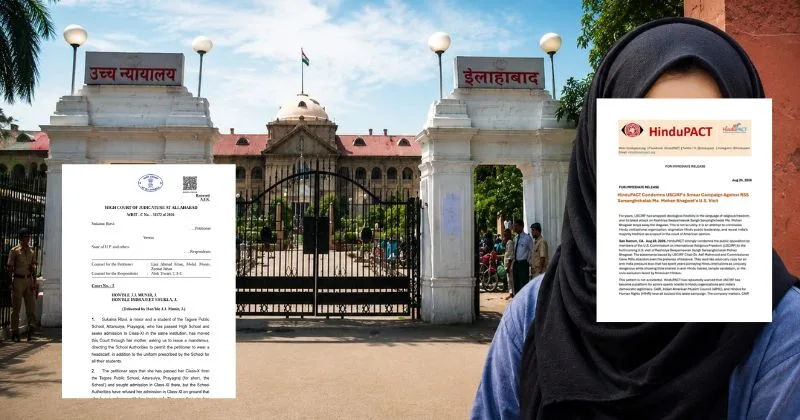
The constitutional, religious and educational debate surrounding the ‘hijab’ in the country has once again reached the doors of the court. The Allahabad High Court dismissed a petition filed by a minor Muslim student from Prayagraj, in which she had sought permission to wear a headscarf along with the prescribed school uniform. The court said that the petitioner had failed to present sufficient material to establish that wearing the hijab is an essential religious practice in Islam, without which the fundamental character of religious faith would be affected.
The court also made it clear that if an educational institution’s dress policy is uniform, genuine, non-discriminatory and framed with the objective of maintaining discipline and institutional identity, a demand to alter the prescribed uniform cannot be accepted as a right.
In fact, the matter came before a Division Bench comprising Justice J.J. Munir and Justice Indrajit Shukla on behalf of a student named Sukaina Rizvi. Sukaina, who studies at Tagore Public School in Attarsuiya, Prayagraj, had completed her Class 10 studies and applied for admission to Class 11. Through her mother, she filed a petition before the High Court seeking permission to wear a headscarf along with the school’s prescribed uniform.
Click here to download the Allahabad High Court Judgement
The petition stated that the student had studied at the same school from Class 6 to Class 10 and had continued to wear the hijab during this period. According to her, the school had not previously objected to it. The situation changed when she sought admission to Class 11, leading to a dispute over her demand to wear the school uniform with the hijab. On behalf of the petitioner, it was argued that wearing a headscarf was an essential religious practice of her faith. Preventing her from doing so would violate the fundamental rights guaranteed under Articles 14 and 19(1)(a) of the Constitution.
The school opposed this claim. Describing itself as a private, unaided, co-educational institution affiliated with the CBSE, the school said that a uniform dress code applied to all students. The school administration stated that other female students from the same religious community were also following the prescribed dress code. Granting an individual exemption to one student could affect the school’s administrative arrangements and discipline.
The State also informed the court that prescribing the school uniform was essentially a matter of the institution’s administrative policy. The purpose of the dress code was to maintain uniformity, discipline and institutional identity among students.
Previous Permission Does Not Create a Permanent Right
The court also did not accept the student’s argument that since she had worn the hijab in previous classes, she had acquired a right to continue wearing it. The Bench said that it was possible that the school had not objected to the headscarf in earlier classes for some reason. This could have been due to the uniform policy not being enforced strictly, administrative inaction, courtesy or some other circumstance. This did not prevent the school from enforcing its dress policy in the future.
According to the court, if a policy had not previously been enforced strictly, that did not create a permanent right in favour of a student on the basis of which the institution could be compelled to continue the same arrangement in future.
The School Had Not Changed the Uniform; the Demand Was to Add an Additional Garment
In the case, the court highlighted an important distinction. The school had not made any new alteration to its prescribed uniform. The dispute concerned the student’s wish to wear a headscarf along with the existing uniform. The Bench said that where a dress code is uniform, genuine, non-discriminatory and intended to maintain discipline and institutional identity, the choice of the prescribed uniform primarily falls within the authority of the school.
Behind this approach, the court also explained the broader purpose of a uniform. According to it, a common dress creates a sense of equality among students, strengthens the identity of the institution, assists in maintaining discipline and reduces the possibility of discrimination on different grounds within the classroom.
The Argument for a Religion-Neutral Environment
The Bench said that applying a uniform dress code to students belonging to different religions promotes a religion-neutral environment in the school. Under such an arrangement, there is no need to create different dress-related rules on the basis of students’ religious identities. The fundamental question before the court was also whether, on the basis of the right to religious freedom, a student could demand clothing different from the uniform prescribed by the institution. The Bench answered this question in the context of the school’s uniform dress policy and its purpose.
The court said that allowing an individual student to depart from the prescribed uniform on a subjective basis could itself weaken the concept of a uniform. It could create a situation in which the authority to determine discipline shifted from the institution to individual students.
Petitioner Failed to Establish Hijab as an Essential Religious Practice
The most significant aspect of the case concerned the religious character of the hijab. The petitioner claimed that wearing a headscarf was an essential religious practice in Islam. The Bench did not find sufficient material in support of this claim. According to the court, the petitioner had not presented sufficient arguments or authoritative religious literature to establish that wearing a headscarf inside the classroom was mandatory for her or that failure to observe it would alter the fundamental character of her religion.
The court treated this claim as merely an assertion in the absence of sufficient evidence. This aspect took the matter beyond a mere dispute concerning the school’s dress policy and connected it with the constitutional test of religious freedom and essential religious practice.
Judgements of Other High Courts Also Considered
The Allahabad High Court considered judgements delivered by various High Courts across the country on this subject. The Bench said that wherever this question had arisen, the view of the High Courts had been that wearing a headscarf by women was not such an essential religious practice of Islamic faith that its absence would place religious faith in jeopardy.
The Bench also referred to the Kerala High Court’s decision in Fatima Tasneem (Minor) v. State of Kerala and the Bombay High Court’s decision in Fatima Hussain Syed v. Bharat Education Society. In both cases, questions relating to demands to wear a headscarf along with the prescribed school uniform had arisen. Alongside these decisions, the court also examined in detail the judgement delivered by the Full Bench of the Karnataka High Court in Resham v. State of Karnataka.
2022 Karnataka Judgement Described as Important
In 2022, the Full Bench of the Karnataka High Court, while deciding the hijab controversy, held that wearing the hijab by Muslim women was not an essential religious practice in Islam. The Allahabad High Court regarded this judgement as highly valuable persuasive authority. The Bench made it clear that it saw no reason to adopt a position different from the approach taken by the Karnataka Full Bench. This observation is significant because the Supreme Court has also heard a matter relating to the same question in the hijab controversy, and the position there has not been finally settled in its entirety.
Split Verdict Had Been Delivered in the Supreme Court
The Allahabad High Court specifically underlined that no authoritative judgement of the Supreme Court finally resolving the question of whether the hijab should be regarded as an essential religious practice has yet emerged. The Supreme Court subsequently considered the Karnataka High Court’s judgement in Aishat Shifa (Hijab Case-2 J.) v. State of Karnataka. There, a split verdict was delivered because of a difference of opinion between the judges.
The Allahabad High Court said that in such a situation, the matter would need to be placed before the Chief Justice for the constitution of an appropriate Bench. Consequently, a final and decisive position from the Supreme Court on this question is still awaited. Nevertheless, the Allahabad High Court said that in such circumstances, the judgement of the Karnataka High Court’s Full Bench constitutes highly valuable persuasive authority for it, and there is no sufficient basis for adopting a different view.
Interim Order Not Regarded as Binding Precedent
The Bench also referred to the 2024 Bombay High Court case of Zainab Abdul Qayum Chaudhary and Others v. N.G. Acharya and D.K. Marathe College and Others. In that case, the Supreme Court had, through an interim order, stayed a provision prohibiting the hijab, caps or badges. The Allahabad High Court clarified that an interim order issued without giving reasons does not constitute a binding precedent and is temporary in nature.
According to the Bench, consistent and reasoned judicial views emerging from various High Courts across the country may be given due importance, even though they are not binding and operate as persuasive authority.
Photographs Also Presented a Different Picture Before the Court
During the hearing of the case, the court also took note of photographs placed on record. The Bench observed that, apart from the petitioner, no other female student, including those belonging to the same religious community, appeared to be wearing a headscarf. It was also important to the court that the school had a uniform dress code and that other students were following it. In such circumstances, the question of allowing a single student to wear different clothing on religious grounds became linked to the wider institutional arrangement.
Court’s Clear Observation on the Concept of Uniform
The Bench said that if every student were allowed to depart from the prescribed uniform on the basis of personal preference or individual interpretation, the very purpose of a uniform would be weakened. According to the court, the purpose of uniforms in schools is not merely to give students a common appearance. Broader objectives are also associated with them, including discipline, equality, institutional identity and reducing discrimination among students.
From this perspective, the court raised the question of balancing an individual religious claim with the institution’s uniform dress policy and said that a uniformly applicable, non-discriminatory dress policy cannot be directed to be changed merely on the basis of individual preference.
Petition Ultimately Dismissed
After considering the arguments of all parties, previous judicial decisions and the claims relating to religious practice, the Allahabad High Court dismissed Sukaina Rizvi’s petition. The judgement presents the court’s approach on two levels. First, students may be expected to comply with a uniform and non-discriminatory dress policy of a school when its purpose is to maintain discipline and institutional identity. Second, sufficient religious and legal material must be presented to establish the hijab as an essential religious practice. (Case: Sukaina Rizvi v. State of Uttar Pradesh and Others-2026).