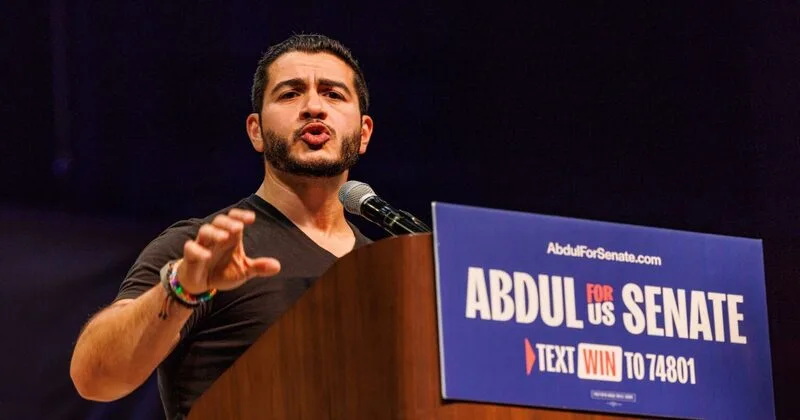
As New York grapples with the election of Zohran Kwame Mamdani as its first Muslim mayor, concerns over Muslim attacks and the fear of Islamist violence have also become part of the wider public debate in the city. Against this backdrop, another Muslim politician is emerging on the national political stage in Michigan. Abdul El-Sayed, a self-described Muslim socialist of Egyptian heritage, is the Democratic nominee for the United States Senate and is seeking to become the first Muslim ever elected to the chamber. His candidacy has brought renewed attention to his religious background, Egyptian lineage, political positions, past statements and record in public office.
Abdul El-Sayed is a 41-year-old physician and former Detroit and Wayne County public health official who became the Democratic nominee for the United States Senate in Michigan after defeating Haley Stevens in the August 2026 Democratic primary. He will face Republican Mike Rogers in the November general election in a contest that could influence control of the Senate. El-Sayed has campaigned on Medicare for All, economic policy and reducing the influence of money in politics.
His candidacy also has a historical dimension because, if elected, El-Sayed would become the first Muslim ever to serve in the United States Senate. No Muslim has previously been elected to the Senate, meaning the Michigan election could result in the first Muslim representation in the chamber. El-Sayed has also referred to the historical significance of his candidacy and has said that he wants voters to assess him based on the work he would carry out for Michigan.
Trump and Vance turn their fire on El-Sayed
President Donald Trump was among the first prominent Republicans to attack Abdul El-Sayed after his Democratic primary victory in Michigan. On August 5, 2026, Trump called El-Sayed a “communist loser” and criticised his political positions. On August 21, 2026, Trump again targeted him, calling him a “communist fanatic” and claiming that El-Sayed’s mother had financed Osama bin Laden. The remarks referred to El-Sayed’s mother, Fatten Elkomy. However, El-Sayed has rejected Trump’s criticism and responded publicly to the attacks.
Trump on El-Sayed: He recently campaigned with a communist fanatic who says that America deserved 9/11 pic.twitter.com/bXrqEaQTjP
— Acyn (@Acyn) August 21, 2026
Vice President JD Vance subsequently joined the criticism. On August 5, 2026, speaking at a White House event in Washington after El-Sayed’s primary victory, Vance warned about the possibility of “President El-Sayed” in the future, saying, “God forbid you’re going to have President El-Sayed in a few years.” Vance also criticised El-Sayed over his previous comments concerning Sharia law and portrayed his candidacy as evidence of changes within the Democratic Party.
El-Sayed’s Sharia views and controversial statements on Israel
He has been criticised for a number of past statements concerning Sharia and Islamist political issues. In a 2009 interview with The New York Times, while discussing the purchase of his first home, El-Sayed said he considered himself religiously obligated to follow Sharia-compliant practices, saying he did not want to choose “the easy way” over the “Shariah-compliant way” and that this was a matter of religious obligation.
In October 2022, in Oklahoma, while speaking as the keynote speaker at a Council on American-Islamic Relations event, he criticised Oklahoma’s 2010 State Question 755, which sought to prohibit courts from considering Sharia law. El-Sayed said that the Sharia ban could not be understood without understanding the Trail of Tears, and connected the political forces behind it with white supremacy, Jim Crow and the Tulsa massacre. These remarks were later cited by JD Vance in his criticism of El-Sayed.
He has also faced criticism for his statements on Israel. On April 19, 2026, during an appearance on CNN’s Inside Politics, El-Sayed said Israel was “just as evil”, and calling Israeli Prime Minister Benjamin Netanyahu a war criminal. On July 12, 2026, he described Israel as a “rogue state” and said that it had committed genocide and practiced apartheid. His positions and associations have subsequently been used by Republican critics to portray him as sympathetic to Islamist politics. He has also spoken at CAIR events and received campaign support from people associated with the organisation.
El-Sayed’s mother, IARA and the terror-financing investigation
When Abdul El-Sayed speaks about his mother, Fatten Elkomy, one part of her professional history stands out. Her work with the Islamic American Relief Agency, or IARA-USA, an organisation that became the subject of a major federal investigation over its financial activities and links to terrorist organisations.
In 2004, FBI agents executed federal search warrants at IARA’s Columbia, Missouri, office on Cherry Street. Agents arrived shortly after 2 p.m. and removed boxes, computers and file cabinets from the building. Law-enforcement officials also changed the locks on three storage units at Columbia Storage on Hickory Street. At the time, Treasury Secretary John Snow stated that the international offices of IARA were providing direct financial support to Usama bin Laden, al-Qaeda, Hamas and other terrorist groups.
Fatten Elkomy, El-Sayed’s mother, had worked in programming for IARA-USA since 1999 and was interviewed by federal agents during the investigation. Speaking to the media, she described her work as humanitarian and said she was helping orphans and children who had lost at least one parent.
She rejected terrorist associations with the agency and said it broke her heart that the children would no longer receive assistance. Yet federal records placed Elkomy’s name among the exhibits in the case. Government Exhibit 349 concerns a $20,772.88 transaction involving Elkomy and IARA official Khalid Al-Sudani.
Abdul El Sayed faces explosive scrutiny over alleged Islamist connections campaign donations and past comments on Sharia law as critics demand answers about who is funding and influencing a candidate seeking a seat in the United States Senate#NYI pic.twitter.com/TbyDFtWvRm
— NewYork-Insight (@NewYork_Insight) August 23, 2026
Al-Sudani was subsequently designated by the U.S. government as a Specially Designated Global Terrorist. Elkomy’s name also appears in transfers and correspondence concerning funds moving to Iraq and the Palestinian territories, areas described in the material as terrorist conflict zones.
The connection raises a broader question about the network surrounding IARA and the Elkomy family. Elkomy’s brother, Mohamed or Mohammed Elkomy, who was Abdul El-Sayed’s uncle, was identified in 19 government exhibits involving telephone conversations between donors, IARA officials and other individuals. The issue therefore extends beyond a single financial document to a wider collection of federal exhibits involving IARA’s operations, donors, officials, transfers and communications.
El-Sayed’s animal control record and Sharia compliance
Abdul El-Sayed presents himself to voters as a doctor committed to public service and healthcare for all, but his record as Detroit’s Health Department chief puts a far more troubling episode under scrutiny.
From 2015 to 2017, socialist Muslim Senate candidate from Michigan Abdul El-Sayed served as executive director and health officer of the Detroit Health Department, placing Detroit’s Animal Control operation under his authority. El-Sayed has boasted that he “rebuilt the animal control system,” but his tenure left behind a record that critics describe as a disturbing trail of destruction.
According to the reports, nearly 4,680 dogs and cats were euthanised by Detroit Animal Care and Control during the period El-Sayed headed the Health Department, with dogs accounting for the overwhelming majority. In 2015, DACC euthanised 1,988 dogs and 272 cats, a total of 2,260 animals. The 1,988 dogs represented 26.4 percent of all dogs euthanised in the county that year, according to the Michigan Department of Agriculture and Rural Development’s Animal Shelter Annual Report.
In 2016, another 1,056 dogs and 29 cats were euthanised. Critics therefore question what lies behind El-Sayed’s record and whether his personal religious outlook and the principles he says he follows should be examined alongside what happened to thousands of animals under his administration. The question becomes particularly pointed because El-Sayed himself has spoken about the importance of following Sharia. In March 2009, he said, “Ultimately, the question is, when I die and I stand before God and go through everything I did in my life, I don’t want to say I did it the easy way instead of the Shariah-compliant way.”
Critics have connected that declaration to Islamic traditions concerning dogs and have questioned whether El-Sayed’s stated commitment to a Sharia-compliant life is relevant to understanding his record.
Sahih Muslim 3811 contains a narration describing an order to kill dogs, with an early Muslim recounting that men were sent through Medina and its surrounding areas and that dogs were killed, including a dog accompanying a camel belonging to desert people. Sahih Bukhari 4.54.50 contains another narration in which Gabriel says that angels do not enter a house containing a picture or a dog.
Critics cite these traditions when discussing the treatment of dogs in Islamic tradition and the meaning of Sharia compliance. They argue that El-Sayed’s own statement about wanting to live according to the Shariah-compliant way should therefore be considered alongside the large number of dogs euthanised while he was responsible for Detroit’s Animal Control operation.
The issue is not simply the ethical treatment of animals, critics contend. It is also about the principles that a candidate says guide his life and the question of whether those principles have any bearing on his record in public office. El-Sayed’s claim that he rebuilt the system thus stands against the stark figures of 1,988 dogs euthanised in 2015 and another 1,056 dogs in 2016, as well as the nearly 4,680 dogs and cats euthanised during his tenure.
Taken together, El-Sayed’s Senate candidacy brings renewed scrutiny of his political positions, his statements on Sharia, his family’s links to IARA, and his record overseeing Detroit Animal Care and Control. His possible election would mark a first for Muslim representation in the Senate, while the controversies surrounding his views, background and public record are likely to remain central to the debate over his candidacy.