
When a political party chooses to sing only a truncated version of the National Song because a section once objected to its civilisational imagery, the question is not merely about protocol. It is about whether the politics of appeasement is once again being placed above the cultural memory of Bharat’s freedom struggle.
The latest controversy over Vande Mataram is therefore much larger than a dispute over two stanzas.
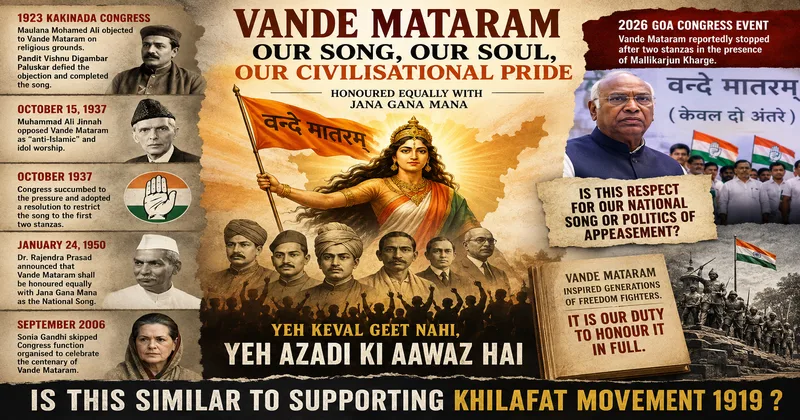
At a Congress event in Goa attended by party president Mallikarjun Kharge, party workers reportedly sang only the first two stanzas of Vande Mataram. The episode came soon after the Congress Working Committee reaffirmed its 1937 position that only the first two stanzas would be sung at party functions.
Union Home Minister Amit Shah has described the decision as an expression of the Congress’s “extreme policy of appeasement” and argued that the historical truncation of the song was an insult to Bankim Chandra Chattopadhyay and the freedom fighters who drew inspiration from it. Congress may call this a reaffirmation of a historical resolution. But history itself raises an uncomfortable question:
Is this similar to supporting the Khilafat movement in 1919—when the Congress leadership allowed a particular religious-political demand to become part of the larger nationalist strategy in the hope of securing political unity?
The comparison is not exact. The two episodes belong to very different circumstances. But the underlying political habit deserves examination: Should national unity be built by asking the majority to repeatedly surrender elements of its civilisational expression, or by creating a common national identity in which every citizen participates without veto?
Vande Mataram: From a poem to a national awakening
To understand the present controversy, one must first understand what Vande Mataram meant to the freedom movement.
Bankim Chandra Chattopadhyay’s composition became far more than a literary work. It emerged as one of the most powerful cultural expressions of resistance to British rule. Rabindranath Tagore sang it at the 1896 session of the Indian National Congress, and during the Swadeshi movement following the Partition of Bengal in 1905, Vande Mataram became a rallying cry of national awakening.
Its words transformed the abstract idea of the nation into an emotional relationship with the motherland.
That is why the song travelled beyond political meetings. Revolutionaries carried it to the gallows. Madan Lal Dhingra reportedly uttered “Bande Mataram” before his execution in London in 1909. Madam Bhikaji Cama incorporated the words into the flag she displayed abroad in 1907.
For generations of freedom fighters, therefore, Vande Mataram was not a partisan slogan. It was an invocation of the motherland. To reduce it to a question of whether a particular religious community is comfortable with some of its imagery is to erase this historical context.
1923: Paluskar versus the politics of religious veto
The Congress itself witnessed this tension much before Independence. At the 1923 Kakinada session of the Congress, Maulana Mohammad Ali Jauhar, who was presiding over the session, objected to the singing of Vande Mataram on religious grounds. Pandit Vishnu Digambar Paluskar refused to accept the objection.
Paluskar’s response was profoundly significant. He essentially reminded the gathering that this was a national political platform, not a religious institution. He proceeded to sing the song and completed the rendition. Contemporary accounts of the episode describe his defiance as an assertion that a national forum could not be governed by the religious restrictions of one community.
That moment deserves to be remembered today. Because the question is not whether every citizen must share the same theological interpretation of Vande Mataram. The question is whether a national symbol can be subjected to a religious veto.
1919 and the Khilafat question
This brings us to the proposed comparison with 1919.
The Khilafat movement was fundamentally concerned with the fate of the Ottoman Caliphate after the First World War. Mahatma Gandhi chose to support the Khilafat cause as a means of bringing Muslim political mobilisation into the Non-Cooperation movement and strengthening Hindu-Muslim unity against British rule. Scholarly accounts describe the resulting Khilafat–Non-Cooperation alliance as an unprecedented episode of mass Hindu-Muslim cooperation, but also note that the Khilafat movement was ultimately undermined by developments in Turkey itself, including the abolition of the Ottoman Caliphate.
The historical lesson is complicated.
Gandhi’s intention was political unity against colonial rule. But the episode demonstrated the danger of making a religiously defined political demand part of the architecture of national politics. The question for the present is therefore not whether Congress today is literally supporting the Khilafat movement. It obviously is not. The question is whether the political psychology of appeasement remains.
If a political organisation modifies or restricts a national-cultural expression primarily because a religious constituency objects to its imagery, one has to ask: Where does accommodation end and appeasement begin?
1937: When Jinnah’s objection became Congress’s problem
The 1937 episode is even more directly relevant. Muhammad Ali Jinnah and the Muslim League objected to the later portions of Vande Mataram, particularly because of their religious imagery. At the Muslim League’s Lucknow session on October 15, 1937, Jinnah articulated the League’s broader political confrontation with Congress.
The Congress subsequently accepted the position that only the first two stanzas should be used at public political gatherings. There is an important historical nuance here.
It is simplistic to say that Congress simply “obeyed Jinnah.” The 1937 decision also reflected the views of figures within Congress who believed that the later verses could create discomfort among Muslims, and Rabindranath Tagore’s views were part of the contemporary discussion. The Congress’s decision was therefore a political compromise emerging from a larger debate about national unity. But compromises also create precedents.
The deeper problem was that a song that had already become an emblem of the freedom struggle was now being defined partly through the objections raised against its civilisational vocabulary.
Prime Minister Narendra Modi, while addressing Parliament during the special discussion on 150 years of Vande Mataram, drew attention to this historical sequence. He noted Jinnah’s opposition in Lucknow on October 15, 1937, and referred to Jawaharlal Nehru’s October 20 letter to Subhas Chandra Bose in which Nehru expressed concern that the Anandamath background of the song could provoke Muslims.
This is precisely where the contemporary Congress position becomes historically significant.
In 2026, the Congress is not merely following an old musical convention. It is consciously reviving a decision made in an era when communal politics was intensifying and the Muslim League was increasingly asserting a separate political identity.
And then came Partition
One must be careful not to make a simplistic causal claim that the 1937 Vande Mataram decision “caused” Partition. Partition resulted from a complex accumulation of political, communal, constitutional and geopolitical factors.
Yet Amit Shah’s larger argument deserves examination: repeated political concessions made in the name of communal accommodation can sometimes strengthen the very logic of communal separatism that they were intended to contain.
The history of the 1930s demonstrates that the Muslim League increasingly moved from demands for safeguards to a politics of separate political identity. The tragedy of Partition was that the politics of appeasement did not ultimately produce permanent communal harmony.
It produced competing nationalisms. That is the historical warning.
1950: The Republic restored the balance
The story, however, did not end in 1937. On January 24, 1950, Dr Rajendra Prasad, presiding over the Constituent Assembly, made the historic declaration that Jana Gana Mana would be the National Anthem, while Vande Mataram, because of its historic role in the freedom struggle, would be “honoured equally” and have “equal status” with it.
This is crucial. Independent Bharat did not treat Vande Mataram as an embarrassing remnant of a communal past. The Republic recognised its historical contribution.
The Constituent Assembly did not say that the National Song should remain permanently imprisoned within the political compromises of 1937. It gave Vande Mataram an honoured place in national life. That is why the present Congress decision deserves scrutiny.
If the Republic accorded Vande Mataram equal status with the National Anthem in national life, why should a political party voluntarily continue to operate according to a compromise made in the charged communal circumstances of 1937?
2006: The controversy never really disappeared
This is not the first time the Congress has faced questions over its relationship with Vande Mataram.
During the UPA era, the centenary of the National Song became controversial in 2006. Congress president Sonia Gandhi did not attend a Congress function organised to mark the centenary. Contemporary reports noted that the BJP attacked her absence, while Congress defended it by saying she had other commitments.
The controversy also involved the government’s decision to make singing of the song optional following protests. There is an important distinction here: absence from one function does not by itself establish disrespect. Nor should every disagreement over the manner of singing Vande Mataram be converted into a test of patriotism.
But when the 2006 episode is placed alongside the 1937 legacy and the Congress’s 2026 reaffirmation, a political pattern becomes difficult to ignore.
The real issue: Who gets to define the nation?
The BJP’s criticism is therefore not merely about whether Congress workers sing two stanzas or five. The deeper issue is ideological.
Does Bharat’s national identity have to be continually negotiated through the sensitivities of religious identity? Or can Bharat define its national symbols through its own civilisational history while simultaneously assuring every citizen equal dignity and constitutional rights? The BJP and RSS tradition has long argued for the latter.
There is nothing inherently anti-minority about asking every citizen to respect a national symbol. Equally, there is nothing inherently secular about repeatedly modifying national-cultural expressions to avoid offending a particular religious constituency.
True secularism cannot mean that the majority’s civilisational vocabulary must constantly be diluted. Nor does genuine nationalism require hatred of any community. The appropriate principle is simpler: the nation comes first, and every community participates in that national identity as an equal stakeholder.
The Paluskar lesson for the Congress of today
Perhaps the most powerful irony is that the answer already exists in Congress’s own history. In 1923, Vishnu Digambar Paluskar refused to allow a national political platform to become subject to a religious veto.
In 1937, Congress chose accommodation. In 1950, the Republic restored Vande Mataram to a position of equal national honour. And in 2026, Congress has chosen to return to the 1937 formula. That should provoke a larger national debate.
Is this merely historical continuity—or the return of an old political instinct? The question becomes even more relevant when viewed against the Khilafat experience. In 1919, Congress sought political unity by supporting a religiously defined movement.
In 1937, it accommodated objections to a national song in the name of communal harmony. In 2026, it is once again defending a historical restriction whose roots lie in the politics of communal accommodation.
The contexts are different. The political logic, however, merits examination. Vande Mataram is not about Hindu versus Muslim. The final point must be emphatic. Vande Mataram is not a declaration that Bharat belongs to one religious community. It is an expression of reverence for the motherland.
A Muslim, Christian, Sikh, Buddhist, Jain or Hindu citizen may interpret the imagery differently. But the national meaning of the song arises from its place in the freedom struggle and from the sacrifices of generations who transformed the words into a cry of resistance against colonial rule.
The correct response to disagreement should therefore be dialogue—not historical amnesia. Bharat’s national identity cannot be permanently constructed through vetoes. Nor can the sacrifices of freedom fighters be selectively remembered.
The Congress has every constitutional right to decide what it sings at its party functions. But when that decision consciously revives the political compromise of 1937, it also invites a legitimate historical question:
Have we really moved beyond the politics of appeasement that repeatedly asked Bharat to negotiate its civilisational self-expression—or are we witnessing its return in a new political form?
And ultimately, there is an even more uncomfortable question for the Congress: If Vishnu Digambar Paluskar could stand up in 1923 and say, in effect, that a national forum cannot be governed by the religious restrictions of one community, why should the Congress of 2026 choose the opposite lesson?
Vande Mataram survived colonial repression, political controversy, Partition and the compromises of history. It does not need the permission of any political party to remain what it has always been: the voice of a civilisation saluting its motherland.