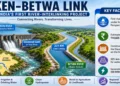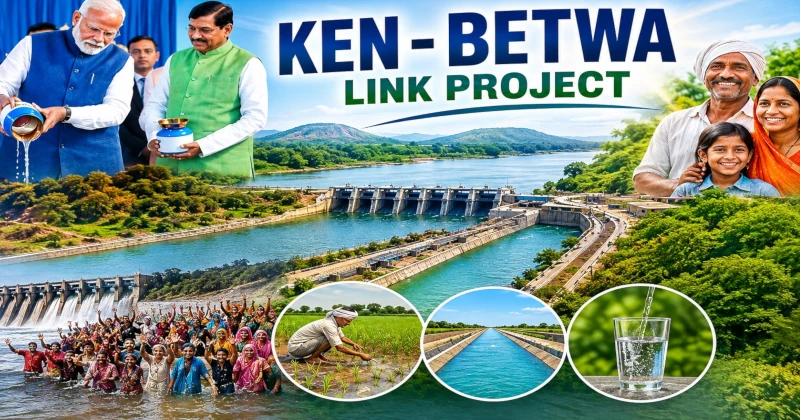
Bundelkhand is a region of India that has endured drought, erratic rainfall, limited irrigation and groundwater crises for years. The Ken-Betwa Link Project is now moving forward with the hope of bringing about a major transformation. With an estimated cost of approximately Rs 44,605 crore, the project aims to provide irrigation to 1.062 million hectares, drinking water to around 62 million people, 103 MW of hydropower and 27 MW of solar power, and has the potential to transform Bundelkhand’s socio-economic life.
However, a new picture is emerging around the project. The entire Opposition has united to sacrifice it at the altar of politics. Without any study, several left-wing organisations have also become active. In these circumstances, viewing the “Ken-Betwa Link Project” through the lens of political allegations and counter-allegations would limit its broader public interest. Yes, every question relating to displacement, rehabilitation, the environment and local rights must be answered with transparency and sensitivity. This is precisely what is being done at the level of governance.
To understand the need for the Ken-Betwa Link Project, one must first understand the geographical and social realities of Bundelkhand. For a long time, the region has struggled with low and erratic rainfall, limited irrigation facilities and groundwater shortages in several areas. Because much of agriculture still depends on rainfall, farmers become helpless in the face of weather uncertainty. In such circumstances, a permanent and relatively reliable water supply can transform the entire structure of the rural economy. This is precisely why the Ken-Betwa Project was conceived.
Its fundamental objective is to carry water from the Ken River to the Betwa River region. It includes works such as the 96.7-metre-high Daudhan Dam in Panna and Chhatarpur, the Lower Orr Project including a 216.465-kilometre-long link canal, the Kotha Barrage and the Bina Complex Multipurpose Project. The foundation stone was laid on 25 December 2024, and the project is targeted for completion by 2030.
Let Facts Not Be Lost Amid the Political Noise
A political controversy has recently emerged over displacement and rehabilitation issues related to the project. According to available administrative figures, the population affected by the four related projects is around 23,000, whereas political claims have put the figure at approximately 50,000. The Ken-Betwa Project will affect 22 villages in Panna and Chhatarpur. Awards amounting to approximately Rs 629.87 crore have been passed for 5,039 affected families associated with the project, of which around Rs 604.745 crore, or approximately 96 per cent, has already been paid. This means that the government is continuously working towards rehabilitation.
Under the project’s special rehabilitation package, the government has provided Rs 12.50 lakh per family. Plots of land and facilities such as electricity and water are being arranged in rehabilitation colonies for affected families. The government has provided Rs 7 lakh for a plot in rural areas and Rs 6.50 lakh in urban areas, and eligible families can also opt for a one-time payment of Rs 12.50 lakh instead of a plot.
In this context, the decision to conduct a fresh survey of the affected villages is significant. According to available information, instructions have been issued to re-survey the 14 affected villages in Chhatarpur, and an additional Rs 7.37 crore has been approved for 59 people from five villages. The payment process is also being advanced for 313 beneficiaries so that eligible adults who have completed 18 years of age can receive the benefits. These steps convey that the development project is moving forward with continuous review of the rights of affected people. If any family feels its name has been left out or that it has not received adequate compensation, a grievance and re-examination process remains open.
Concern for the Environment Is Equally Important
One of the major questions surrounding the Ken-Betwa Project concerns the Panna Tiger Reserve and forest areas. Balancing development and the environment is not easy. Large projects can have an environmental impact, but human needs must also be met. The government has said the project has received the necessary environmental, wildlife, tribal affairs, and forest-related clearances.
The government has made provisions for an Environmental Management Plan, compensatory afforestation, wildlife conservation, habitat development, catchment-area improvement, and an Integrated Landscape Management Plan for the Greater Panna Landscape. The Wildlife Institute of India has prepared a comprehensive plan for Panna Tiger Reserve and the surrounding area. Therefore, environmental questions should take precedence over politics of opposition or support, based on scientific monitoring and public accountability.
The Possibility of Transforming Farmers’ Lives
The project’s greatest social impact will be visible in the fields. Better irrigation availability will reduce dependence on rainfall. Farmers will be able to sow their crops on time, and the possibility of taking more than one crop will increase. Along with higher productivity, opportunities may also emerge to shift towards crops offering greater returns. This will directly affect rural incomes and the local economy. The benefit of drinking water is no less significant. Providing drinking water to around 62 million people can bring about a major transformation in rural and urban life. Water availability is also linked to health, sanitation, and saving time for women and children.
Impact on Employment and Migration
History and the present offer many examples: when water reaches a region, economic activity follows. During the construction phase, employment opportunities are created in engineering, transport, material supply, machine operation and various services. As irrigation facilities expand, new opportunities can develop in agriculture, agro-processing, transport, trade, and rural services. Distress migration in Bundelkhand has long been a matter of social concern. If irrigation, drinking water, and local employment establish a sustainable foundation, they may help reduce migration pressure in the future.
It would not be appropriate to confine the debate over the Ken-Betwa Project to simplistic frameworks such as ‘development versus environment’ or ‘government versus affected people’. The real challenge is far more complex. On one side are the water needs of millions of people in Bundelkhand and the future of its farmers; on the other are forests, biodiversity and the rights of local communities.
The right approach would be to move the project forward while ensuring compliance with environmental conditions at every stage. Water should be provided, but the prescribed minimum environmental flow for downstream areas must be maintained. Construction should take place, but affected families must receive timely and fair compensation. Rehabilitation should take place, but people’s livelihoods and social dignity must also be protected. The project is said to include a provision to maintain a minimum environmental flow throughout the year for downstream areas.
Everyone needs to understand here that Bundelkhand needs water more than political slogans. Farmers need irrigation more than speeches. Villages need drinking water more than disputes, and affected families need justice more than assurances. The real success of the “Ken-Betwa Link Project” will come only when trust is built alongside its reservoirs and canals. Therefore, the need of the hour is to take the Ken-Betwa Project out of the political laboratory and place it on the test of public interest.
Those opposing this project today, influenced by others, should also understand that its benefits are widespread. Still, they will be meaningful only when every affected family in the way of development receives justice, respect, and a secure future. For Bundelkhand, this project is a major opportunity to take the drought-stricken society of Bundelkhand towards permanent water security, agricultural advancement, and economic confidence. Rather than turning this possibility into a subject of political conflict, the greatest need of the hour is to keep it a matter of transparency, accountability, and public interest.