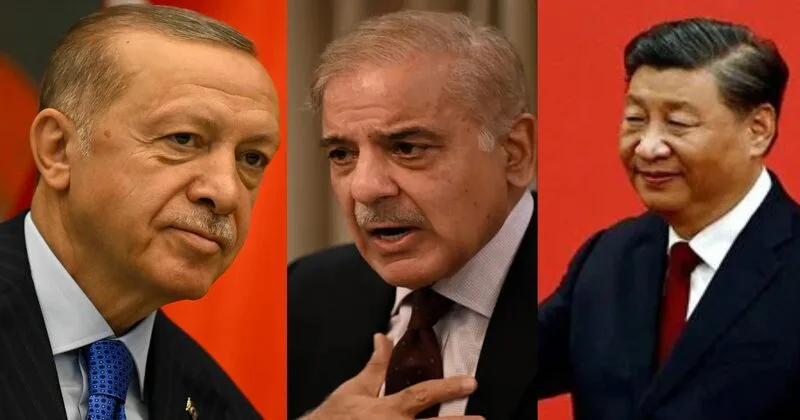
In a pivotal apprehension about potential threats to India’s national security, as per the reports, China and Turkey have conducted a 60 hour long and continuous military airlift in Pakistan. As per the intelligence inputs and analysis, it is decoded that the military aircrafts of Ankara and Beijing have been deploying critical weapons in the military bases of Pakistan, thus conducting a prolonged airlift.
This Pakistan-China-Turkey nexus has thus spiked speculations about the intent and actions of the trilateral defence partnership. Why are Beijing and Ankara embarking a major military deployment in Pakistan amid a precarious geopolitical timeline, when the conflict in West Asia is engulfing rapidly? Does deployment of weapons in the vicinity of West Asia has a deeper strategic signalling and calculations?
In this backdrop, India remains on high alert to consolidate its national security. When such rigorous trilateral military presence and activities is underway in the immediate western frontier, which is a historical threat to India, it is prudent for New Delhi to track, decode the movements and thereby ensure that the country’s national security, sovereignty is not adversely affected.
INDIA IS WATCHING & TRACKING
CHINA-TÜRKIYE’S PAK AIRLIFT EXPOSED.
60-HOUR MILITARY SURGE
Chinese warplanes at Pak Bases. Turkiye flies in drones and war gear.Timing is awkward and consequential as this arms boost to Pak comes ahead of SCO & BRICS meets.
MANOJ GUPTA reports… pic.twitter.com/kMg2f6MUDd
— Rahul Shivshankar (@RShivshankar) August 20, 2026
Unusual deployment in Nur Khan & other Pakistani bases raises doubts
As per the sources, heavy Chinese and Turkish military transport aircrafts are doing multiple rounds of landing in Pakistan. As per senior intelligence officers analysis, Chinese military aircraft landed in Nur Khan base of Pakistan near Rawalpindi and also in Masroor airbase near Karachi. Similarly, Turkish-owned military equipment has been said to have arrived in Pakistan on a large-scale. Thus, analysts suggest that this is much beyond the routine military activity. The 60 hour long military overhaul signals a bigger logistical preparations, thus stimulating India to be on high alert.
Pakistan’s dependence on China and Turkey for defence refuelling
Pakistan is one among the largest defence importers of China. For decades, Islamabad has relied on Beijing for its fighter aircrafts, air defence systems, naval frigates, submarines, artillery and other Unmanned Aerial Vehicles. As per the reports, more than 80 per cent of Pakistan’s military hardware is fuelled from China. Islamabad and Beijing jointly produce JF-17 Thunder aircraft and also Pakistan has procured the J 10C jets from China. Beyond the supply of military hardware, China also provides Pakistan, significant diplomatic cover, intelligence sharing, satellite inputs and other critical aid.
Meanwhile, Pakistan also has deep defence ties with Turkey. With the latest, Pakistan-Saudi Arabia-Turkey defence pact, this relationship is anticipated to grow further, causing significant security concerns for India. During Operation Sindoor, Turkey supplied Pakistan, a wave of drones that was targeted towards India. However, New Delhi successfully neutralised the intruding into the territory and successfully defended national security and sealed strategic edge.
Pakistan has also acquired T129 ATAK military helicopters from Ankara. Pakistan and Turkey are also cooperating on Turkey’s KAAN fifth-generation fighter jet programme and various other unmanned aerial systems.
The significant surge of Chinese and Turkish military aircraft traffic in Pakistan over the past hours has thus evoked serious security alarm in India. New Delhi remains on toes to analyse the swift military activities in its western frontier, as Pakistan poses a significant threat to India’s sovereignty, territorial integrity and security through cross-border terrorism and other illicit channels.