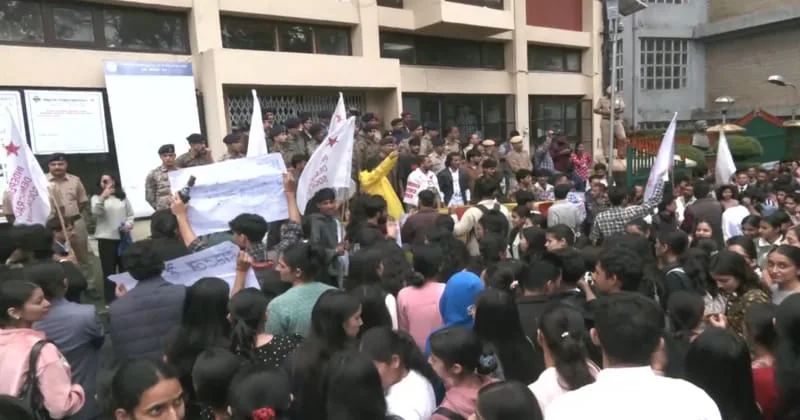
HPU students protest fee hikes of over 25 per cent, raising questions over CJP’s silence in Congress-ruled Himachal Pradesh
Shimla: The fee hike controversy at Himachal Pradesh University (HPU) has intensified, with students taking to the streets and demanding that the increased charges be rolled back. Students affiliated with the Students’ Federation of India (SFI) and the Akhil Bharatiya Vidyarthi Parishad (ABVP) held separate demonstrations on the university campus on August 19, and marched towards the Vice-Chancellor’s office.
The ABVP has been observing a relay hunger strike for 16 days, seeking a rollback of the fee hike as well as restoration of student union elections at the university and colleges.
According to student organisations, the university’s fee revisions go beyond the stated 25 per cent increase in several categories. They have particularly raised concerns over non-subsidised courses, examination-related charges and fees applicable to PhD scholars.
Non-subsidised courses have witnessed increases of 40 to 50 per cent, while certain categories have allegedly gone up by substantially higher margins. The organisation also claimed that examination fees have increased by around 50 per cent and some PhD-related charges have risen sharply. These figures are claims made by the student organisation and would require verification against the university’s official fee schedule.
The ABVP, meanwhile, has focused on the financial burden on students and demanded that revised fees should not be imposed retrospectively on students who had already taken admission under the earlier fee structure.
While the student protests have intensified at a major university in Himachal Pradesh, another question is increasingly being raised in the political discourse: where is CJP when students are protesting over fee hikes in a state governed by Congress? The issue has triggered debate over whether student concerns receive political attention selectively, depending on which party is in power.
The protesters’ demands at HPU are centred on a straightforward issue: the financial burden on students. Yet, unlike protests in BJP-ruled states, there has been little visible political spotlight from the Congress ecosystem around the HPU fee-hike controversy. The contrast has led to questions over whether student issues are being treated as matters of genuine concern or as political opportunities depending on the government in power. If fee hikes are a serious student issue in BJP-ruled states, why should the same concern disappear when the government involved is led by Congress?
The HPU controversy has therefore placed the spotlight not only on the university’s fee structure but also on the consistency of political activism surrounding student grievances. For now, the ABVP has said its relay hunger strike will continue until a concrete decision is taken on reducing the fee hike. The final decision is expected to go through the university’s Executive Council.
