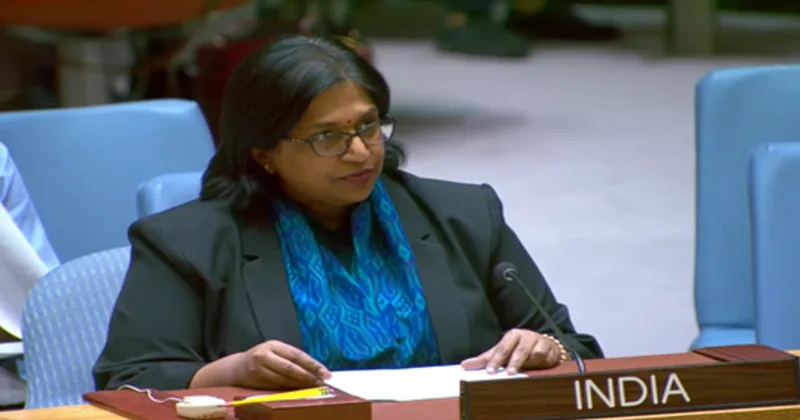
India's Charge d'Affaires at the UN Mission, Yojna Patel
New York: India has strongly called for transparency and objectivity in the United Nations Security Council(UNSC) process of listing and delisting terrorist organisations. New Delhi cautioned against using the platform for narrow political agendas and the comment comes in the backdrop of criticising & exposing Pakistan’s role in dealing with terrorism.
Addressing the UNSC Open Debate on Working Methods on August 19, Wednesday (local time), India’s Charge d’Affaires at the UN Mission, Yojna Patel, stated, “Presence in the Security Council must not be instrumentalised to legitimise terrorists by attempting to de-list them or to list other entities as terrorist organisations based solely on political considerations, without any objective criteria or supporting documentation”.
Islamabad and Beijing have attempted to register outfits like the Baloch Liberation Army and the Majeed Brigade as ‘terrorist groups’ under UN sanction regimes, though Washington, Paris and London successfully blocked the move. Concurrently, Pakistan has tried to secure the delisting of terrorists it shelters, while China previously stalled the designation of global terrorist figures such as Jaish-e-Mohammad founder Masood Azhar and Lashkar-e-Taiba leader Sajid Mir.
“Security Council membership brings significant responsibilities”, Patel said. “This must not become a platform to pursue narrow political interests”, she added. Addressing the persistent opacity in designating terror entities, she emphasised, “There must be more transparency and objectivity on this front”.
The Indian envoy pointed to the operational impact on subsidiary panels, which have faced an eight-month deadlock in appointing leadership due to consensus disagreements driven by Pakistan’s bid to lead key sanctions committees. “These bodies have not been able to deliver optimally in the recent past, primarily due to the delay in finalising the Chairs”, Patel noted.
Demanding swift action from the global body, she added, “India calls on the Security Council to urgently address this issue and finalise the Chairs on priority in a definitive and non-negotiable timeline to resolve the leadership appointments”, India further reiterated during the UNSC debate.
Highlighting critical issues in UN peacekeeping operations, Patel underscored the disconnect between Council mandates and the operational challenges faced by major troop-and police-contributing nations.
Given that troop-contributing nations go far beyond the UNSC membership, she affirmed that as direct stakeholders, they must be part of the UNSC decision-making architecture pertaining to all key questions of peacekeeping, such as mandates and resources.
India also called for urgent reforms in the United Nations Security Council (UNSC), saying the world body’s decision-making structure must reflect present-day realities and give greater representation to the Global South. Ambassador Yojna Patel, said the need for reforming the Security Council was “more pronounced and pressing than ever before”.
“The world of 1945 has changed beyond recognition. UN membership has grown fourfold since then. The outcome of one conflict 80 years ago cannot determine the composition, dynamics, approaches and working methods for perpetuity. This needs to change and must happen at the earliest”, Patel said. She said India’s position on UNSC reforms was well known and called for expansion in both categories of membership, with greater representation for developing countries.
“We seek an expansion in both categories, with greater representation for the Global South. This could be achieved only through text-based negotiations, with clearly defined milestones and timelines”, she said.
Patel highlighted that discussions on improving the UNSC’s working methods should be part of broader reforms, including membership categories, regional representation and the veto issue.
She also raised concerns over the continued provisional nature of the Security Council’s Rules of Procedure, saying existing frameworks should not be cited as an obstacle to implementing reforms. Calling for greater transparency, India said non-permanent members of the Security Council should have equal access to documents and information. “All Security Council members must enjoy the same set of privileges in terms of access to documents. Access to historical documents must not be the exclusive preserve of a few”, she reiterated.
(With Inputs from ANI)
