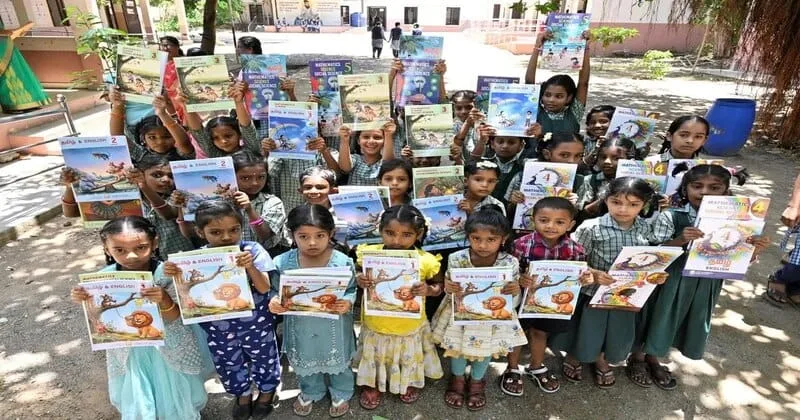
New Delhi: The UDISE+ Report 2025–26 presents a comprehensive assessment of school education in India, covering 14.67 lakh schools, 1.03 crore teachers, and 24.72 crore students. It highlights improvements in enrolment, Gross Enrolment Ratio (GER), teacher availability, pupil–teacher ratios, retention and transition rates, alongside reduced dropout rates. The report also records progress in digital and physical infrastructure, greater participation of women teachers, and continued advances in gender equity, social inclusion, and accessible education, reinforcing evidence-based planning under NEP 2020.
Data-Driven Governance in Education: Insights from UDISE+
The Unified District Information System for Education Plus (UDISE+) is a digital platform developed by the Department of School Education & Literacy (DoSE&L) to collect and manage comprehensive school education data across India. Since its launch in 2018–19, UDISE+ has facilitated evidence-based planning, policymaking, and monitoring of educational progress. It also serves as a key data repository for tracking the implementation of the National Education Policy (NEP) 2020, which seeks to ensure universal access, equity, quality learning, and improved student retention.
School Education Landscape
The UDISE+ 2025–26 report reflects a strengthening Indian school education system that comprises nearly 14.67 lakh schools, 1.03 crore teachers, and over 24.72 crore enrolled students. This sustained enrolment and improved teacher availability translate to an average of seven teachers and 169 students per school. Consequently, the system maintains a highly favourable overall Pupil–Teacher Ratio (PTR) of 24:1, sitting comfortably well within the NEP 2020-recommended benchmark of 30:1.
Gross Enrolment Ratio (GER): Expanding Access to School Education
The Gross Enrolment Ratio (GER) at the Secondary stage improved to 71.7%, while the Middle stage GER stood at a consistently high 89.6%. Enrolment remained well distributed across all stages of school education, with the Secondary stage accounting for 27.16% of total enrolment, followed by the Preparatory stage (25.60%), Middle stage (25.58%), and Foundational stage (21.66%). Together, this balanced distribution and the rising secondary GER reflect India’s continued progress in expanding educational access and sustaining student participation throughout the schooling continuum.
Favourable Pupil–Teacher Ratio: Improving Learning Outcomes
In 2025–26, the PTR across all stages of school education reflected continued improvements in teacher availability. The stage-wise PTR stood at 10:1 at the Foundational stage, 12:1 at the Preparatory stage, 17:1 at the Middle stage, and 21:1 at the Secondary stage. These highly favourable ratios enable greater individual attention, foster effective classroom engagement, and create an optimal environment for improved learning outcomes.
Improved Student Retention and Lower Dropout Rates
The UDISE+ 2025–26 report highlights sustained progress in keeping children within the Indian school system. The dropout rate notably declined to 1.8% at the Preparatory stage and 7.0% at the Secondary stage. While the Middle stage saw a marginal increase to 3.6%, dropout rates across all three stages remain significantly lower than in 2022–23.
This positive trend is mirrored by strong student retention rates, which stood at 98.5% (Foundational), 91.1% (Preparatory), 83.7% (Middle), and 51.9% (Secondary). Furthermore, transition rates between successive stages remained robust—with 99.2% of students progressing from the Foundational to the Preparatory stage, 93.8% moving to the Middle stage, and 88.3% advancing to the Secondary stage. Together, these metrics underscore a clear and improving continuum of educational access and student progression.
Decline in Single-Teacher and Zero-Enrolment Schools
In 2025–26, the number of schools operating with a single teacher decreased by approximately 3% to 1,00,843, while zero-enrolment schools saw a significant 29% decline compared to the previous year (2024-25), dropping to 5,663. These improvements reflect continued efforts to rationalise teacher allocation, optimise deployment, and ensure that educational resources are more effectively aligned with student needs across the country.
Gender and Social Inclusion
The UDISE+ 2025–26 report reflects continued progress towards a more inclusive school education system. Girls accounted for 48.4% of total student enrolment, indicating a balanced gender distribution across schools. Women also continued to play a significant role in the teaching workforce, constituting 54.9% of all teachers.
The social composition of school enrolment remained broad-based and representative. Students from Other Backward Classes (OBCs) accounted for the largest share at 44.9% of total enrolment, followed by the General category (27.5%), Scheduled Castes (17.7%), and Scheduled Tribes (10%). Together, Scheduled Caste and Scheduled Tribe students comprised 27.7% of total enrolment, reflecting sustained efforts to promote equitable access to school education. This commitment to inclusivity also extends to Children with Special Needs (CWSN), a demographic comprising 57.16% boys and 42.84% girls. Collectively, this data highlights India’s dedication to advancing inclusive education through accessible infrastructure, specialised support services, and equitable learning opportunities for all students.
Infrastructure Development
The UDISE+ 2025–26 report highlights significant strides in modernising school infrastructure to create a more conducive environment for teaching and learning. On the digital front, the proportion of schools equipped with computers increased to 69.9%, and internet connectivity rose to 67.4%, expanding opportunities for technology-enabled education.
Basic infrastructure in schools also recorded steady gains with the availability of:
Electricity in 95% of schools
Safe drinking water in 99.5% of schools
Girls’ toilets in 98.5% of schools
Boys’ toilets in 97.2% of schools
Handwashing facilities in 96.9% of schools
Libraries in 90.5% of schools
Rainwater harvesting in 29.9% of schools
Ramps with handrails in 58.2% of schools.
Together, the expansion of these digital and physical facilities reflects a sustained commitment to improving accessibility, inclusivity, and the overall quality of India’s educational landscape.
Decoding Progress: Key Takeaways from UDISE+ 2025–26
The UDISE+2025–26 report reflects continued progress in strengthening India’s school education system through improved access, equity, quality, and infrastructure. The new report highlights key gains in teacher availability, favourable pupil–teacher ratios, student retention and transition, gender parity, social inclusion, digital readiness, and school infrastructure, underscoring sustained efforts to improve educational outcomes across the country.
As a comprehensive national database, UDISE+ continues to enable evidence-based planning, informed policymaking, and effective monitoring of the school education sector. Its findings reaffirm the steady progress towards the vision of the NEP 2020 to create an equitable, inclusive, technology-enabled, and learner-centric education system.