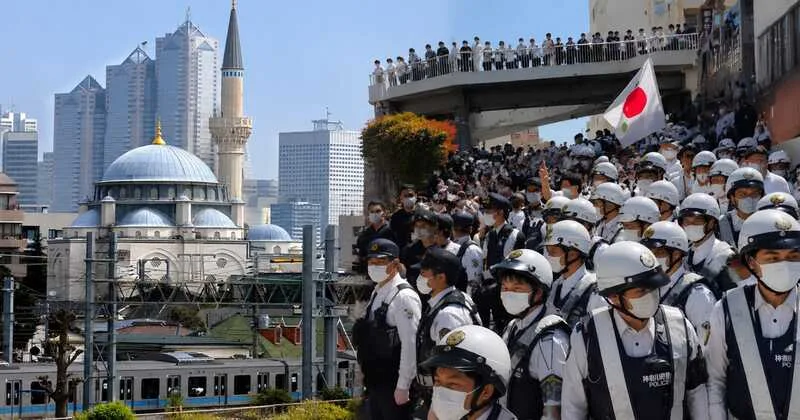
Fujisawa residents raise concerns over religious practices and the growing presence of non-native culture in their community
The coastal city of Fujisawa, a laid-back and usually tranquil seaside town located about an hour’s drive south of Tokyo, has become the focal point of escalating social friction and public unrest in recent days. Massive mobilizations have swept through the municipality as thousands of frustrated local residents gathered near the local train station and city administrative areas to stage large-scale demonstrations against the proposed construction of what would be the city’s very first mosque.
Multiple videos shared widely across social media platforms depict impassioned crowds raising slogans, waving placards, and marching through the streets to voice their fierce opposition. The sheer scale and intensity of this mobilization make it abundantly clear that the underlying dispute extends far beyond a conventional local zoning disagreement.
Protesters have openly expressed anger and anxiety over the project, pointing out that the proposed structure is planned to be significantly larger than nearby historic Japanese Shinto shrines. To many local participants, erecting a oversized religious complex in such close proximity to traditional sites is seen as deeply disrespectful and represents an aggressive act of provocation directed straight at Japan’s long-standing cultural traditions and heritage.
As tensions mount, public consultations organized around the mosque project have turned increasingly disorderly, forcing local law enforcement to deploy police presence to maintain basic order during heated confrontations between neighborhood residents and project representatives.
The rising unrest in Fujisawa reflects broader nationwide demographic changes, where Japan’s shrinking domestic workforce and rapidly aging society have compelled the national government to expand pathways for incoming foreign labor.
Structured initiatives such as the Technical Intern Training Program and the Economic Partnership Agreement (EPA) have brought in thousands of foreign workers to fill open jobs in critical sectors like caregiving and nursing.
A considerable proportion of these arrivals have originated from Indonesia, the world’s most populous Muslim-majority nation. To support these growing non-native communities, religious infrastructure has expanded dramatically, with the number of mosques rising from approximately 50 in 2008 to at least 164 by July 2025, and reaching an estimated 167 nationwide shortly thereafter, a far cry from 1935 when the nation’s very first mosque, the Kobe Mosque, was founded.
Across Japan, the total foreign resident population, comprising arrivals from China, Vietnam, South Korea, and the Philippines, surpassed four million in 2025, with a record 2.57 million active in the labor force during a single year in which Japan’s native population dropped by nearly one million.
Within these overall national demographics, official counts indicate that the total number of foreign residents and Japanese citizens belonging to the Islamic faith grew from 230,000 in 2019 to roughly 420,000 by the end of 2024, according to Hirofumi Tanada, a professor emeritus at Waseda University.
Though this total represents approximately 0.3 per cent of Japan’s overall population, its rapid growth and the expansion of halal food systems and distinct social customs have created a sharp disconnect with traditional Japanese social norms.
A central point of contention heightening local opposition in Fujisawa and surrounding regions stems from unyielding conflicts over end-of-life customs and environmental safety. In Japan, cremation is an overwhelmingly universal norm, accounting for 99.9 per cent of all cases.
Because public cemeteries in regional cities are designed exclusively for cremation, they do not offer earth burial plots for religious minorities. Conversely, Islamic traditions strictly mandate full-body burial, driving Islamic associations since the 1960s to acquire private land for burial grounds.
However, these attempts have encountered persistent resistance from local communities, who view non-cremation practices as entirely unfamiliar and voice grave concerns regarding air and ground environmental degradation. Neighborhood groups in several regions have persistently raised alarms over potential groundwater contamination caused by uncremated remains, fearing that underground fluids could pollute local water supplies and degrade the natural environment.
With only about ten cemeteries across the entire country currently accommodating ground interments, efforts to establish new private sites, such as a heavily opposed project in Hiji in Oita Prefecture, continue to trigger intense local backlash from residents determined to safeguard their local ecosystems.
Beyond burial disputes, residents in Fujisawa are voicing deep frustration over recurring urban disruption, noise pollution, and public inconvenience linked to non-native religious gatherings. Neighborhood associations have expressed strong objections to the public call to prayer, the Adhan, as well as loud sermons, describing them as intrusive sources of noise disturbance that disrupt the peace and decorum of quiet residential zones.
Concerns have also intensified surrounding large-scale festive events, such as Eid al-Fitr, which bring massive crowds into local neighborhoods and cause severe traffic congestion and parking shortages. Furthermore, persistent reports of worshippers utilizing public parks to accommodate overflow crowds have led to formal complaints from local associations regarding the unauthorized use of shared public spaces.
In Fujisawa, where an online petition opposing the mosque gathered more than 32,000 signatures and raised nearly one million yen ($6,150) in donations in late 2025, residents are deeply angered that the municipal government authorized the project. Demonstrators have taken to the streets to protest against local officials for approving the building permits, arguing that despite meeting technical administrative regulations, the sheer physical footprint and visibility of the structure will permanently alter and degrade the character of their seaside community.
The controversy surrounding the Fujisawa mosque comes at a time when national policy is shifting toward stricter regulatory oversight and tighter immigration controls. While previous administrations relied on temporary visas in what critics termed a stealth immigration system, Prime Minister Sanae Takaichi has adopted a highly conservative stance against large-scale foreign influxes.
Demonstrating this firm approach, the Japanese government decided in June 2026 to raise visa fees for foreign nationals fivefold, marking the first fee increase in nearly 50 years. Additionally, the government is moving to increase the staff of the Immigration Services Agency by about 230 people to strengthen enforcement against illegal overstayers, while officials actively consider introducing hard limits to manage the total number of foreign residents permitted in the country.
Meanwhile, online platforms have seen worsening verbal abuse, with members of the Muslim community being subjected to severe slurs, called terrorists, accused of making bombs, and told to get out of Japan or go back to their own countries.
The Fujisawa controversy has sparked intense online debate internationally, with user comments reflecting deep hostility toward foreign expansion. One post warned Japan to “avoid the damage now or regret it later” and to “protect your culture before it’s too late,” while another post questioned which administrative authority could pass construction permits for such a intrusive project.
Another post went further, issuing an extreme call to oppose the establishment of Islamic facilities entirely, warning that non-native cultural systems would irreversibly compromise the country’s social fabric and security.
