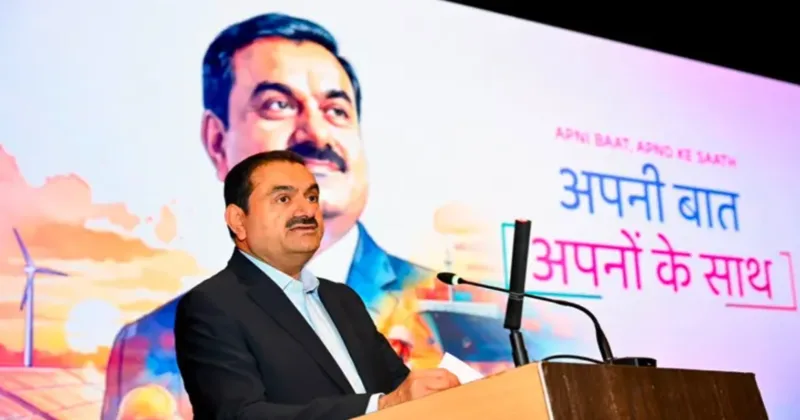
Adani Group Chairman Gautam Adani
New Delhi: Gautam Adani has broken his silence after the dismissal of the US criminal case against him and his nephew Sagar Adani, looking back at a period that subjected the Adani Group to intense financial, political and legal scrutiny.
For Adani, the journey began with the Hindenburg Research report in January 2023. The US short-seller made a series of allegations against the conglomerate, including stock manipulation, misuse of offshore entities and excessive debt. The Adani Group rejected the allegations.
The fallout was immediate. The group’s listed companies suffered a dramatic decline in market value, with around $150 billion wiped out from their combined market capitalisation within weeks.
But the crisis did not end there.
In November 2024, US prosecutors accused Adani and others of agreeing to pay around $265 million in alleged bribes to Indian officials to secure solar-power contracts and of misleading US investors. Adani and the group denied the allegations.
On August 10, 2026, US District Judge Nicholas Garaufis dismissed the criminal charges after the US Justice Department sought to withdraw the case.
For Adani, the end of the US case represents another important moment in a long-running episode that he says ultimately strengthened rather than weakened his conviction.
Speaking to employees and partners during the second edition of ‘Apni Baat, Apno Ke Saath’, Adani recalled one of the most consequential decisions taken by the group during the 2023 crisis.
The Adani Group withdrew its Rs 20,000 crore follow-on public offering (FPO) even though the issue had been fully subscribed.
Adani described the decision in simple terms: “Trust is greater than any legal right.”
His argument was that having a legal right does not necessarily mean that exercising it is always the right course of action.
The decision came at a time when investor confidence was under severe pressure. Rather than proceed with the share sale, the group returned the money to investors.
At the time, critics interpreted the move as a sign of weakness. Adani now presents it as a decision guided by the group’s larger commitment to trust.
Businesses kept moving despite the storm
While the legal and market battles dominated public attention, the group’s businesses continued to operate and expand.
Adani said employees, workers, suppliers, contractors, vendors and other partners remained focused on their responsibilities despite the intense scrutiny surrounding the group.
The results, according to the group, became visible in the years that followed.
By FY26, the Adani Group reported record capital expenditure of Rs 1.53 lakh crore and an all-time high EBITDA of nearly Rs 95,000 crore. Its renewable-energy capacity expanded to 19.3 GW, while cargo handled by its ports crossed 500 million tonnes.
The group’s combined market capitalisation also recovered from the sharp decline following the Hindenburg report, returning to and subsequently exceeding pre-crisis levels, according to the figures cited by the group.
Several Adani companies also recorded substantial recoveries from their lows. Adani Power, in particular, saw its market value rise sharply during the recovery period.
The numbers became an important part of Adani’s broader response to the crisis: while allegations and market narratives can trigger immediate volatility, businesses ultimately have to prove themselves through execution.
Interestingly, Adani did not use his address only to criticise those who questioned the group.
He said criticism, regardless of the intention behind it, can provide an opportunity for introspection and improvement.
That approach marked a different tone from the confrontational response often seen during corporate controversies. Instead of presenting criticism solely as an attack, Adani argued that difficult questions can force institutions to examine themselves more closely.
The experience, he said, also deepened his faith in people.
He recalled receiving encouragement from individuals across India whom he had never personally met during the most difficult phase of the crisis.
With India preparing to celebrate its 80th Independence Day, Adani used the occasion to move beyond his own experience and speak about the larger challenge facing Indian businesses and young professionals.
He urged the more than three lakh employees and partners associated with the Adani Group to consider what their generation would leave behind.
For Adani, the answer cannot be measured only in balance sheets or infrastructure projects.
He pointed to the Khavda Renewable Energy Park and conversations with young engineers as examples of how development can create opportunities and transform lives.
He argued that development should also be judged by the hope it creates, dignity it restores and lives it changes.
Drawing upon the Hindu story of Samudra Manthan, Adani said adversity does not necessarily create character but reveals it.
The Hindenburg episode, the subsequent market turmoil and the US legal proceedings tested the group’s ability to remain patient, follow due process and continue executing its businesses, he said.
His latest message is therefore less about declaring victory over critics and more about what he believes the episode taught him.
The Adani Group emerged from the crisis with its businesses continuing to expand, its market value recovering and the US criminal case now dismissed.
Adani’s focus has consequently shifted from defending the past to building for the future.
His stated ambition is to create institutions that can outlast their founders, expand opportunities and contribute to a stronger and more self-reliant India.
For a business group that spent years operating under an extraordinary level of scrutiny, the journey from the 2023 market shock to the dismissal of the US case has become a story of resilience—and, in Adani’s own telling, a reminder that long-term trust is built not when times are easy, but when they are hardest.
