New Delhi: The Lok Sabha committee constituted to inquire into allegations against former Allahabad and Delhi High Court judge Justice Yashwant Varma has found all three charges framed against him to be proved in connection with the recovery of burnt currency from his official residence in New Delhi.
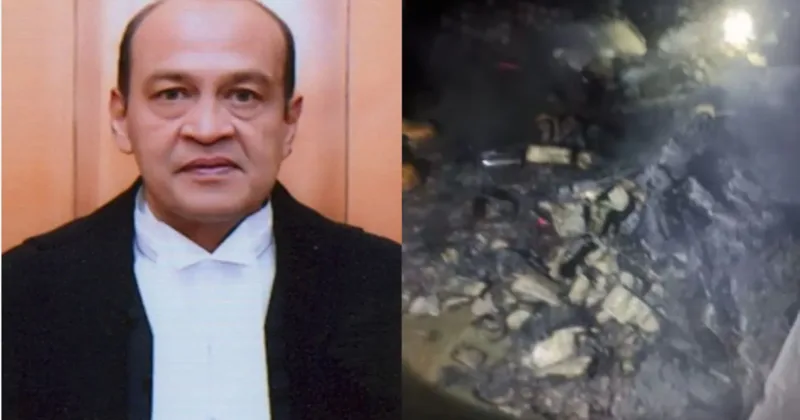
The report, tabled in the Lok Sabha, deals with the controversy that erupted after a fire at Justice Varma’s official residence at 30, Tughlaq Crescent, New Delhi, on March 14-15, 2025. Following the incident, witnesses reported seeing bundles and heaps of burnt, half-burnt and wet Rs 500 notes in a storeroom on the premises.
Justice Varma had denied wrongdoing and later resigned as a judge on April 10, 2025.
What did the inquiry committee find?
The committee examined three broad charges.
The first concerned the presence of substantial unexplained currency at the judge’s official residence. The second related to the failure to preserve the currency and other material evidence following the fire. The third concerned the explanations provided by Justice Varma regarding the cash and the circumstances surrounding its discovery.
The committee concluded that all three charges had been established.
🚨 BIGGEST SHOCKER!
Report on Justice Varma case submitted.
=> NO ONE PLANTED THE CASH.A full judicial inquiry has now found all three Articles of Charge PROVED against Justice Yashwant Varma 🤯
– Unexplained cash recovered from his official residence.⁰
– Failure to… pic.twitter.com/Xre2MDIBUV— The Analyzer (News Updates🗞️) (@Indian_Analyzer) August 12, 2026
On the first charge, the panel relied on the statements of Delhi Fire Services and police personnel who said they had seen large quantities of currency in the storeroom. Photographs and other electronic material were also considered during the proceedings.
However, because the notes were not properly seized, counted or preserved, the committee said it was impossible to establish the exact amount of cash that had been present.
The panel made an important distinction: its finding did not amount to a criminal finding that Justice Varma personally owned the currency.
Instead, it concluded that substantial unexplained currency was found within premises occupied by the judge and that he had failed to provide a satisfactory explanation regarding its presence, source or ownership.
Justice Varma had maintained that the storeroom was detached from his main residence and that he did not have access to it. The committee did not find this explanation sufficient.
Panel flags failure to preserve evidence
The committee also examined what happened to the currency after the fire.
It found significant lapses in the handling of the scene. The notes were not immediately seized or inventoried, no proper panchnama was prepared and the storeroom was not promptly secured. Cleaning was subsequently carried out, after which the currency was no longer available for examination.
The committee described the failure to preserve the material evidence as a “material lapse” by the police.
However, it said this lapse did not erase the evidence of officials who had personally seen and identified the currency.
The panel also examined evidence concerning members of the judge’s household establishment. A witness, CG Rawat, reportedly told the committee that Justice Varma’s private secretary Rajinder Singh Karki and household staff member Mohd. Rahil were seen near the storeroom after the fire while cleaning was taking place.
The committee clarified that it was not claiming that Justice Varma personally removed the cash. Instead, it held that he had failed to ensure the preservation of material evidence at premises under his institutional charge.
Committee rejects shifting explanations
The third charge focused on Justice Varma’s response to the allegations.
According to the report, Justice Varma initially denied the existence of unexplained cash but subsequently raised questions about the failure to seize the notes, the possibility that the currency had been planted and the prospect of a larger conspiracy.
The committee said these claims were not adequately supported by evidence during the proceedings.
It also noted that Justice Varma withdrew from the inquiry after the presenting side had completed its evidence and witnesses had been cross-examined.
The panel clarified that his withdrawal alone could not be treated as proof of wrongdoing. However, it considered the withdrawal alongside what it described as his failure to produce evidence supporting the allegations he had raised.
The committee ultimately described his explanation as evasive, incomplete and misleading in effect, holding the third charge proved.
How the inquiry began
The inquiry committee was constituted by Lok Sabha Speaker Om Birla under the Judges (Inquiry) Act, 1968 to examine allegations concerning Justice Varma.
The panel was headed by Supreme Court Justice Aravind Kumar and included then Bombay High Court Chief Justice Shree Chandrashekhar, who was subsequently elevated to the Supreme Court, and senior advocate B.V. Acharya.
The committee submitted its report to Speaker Om Birla on May 18, 2026.
The inquiry followed the March 2025 fire at Justice Varma’s official residence and the subsequent reports of large quantities of burnt currency being found at the premises.
Justice Varma resigned from the judiciary on April 10, 2025, while continuing to deny allegations of wrongdoing.
What the findings mean
The committee’s findings now place the controversy on a formal institutional footing. While the report does not itself constitute a criminal conviction or establish personal criminal ownership of the currency, its conclusion that all three charges were proved represents a serious finding against the former judge.
The report also highlights questions over the handling and preservation of evidence, the accountability of officials responsible for securing the site and the adequacy of Justice Varma’s explanations during the inquiry.
The findings will now form part of the parliamentary record and could have wider implications for the judicial accountability process and the manner in which allegations involving serving or former judges are examined.
The committee also recorded its appreciation for the assistance provided by Additional Solicitor General Aishwarya Bhati, Raja Thakare, senior advocates Sidharth Luthra and Siddharth Aggarwal, and advocates Karan Umesh Salvi and Sameeksha Dua during the proceedings.