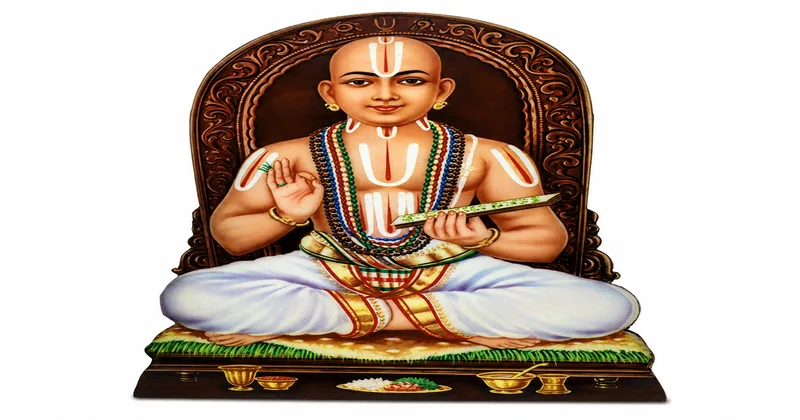
More than 700 years ago, Sanskrit scholar and poet Vedanta Desika, whose birth name was Venkatanatha, created something that sounds almost impossible: a Sanskrit poem that could also be read like a chess puzzle.
In 14th century, the scholar & poet Vedānta Deśika (birth name Veṅkaṭanātha) was challenged by a rival scholar to a intellectual duel. The rival boasted that Desika could not match his poetic speed & challenged him to compose 1000 distinct Sanskrit verses in a single night.… pic.twitter.com/BEnGcs7zFp
— Parimal (@Fintech03) July 31, 2026
According to tradition, Desika was challenged by a rival scholar to a poetic contest. He was asked to compose 1,000 Sanskrit verses in a single night. Desika accepted the challenge and went on to create Paduka Sahasram, a celebrated work dedicated to the divine sandals of Bhagwan Ranganatha. The work contains 1,008 verses. But what makes it truly fascinating is that some of its verses were designed using mathematical patterns and chess-like movements.
A poem hidden inside a chessboard
The most remarkable example appears in the 30th chapter, Chitra-paddhati. Here, verses 929 and 930 are connected through a clever arrangement of Sanskrit syllables. The syllables of verse 929 can be placed in a 4 × 8 grid, creating 32 spaces—much like a small chessboard. If the syllables are read normally from one end to the other, they form verse 929, a complete Sanskrit verse praising the divine sandals of Bhagwan Ranganatha. But then comes the astonishing part. Instead of reading the syllables in their normal order, follow the movement of a chess knight.
A knight moves in an L-shape, two squares in one direction and one square to the side. When the 32 spaces are visited according to this movement, the syllables form verse 930. So, from the same arrangement of syllables, two different Sanskrit verses emerge.
One reading gives verse 929. The knight’s movement gives verse 930. And both are grammatically correct Sanskrit verses with their own meanings. The secret lies partly in the flexibility of Sanskrit. Sanskrit words carry a lot of grammatical information within the words themselves. This means that sentences can often be rearranged more freely than in many modern languages without completely losing their meaning. Sanskrit poetry also follows strict rules of metre, meaning that the number and pattern of syllables matter. This gave poets like Desika the ability to arrange syllables in highly complicated patterns while still keeping the poem meaningful.
In citrakavya, or “pattern poetry”, Sanskrit poets went even further. They created poems that could be arranged into shapes such as lotuses, wheels and other geometric designs. In Desika’s case, the pattern follows the movement of a chess knight.
Desika did not invent the Knight’s Tour
There is an important point to remember. It would not be correct to say that Vedanta Desika invented the Knight’s Tour. Similar knight-movement poetic patterns existed in India centuries before him. Earlier Sanskrit poets, including Rudraṭa and Ratnakara, are associated with examples of such constructions. Desika’s achievement came later, in the 14th century. What makes his work remarkable is the extraordinary way he used the idea inside Sanskrit poetry. A single arrangement could be read normally to produce one verse and then followed through a knight’s movement to produce another. Centuries later, European mathematicians such as Leonhard Euler studied the Knight’s Tour as a formal mathematical problem.
So, Desika should not be described as the inventor of the puzzle. Instead, his work is an extraordinary example of how Indian poets had already combined mathematics, chess-like movement and literature centuries earlier.
Poetry, mathematics and chess in one work
What makes this achievement so fascinating is that Dedika had to satisfy several conditions at the same time.
The syllables had to:
fit into the 4 × 8 grid;
follow the required movement of the knight;
form meaningful Sanskrit words;
maintain correct grammar;
follow the rules of Sanskrit metre;
and still convey a poetic and devotional meaning.
In other words, Desika was not simply arranging random letters on a board. He was creating real poetry under a mathematical restriction. That is what makes the achievement so extraordinary.
The example from Paduka Sahasram also shows how advanced Sanskrit poetic traditions could be. Indian poets did not always treat poetry simply as words written from left to right. Through citrakavya, words and syllables could become part of elaborate patterns and designs.
A poem could be read in different directions or arranged into a particular shape while still retaining meaning. This created a fascinating connection between language, mathematics, geometry and poetry. Desika’s knight-based verses are one of the most memorable examples of this tradition.
Today, a computer can easily calculate a Knight’s Tour. But Desika had no computer, calculator or modern mathematical software. He had to work with language itself. He had to find the right Sanskrit syllables, place them into the correct positions, ensure that the knight’s route worked, and at the same time make sure that the resulting sequences were proper verses. That is what makes the achievement so impressive. The story of Paduka Sahasram is therefore not simply about a poet writing 1,000 verses in one night. It is about a poet turning language into a puzzle and a chess movement into poetry.
More than seven centuries later, the verses of Vedanta Desika continue to show how closely poetry, mathematics, Sanskrit grammar and intellectual creativity could come together in India’s literary tradition. He did not invent the Knight’s Tour. But his use of the idea in Paduka Sahasram remains a remarkable example of mathematics hidden inside poetry.