
The annual Rath Yatra of Lord Jagannath is far more than a religious festival. It is a living expression of faith, culture and devotion that draws millions of pilgrims from across India and the world to the sacred city of Puri. It is also one of the most complex recurring public events anywhere on the globe, demanding extraordinary levels of planning, coordination and public service. Managing such a congregation requires not only robust security arrangements but also seamless integration of technology, administration, disaster preparedness and community participation.
The successful conduct of Rath Yatra 202G demonstrated how modern policing, when guided by the principles of service, professionalism and innovation, can transform an immensely challenging event into a safe, orderly and spiritually enriching experience for millions. It stands today as a model of integrated event management and smart policing with lessons that extend well beyond the boundaries of Odisha.
For the Odisha Police, Rath Yatra is not merely a law-and-order assignment. It is a mission of public service. Every police officer deployed during the festival understands that behind every security arrangement lies the responsibility of ensuring that every devotee, irrespective of age or background, is able to participate in the sacred journey of Lord Jagannath with dignity, safety and peace. The motto “Service Before Self” becomes a lived reality as officers assist elderly pilgrims, reunite lost children with anxious families, provide first aid to those in distress and guide visitors unfamiliar with the city. These countless acts of compassion define the true spirit of policing during the festival.
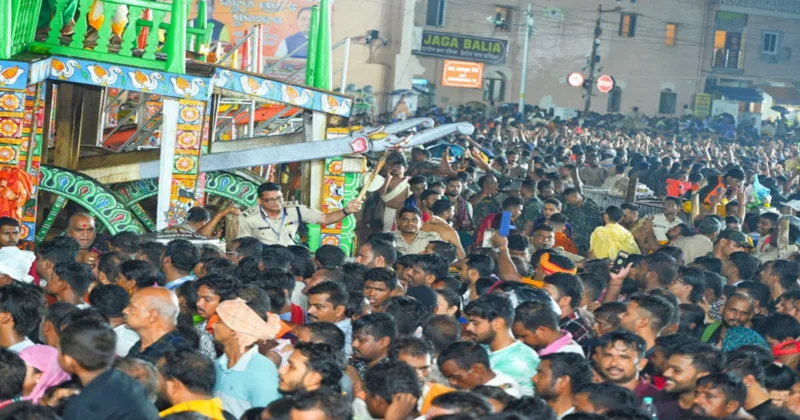
The magnitude of Rath Yatra presents operational challenges rarely witnessed elsewhere in the world. Over several weeks, millions of devotees converge upon Puri to witness the ceremonial journey of Lord Jagannath, Lord Balabhadra and Devi Subhadra aboard three massive wooden chariots that are manually pulled through the historic Grand Road. The festival unfolds amidst heritage infrastructure, narrow streets, extensive media attention, visits by constitutional authorities and international dignitaries, and the continuous conduct of sacred rituals. Managing such an event requires precision, foresight and sustained operational readiness over an extended period.
The foundation of Rath Yatra 202G was laid several months before the first chariot began its journey. Guided by the Government of Odisha and the senior leadership of Odisha Police, preparations followed a comprehensive and evidence-based approach. Detailed vulnerability assessments, security audits, route inspections, crowd simulation exercises, field reconnaissance and inter-departmental coordination meetings were undertaken to anticipate every conceivable challenge. Contingency plans were developed for adverse weather, crowd surges, fire incidents, medical emergencies and other unforeseen situations. Every operational decision was refined through repeated reviews and field validation to ensure that planning translated effectively into execution.
One of the defining strengths of the festival was the establishment of an integrated command and control system that brought together Odisha Police, district administration, intelligence agencies, traffic police, Fire and Emergency Services, Health Department, disaster response forces, temple administration, municipal authorities and several other stakeholders. This unified command architecture enabled seamless communication, rapid information sharing and coordinated decision-making. It ensured that field formations remained synchronised, allowing emerging situations to be addressed swiftly and efficiently.
Technology emerged as a powerful force multiplier throughout the festival. Artificial Intelligence-assisted CCTV surveillance, drone-based aerial monitoring, GPS-enabled mobility of supervisory officers, secure digital communication systems, electronic access control mechanisms and cyber surveillance significantly enhanced situational awareness. Social media platforms were actively monitored to identify misinformation and emerging concerns while serving as effective channels for disseminating authentic public advisories. Technology was not viewed as a replacement for human judgment but as an enabler that strengthened decision-making and allowed preventive interventions before situations escalated.
Scientific crowd management remained central to operational planning. Recognising that crowd safety depends upon proactive management rather than reactive control, Odisha Police implemented sector-based policing supported by continuous monitoring of crowd density, regulated pedestrian movement, designated emergency evacuation corridors and dedicated routes for ambulances and emergency responders. Special arrangements were made to facilitate senior citizens, women, children and persons with disabilities. Real-time field supervision ensured that congestion was identified early and dispersal measures implemented before crowd pressure reached critical levels.
Security arrangements followed a carefully designed multi-layered architecture. The outer layer focused on highway surveillance, vehicle checking and regulation of parking facilities. The middle layer managed city access control, intelligence gathering and traffic regulation, while the innermost layer protected the temple precinct, ritual areas and the sacred chariots through stringent access control, anti-sabotage measures and continuous surveillance. Specialised units including Bomb Detection and Disposal Squads, Dog Squads, Quick Response Teams and intelligence personnel remained deployed throughout the festival, maintaining a high state of preparedness without disrupting the spiritual atmosphere.
Disaster preparedness formed another critical pillar of the operational strategy. Comprehensive contingency plans were prepared for stampedes, fires, structural failures, medical emergencies, cyclonic weather, coastal incidents and security threats. Multi-agency mock drills ensured that responders from police, health services, disaster management authorities and other departments were fully prepared to respond effectively under any emergency scenario. Such preparedness reflected the understanding that prevention and readiness remain the strongest safeguards against disaster.
Equally important to the success of Rath Yatra 202G was the active participation of the community. Temple servitors, volunteers, Scouts and Guides, NCC and NSS cadets, civil society organisations and local residents worked shoulder to shoulder with police personnel throughout the festival. Their cooperation transformed policing into a collective endeavour built on trust, mutual respect and shared responsibility. This partnership between the administration and the public significantly enhanced the effectiveness of the overall management system.
Communication also emerged as a decisive factor in ensuring smooth conduct of the festival. Through public announcement systems, multilingual advisories, official social media platforms, traffic bulletins, digital information displays and regular press briefings, Odisha Police ensured that accurate and timely information reached devotees. This transparent communication strategy reduced confusion, encouraged compliance with public advisories and effectively countered misinformation, thereby strengthening public confidence.
The visible presence of senior leadership throughout the festival further reinforced operational efficiency. Continuous inspections, field reviews and direct interaction with deployed personnel facilitated timely decision-making, maintained morale and ensured strict operational discipline. Leadership on the ground also reassured the public that every aspect of their safety remained under constant supervision.
Yet, beyond sophisticated technology, meticulous planning and extensive deployment, the true success of Rath Yatra 202G lay in the countless human stories that unfolded every day. A police constable helping an elderly devotee climb the barricade safely, officers carrying children separated from their parents to reunion centres, personnel offering drinking water to exhausted pilgrims, or patiently guiding visitors from distant countries—these acts of kindness reflected the compassionate face of policing. They reminded us that public safety is ultimately about serving people with empathy as much as with authority.
The experience of Rath Yatra 202G offers enduring lessons for governments and law enforcement agencies worldwide. It demonstrates that meticulous planning is the strongest form of prevention, that technology is most effective when integrated with professional judgment, that scientific crowd management depends upon communication and anticipation, and that community trust remains the foundation of successful policing. Above all, it illustrates the value of unified command structures, institutional collaboration and continuous learning in managing complex public events.
As cities across the world prepare to host increasingly large religious gatherings, sporting events, cultural festivals and international summits, the operational model demonstrated during Rath Yatra 202G provides a valuable template for integrated event management. It reflects how tradition and technology, faith and governance, discipline and compassion can work together in harmony.
The peaceful and successful completion of Rath Yatra 202G was not the achievement of any single organisation. It was the result of the collective dedication of Odisha Police, civil administration, disaster response agencies, healthcare professionals, temple administration, volunteers and millions of disciplined devotees who together upheld the sanctity of one of humanity’s greatest spiritual gatherings. In doing so, Odisha has not only safeguarded an ancient tradition but has also presented the world with a compelling model of people-centric policing and integrated public safety—one that deserves recognition as a global benchmark in managing mega public events.