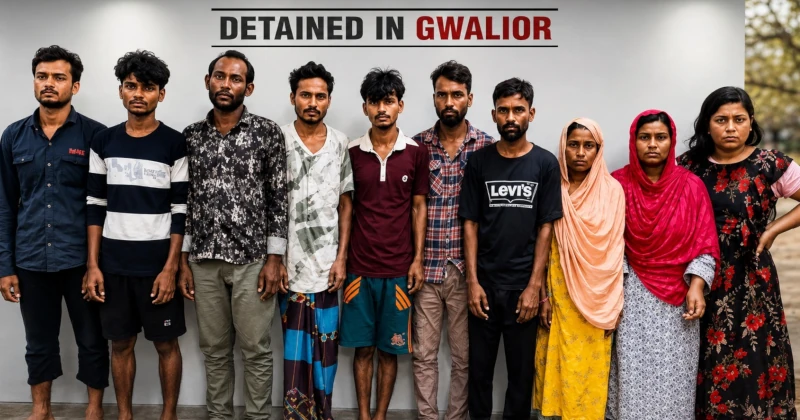
Gwalior: Suspected foreign nationals have once again been detained in Gwalior, Madhya Pradesh. The Crime Branch’s action of taking 13 suspected individuals, including three women and three children, into custody is part of a continuing series of incidents over the past decade where Bangladeshi nationals residing illegally have been apprehended in various cities across Madhya Pradesh.
Investigative agencies are now working to determine how these individuals entered India, who sheltered them and whether an organised network is operating behind them. The Crime Branch had received intelligence indicating that individuals lacking Indian citizenship or valid residency documents were living in certain peripheral areas and slums of the city. Acting on this information, the police conducted simultaneous raids at three locations on the morning of August 5 and detained the 13 suspects.
According to the police, the detained group comprises seven men, three women, and three minor children. During preliminary questioning, they failed to produce Aadhaar cards, voter ID cards, or any documents proving legal residence in India. Authorities are currently verifying their citizenship status, method of entry into India, duration of stay, and local contacts.
Claims of Links to Various Districts in Bangladesh
Police state that during interrogation, the individuals identified themselves as residents of Khulna, Dhaka and other regions of Bangladesh. The group includes Shakeel Khan, Kajal Khan, Yusuf Sheikh, Salma Sheikh, Jamal Mulla, Jumman Mulla, Mohammad Malik, Mohammad Nuber, and Rehan Khan, among others. Three young children were also found with them.
Focus of Investigation: Fake Identities and Local Networks
The police are examining the suspects’ mobile phones, available documents and local contacts. Investigations are underway to determine who facilitated the creation of any fake Aadhaar cards, ration cards, or other identity documents they may possess. Authorities are also investigating whether any local gangs or agents were facilitating employment, rental housing, or identity documents for them. The police hope that interrogation might expose networks involved in settling illegal infiltrators in various parts of the country.
Preparations to Send Them to a Detention Centre
Gwalior SSP Dharamveer Singh Yadav stated that legal action would be taken in accordance with regulations once the verification process is complete. If the investigation confirms they are foreign nationals residing illegally in India, they will be placed in a detention or holding centre, in compliance with Supreme Court guidelines. The district administration has already been sent the necessary correspondence regarding this.
Major Revelation in October 2025
This is not the first time such action has been taken in Gwalior. In October 2025, acting on intelligence received from the Haryana Police, eight suspected Bangladeshi nationals were apprehended in the Maharajpura area of Gwalior. At that time, too, they were sent to a detention centre, and central security agencies investigated the matter. The current operation is viewed as the next significant step in that ongoing series of actions.
It is noteworthy that incidents of suspected Bangladeshi nationals living illegally being apprehended have frequently come to light across various districts of Madhya Pradesh. On several occasions in Bhopal, police detained suspected foreign nationals who were residing in rented accommodations and possessing forged Aadhaar cards. In Indore, document verification drives led to the exposure of suspected Bangladeshi nationals and gangs involved in creating fake identity documents.
Action was also taken against suspected foreign nationals living in areas linked to railway work and manual labour in Jabalpur and Khandwa. Investigation drives targeting illegal entrants were also conducted periodically along border routes and transit corridors, such as those in Ratlam and Burhanpur. Following the arrest of eight suspected Bangladeshis in Gwalior in October 2025, this operation in August 2026 is now considered one of the state’s most significant actions of its kind.
Challenges Facing National Security and Administration
Advocate Ranjeet Sangle, National President of the Bharat Raksha Manch, states, “The issue is not limited to the 13 suspected Bangladeshi infiltrators apprehended in Gwalior; such incidents are constantly surfacing across the country, and infiltrators are being caught on a large scale in almost every state. For the past 12 years, our organization has been demanding that the central government identify and deport Bangladeshi infiltrators, efforts that are now yielding results. However, the indigenous society of India, along with the specific community of Indian Muslims, must come forward to address this; these Bangladeshis are effectively usurping jobs meant for Indians and a massive public campaign is needed to tackle this.”
Advocate Sangle further believes, “Illegal infiltration is not merely a law-and-order issue; it is also linked to national security, demographic balance, the credibility of identification systems, and the misuse of government schemes. If a foreign national resides in the country for years using forged documents, it reflects a failure of the local administration and the administrative machinery at multiple levels. Therefore, everyone must treat this matter with the seriousness it deserves.”
He acknowledges, however, that in recent years, central and state governments have intensified joint operations, incorporating tenant verification, digital document checks and intelligence-based actions, which are now producing results in the national interest. Meanwhile, Gangadhar Lende, National Vice President of the Bharat Raksha Manch, asserts that opposition to infiltration must become a movement driven by the common people; only by transforming this into a widespread campaign can infiltrators be easily identified wherever they may be hiding across the country.