Remembering the August 1998 Chamba Massacre of Hindus
September 12, 2026
  • Read Ecopy
  • Circulation
  • Advertise
  • Careers
  • About Us
  • Contact Us
Android AppiPhone AppArattai
Organiser
  • ‌
  • Bharat
    • Assam
    • Bihar
    • Chhattisgarh
    • Jharkhand
    • Maharashtra
    • View All States
  • World
    • Asia
    • Europe
    • North America
    • South America
    • Africa
    • Australia
  • Editorial
  • International
  • Opinion
  • RSS @ 100
  • More
    • World Hindu Congress 2026
    • Op Sindoor
    • Analysis
    • Sports
    • Defence
    • Politics
    • Business
    • Economy
    • Culture
    • Special Report
    • Sci & Tech
    • Entertainment
    • G20
    • Azadi Ka Amrit Mahotsav
    • Vocal4Local
    • Web Stories
    • Education
    • Employment
    • Books
    • Interviews
    • Travel
    • Law
    • Health
    • Obituary
  • Subscribe
    • Subscribe Print Edition
    • Subscribe Ecopy
    • Read Ecopy
  • ‌
  • Bharat
    • Assam
    • Bihar
    • Chhattisgarh
    • Jharkhand
    • Maharashtra
    • View All States
  • World
    • Asia
    • Europe
    • North America
    • South America
    • Africa
    • Australia
  • Editorial
  • International
  • Opinion
  • RSS @ 100
  • More
    • World Hindu Congress 2026
    • Op Sindoor
    • Analysis
    • Sports
    • Defence
    • Politics
    • Business
    • Economy
    • Culture
    • Special Report
    • Sci & Tech
    • Entertainment
    • G20
    • Azadi Ka Amrit Mahotsav
    • Vocal4Local
    • Web Stories
    • Education
    • Employment
    • Books
    • Interviews
    • Travel
    • Law
    • Health
    • Obituary
  • Subscribe
    • Subscribe Print Edition
    • Subscribe Ecopy
    • Read Ecopy
Organiser
  • Home
  • Bharat
  • World
  • Operation Sindoor
  • Editorial
  • Analysis
  • Opinion
  • Culture
  • Defence
  • International Edition
  • RSS @ 100
  • Magazine
  • Read Ecopy
Home Bharat

Forgotten Blood: Remembering the August 1998 Chamba Massacre of Hindus

The August 1998 Chamba massacre claimed the lives of 35 Hindu labourers in twin terrorist attacks in Himachal Pradesh's Chamba district, marking one of the deadliest spillovers of militancy beyond J&K.

Kapil GanjooKapil Ganjoo
Aug 3, 2026, 05:00 pm IST
inBharat, World, Jammu and Kashmir
Follow on Google News
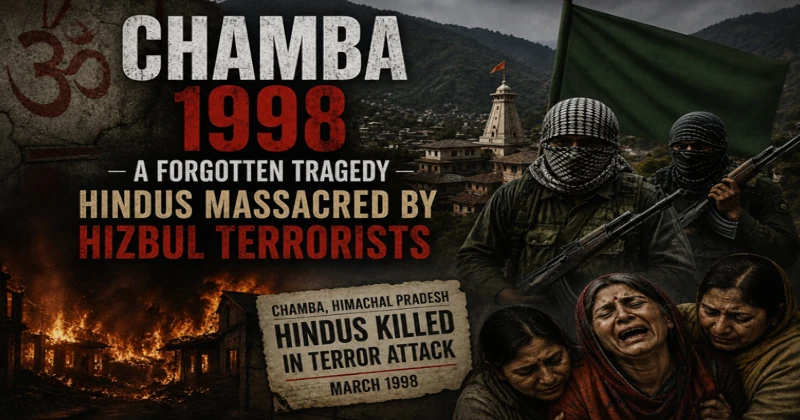
August 1998 Chamba Massacre (AI-generated Image)

August 1998 Chamba Massacre (AI-generated Image)

Facebook
Twitter
WhatsAppTelegramEmail

In the Indian subcontinent, the inception of Islamic terrorism began with the Soviet Invasion of Afghanistan from 1979 to 1989 till Soviet withdrawal from Afghanistan. During this time, Pakistan, due to the war in Afghanistan, became the favorite of NATO (North Atlantic Treaty Organisation) against Communist Soviet Union. Meanwhile, in Pakistan in 1977, General Zia ul Haq took over the power, and he turned Pakistan to a radical Muslim state. In the Afghanistan war, Zia ul Haq received billions of dollars of cash and arms from NATO Countries and oil-rich Gulf nations because Pakistan was a geopolitical hub during this time. Now, because of this flow of money and materials, the Bin Qasim port of Karachi became the hub of the Pakistani economy, and its army and ISI (Inter-Service Intelligence) thrived.

General Zia Ul Haq in mid early 80’s decided to create a havoc of terrorism in India because in 1971 India divided Pakistan into two parts, today’s Pakistan and Bangladesh. So, Zia decided to take revenge for this defeat by diving into India. Meanwhile, in 1986, in the Afghanistan war, the entry of Osama Bin Laden changed the war dynamics and the Pakistani army because of the billions of dollars that they received from NATO and oil-rich Gulf countries, along with weapons and tens of thousands of Mujahidin Whom Pakistani army was training for combat, they decided to invade Kashmir and also supported the Khalistan terror in Punjab.

Kashmir Insurgency

Kashmir was very important for Pakistan since its inception in 1947. Because water from J&K (Indus Valley) was feeding 85 per cent of Pakistan’s population and 90 per cent of its agricultural and industrial output. Secondly, Kashmir has a Muslim majority status, but the king was Hindu, so he decided to merge with the ‘Union of India,’ which Pakistan always opposed. But, by 1986, as the Soviet economy started crumbling and Islamic Mujahedin (Jihadis) were overtaking Afghanistan Pakistani army along with huge money, arms, and thousands of trained Jihadis invaded Kashmir. So, in 1986, hundreds of Islamic infiltrators invaded the Indian territory of Kashmir, which led to the Anantnag riots, where hundreds of Kashmiri Hindus (Pandits) were killed.

Even though the Indian Border Forces and intelligence were issuing warnings to the Central Congress Government about it. But then government was not serious about stopping this infiltration along the border.

Now, in 1989, Soviet troops withdrew from Afghanistan, so Pakistan, without wasting time, shifted Islamic Jihadis to Kashmir, and the outbreak of Islamic terrorism began in the Kashmir valley. By late 1989 and early 1990, several Kashmiri Hindus were killed, and 300,000 were expelled within months because of security failures.

Now, after the decisive early success in the Kashmir valley, the Islamic Jihadis decided to invade the Chenab valley in the Jammu region. Now, Chenab valley, unlike other parts of Jammu, has linguistic and cultural similarities with Kashmir valley, especially Muslims, and almost all the Muslims in Chenab valley are Kashmiri Muslims and speak the Kashmiri language. So, they decided to join with the Kashmiri Muslims of the valley and wipe out the Hindus in the Chenab valley and other parts of Jammu, and then invade the other regions of India.

After the beginning of full-fledged Islamic terror in Chenab valley in the early 90s, the Jihadis tried to invade other parts of the Jammu region, especially the Dogra community, because that is the dominant Hindu community in the Jammu region and Himachal Pradesh, especially the western districts of Himachal Pradesh, which are culturally part of the Jammu region.

Even though in the beginning, Islamic terrorism was furthered by section of  Kashmiri Muslims, but later Gujjars, Bakerwals, and Pothwari Muslims of the Rajouri and Poonch region also joined the Jihadist Movement.

Chamba Massacre (1998)

Now, in August 2-3 1998, in Chamba, because of its border with Chenab valley (then Doda district), the terrorists from the Gujjar and Bakerwal community invaded Chamba and killed the Hindu laborers, especially from the Gujjar and Bakerwal (Gaddi) community. In this incident, the massacre took place in two separate incidents at Kalaban and Satrundi. Meanwhile, 26 people were killed in Kalaban region, and then nearly 9 people were killed in Satrundi, leading to a death toll of 35 people. Terrorists used the dense forest location of the border. Now, because of this massacre, there were clashes between the Hindu (Gaddis) and Muslim (Gaddis) along the borders of Jammu and Himachal.

Also Read: Rashtra Kavi Maithili Sharan Gupt Birth Anniversary: Remembering poet who gave voice to India’s national spirit

The mastermind of this incident was Billu Gujjar, a top Hizbul terrorist who belongs to the Muslim (Gaddi) community. Billu Gujjar was a native of the Gool region in today’s Ramban district, part of the Chenab valley.

He was arrested by the Punjab police in Pathankot after a few days, and he was jailed then. But in September 2006, Billu Gujjar was killed by the J&K police in an encounter.

The aims of Jihadists in Pakistan were not just to subsume the Kashmir valley or state of J&K, but they also want to occupy the other parts of the country as part of their ‘Gajwa-E-Hind’. So this Chamba incident shows their clear intentions. But the tremendous resistance from the Hindu communities in the Jammu region and the armed forces during the counterinsurgency drive (Mid 90’s) the Jihadist elements were contained to the Kashmir valley only.

Topics: 1998 Chamba MassacreChamba MassacrePakistani economyHindusKashmir ValleyKashmiri Muslims
Kapil Ganjoo
Kapil Ganjoo
Academic and Researcher with a strong foundation in law and history. He completed his B.A. LL.B. graduation, followed by a Master’s degree in History (M.A.). Currently, he is serving as an Assistant Professor at the Center for Indic Studies at Indus University. [Read more]
Share
Tweet
SendShareSend
✮ Subscribe Organiser YouTube Channel. ✮
✮ Join Organiser's WhatsApp channel for Nationalist views beyond the news. ✮
Previous News

Sheikh Hasina’s first public appearance since leaving Bangladesh; Will she hint at return to Dhaka & political future?

Next News

Tamil Nadu: DMK’s A Raja, Kanimozhi criticise the Vande Mataram law; Hindu Munnani condemns Raja’s Partition analogy

Related News

RSS Sarsanghchalak Dr Mohan Bhgawat answer the questions in London at Universal Oneness event

RSS@100 event in London: Dr Mohan Bhagwat answers from Hindutva to Youth to Loyalty to Britain

(Left) RSS Sarsanghchalak Dr Mohan Bhgawat (Right) Bawa Jain, Secretary General, World Council of Religious Leaders

Mohan Bhagwat’s ‘If any Hindu thinks there is no Muslim in Bharat’ remark: Bawa Jain says it opens a new dialogue

Shocking: Islamic cleric attributes his own misogynistic claims to the founder of Islam

Hindu minor, Sourabh Chandra Roy, was allegedly dragged into a mosque in Bangladesh’s Lalmonirhat

Bangladesh: Hindu minor allegedly dragged into Mosque and brutally beaten in Kaliganj

‘Conversion Drive’ sparks Hindu protest in West Bengal: Argentina missionary confronted in Hingalganj

“Hindus and Sikhs may follow different religions, but we share same values & spirit: Sikh Leader Kashmir Singh Dhaliwal

Load More

Latest News

RSS Akhil Bharatiya Karyakarini Sadasya Dr Manmohan Vaidya at a Pramukh Jan Samvad Sangosthi organised by Kashi Mahanagar on the occasion of the RSS Centenary Year,

Entire society must unite with a sense of oneness; This Is the spirit of Sangh Work: Dr Manmohan Vaidya

‘Samuel Could Never Do This’: Mother Rejects Blasphemy Allegations Against Son in Lahore

Pakistan Blasphemy Case: Mother of Christian man Samuel Arif claims false implication, seeks justice

Prime Minister Narendra Modi, along with Chinese President Xi Jinping, Russian President Vladimir Putin and other world leaders, poses for a picture at a joint tree plantation initiative during the BRICS Summit

BRICS Summit 2026: India as the voice of Global South, shared responsibilities & scripting inclusive world order

Chinese President Xi Jinping and Prime Minister Narendra Modi

BRICS Summit 2026: PM Modi hold talks with President Xi; Stresses border peace & tranquility as key to India-China ties

Tamil Nadu: Hindu Munnani flags TVK govt’s restrictions on Vinayaka pandals, barring women, children from processions

Lashkar-e-Toiba founder Hafiz Saeed. (File image)

J&K Terror Case: Hafiz Saeed gets second NBW; NIA says he operates from Pakistan

Pakistan’s push for a place in the expanding BRICS bloc faces a difficult diplomatic road ahead, despite backing from key partners.

Pakistan knocking BRICS Door: Why Islamabad’s 2023 membership bid remains elusive despite Chinese and Russian support

BRICS Bazaar

BRICS Bazaar: Global traditions and cultural diplomacy take center stage at New Delhi’s National Crafts Museum

(From Left to Right): Russian President Vladimir Putin, PM Modi & Chinese President Xi Jinping

BRICS New Delhi Declaration | Key Takeaways: Cross-border payment, counter-terrorism to tech ties & supply resilience

New Delhi, Sep 12 (ANI): Prime Minister Narendra Modi, along with Chinese President Xi Jinping, Russian President Vladimir Putin and other world leaders, poses for a picture at a joint tree plantation initiative during the BRICS Summit at Bharat Mandapam, in New Delhi on Saturday. (Narendra Modi Photo Gallery/ANI Photo)

BRICS Summit 2026: Multilateralism through strategic partnership; Charting the roadmap for future

Load More
  • Privacy
  • Terms
  • Cookie Policy
  • Refund and Cancellation
  • Delivery and Shipping

© Bharat Prakashan (Delhi) Limited.
Tech-enabled by Ananthapuri Technologies

  • Home
  • Search Organiser
  • Bharat
    • Assam
    • Bihar
    • Chhattisgarh
    • Jharkhand
    • Maharashtra
    • View All States
  • World
    • Asia
    • Africa
    • North America
    • South America
    • Europe
    • Australia
  • Editorial
  • Operation Sindoor
  • Opinion
  • Analysis
  • Defence
  • Culture
  • Sports
  • Business
  • RSS @ 100
  • Entertainment
  • More ..
    • Sci & Tech
    • Vocal4Local
    • Special Report
    • Education
    • Employment
    • Books
    • Interviews
    • Travel
    • Health
    • Politics
    • Law
    • Economy
    • Obituary
  • Subscribe Magazine
  • Read Ecopy
  • Advertise
  • Circulation
  • Careers
  • About Us
  • Contact Us
  • Policies & Terms
    • Privacy Policy
    • Cookie Policy
    • Refund and Cancellation
    • Terms of Use

© Bharat Prakashan (Delhi) Limited.
Tech-enabled by Ananthapuri Technologies