August 15, 1947… The Tiranga was flying with full glory atop the Red Fort in Delhi. The dream of independence had materialised in the eyes of crores of Indians; yet, at that moment, a part of ‘Bharat Maataa’ remained shackled in the chains of foreign subjugation. Portuguese rule maintained a cruel grip over the land of Dadra and Nagar Haveli. The tribal communities and ordinary citizens residing there looked towards independent India with eyes full of hope.
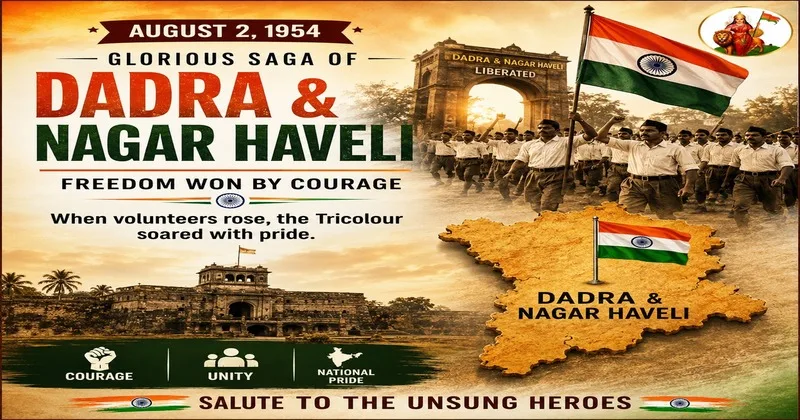
Circumstances were such that diplomacy was silent and the government felt helpless, but patriotism was not one to remain silent! Disregarding their own lives, volunteers of the Rashtriya Swayamsevak Sangh (RSS) displayed such courage that, on the morning of August 2, 1954, the Indian Tiranga was hoisted with pride on the soil of Dadra and Nagar Haveli for the first time. It was a proclamation of national consciousness, proving that when the nation is placed above all else, history writes a new chapter through the hands of a few dedicated individuals.
When the Organisation Prioritised ‘Rashtra-Dharma’
According to source material, a well-planned strategy to liberate Dadra and Nagar Haveli was devised under the guidance of the then ‘Sarsanghchalak’ of the RSS, the revered Shri Guruji Madhav Sadashiv Golwalkar. In this campaign, disciplined RSS volunteers worked alongside the ‘Azad Gomantak Dal’ and the ‘United Front of Goans’.
The campaign was orchestrated with Pune as its base. Volunteers were trained, resources were mobilized and the entire operation was kept highly confidential. According to information cited in various sources, renowned music composer Sudhir Phadke, Bharat Ratna Lata Mangeshkar and the legendary singer Mohammed Rafi raised financial support for this campaign through a special musical program.
This was undoubtedly a unique example of the national consciousness of that era, a time when even artists were dedicating themselves to the national interest. In his book “The Liberation of Goa”, Dr. P.D. Gaitonde notes that volunteers from Pune played a remarkable role in arranging arms and supplies. Meanwhile, Nilesh Kulkarni’s book “Uprising: The Liberation of Dadra and Nagar Haveli” (HarperCollins India, 2024) provides a detailed account of the background, organisation and strategy of this entire campaign.
The Courage of 29 Heroes Against a Force of 300 Armed Soldiers
The campaign gained momentum with the liberation of Dadra on July 22, 1954, but the decisive battle was to take place in Silvassa. According to historical records, on the night of August 1, 1954, a mere 29 volunteers and revolutionaries, led by Rajabhau Wakankar and Vishwanath Lavande, set out towards the Portuguese outpost.
They possessed only a few pistols and old rifles, whereas they faced hundreds of Portuguese soldiers equipped with modern weaponry. Amidst such daunting odds, the volunteers employed a brilliant psychological strategy. Through thunderous chants of “Bharat Mata Ki Jai” and “Har-Har Mahadev,” they created an atmosphere that led the Portuguese soldiers to believe a massive Indian army had arrived. In a sense, this was a triumph of indomitable self-confidence, organization and patriotism.
Names That History Will Always Remember
Indeed, there are many names that serve as sources of inspiration in this saga of the liberation of Dadra and Nagar Haveli. Rajabhau Wakankar led from the front lines, while Vishwanath Lavande played a pivotal role in the decisive conflict. Many activists, such as Babasaheb Purandare, Prabhakar Kulkarni, Nana Kajrekar and Prabhakar Sinari, contributed to the success of this campaign; however, the greatest strength of this struggle lay in the nameless tribal families who guided volunteers through the forests, provided food and risked their lives in defiance of foreign rule. Though their names may rarely appear in the annals of history, their contribution to this victory remains indelible.
August 2, 1954: When the Tiranga Soared with Pride
Following a night-long struggle, the morning of August 2, 1954, brought the historic moment that had been awaited for years. The Portuguese flag was lowered and India’s Tiranga was hoisted atop the government building with full honour and pride. That moment signified more than just a change of flags; it marked the end of subjugation. Tears welled up in the eyes of the local people, tears that flowed spontaneously from the sheer joy and excitement of freedom. Amidst chants of “Bharat Mata Ki Jai” and “Vande Mataram,” Dadra and Nagar Haveli felt itself, for the first time, to be an integral part of independent India.
A Unique Seven-Year Transition and Eventual Full Integration
Following liberation, the administrative system in Dadra and Nagar Haveli was managed with the cooperation of local leadership. Historical records mention the formation of a senior ‘panchayat’ and the establishment of an administrative framework. Ultimately, on August 11, 1961, the territory was formally designated as a Union Territory of India through the Tenth Amendment to the Constitution. Shortly thereafter, on December 19, 1961, the Indian Armed Forces liberated Goa, Daman and Diu from Portuguese rule, thereby completing the consolidation of India’s territorial integrity.
From the Pages of History to National Consciousness
The liberation of Dadra and Nagar Haveli was, in essence, a triumph of the national resolve demonstrated by “Swayamsevaks”. It proved that while national self-respect may be safeguarded by government decisions, it is often equally preserved through the awakened consciousness of society and the sacrifices of dedicated individuals.
Today, as we take pride in the achievements of independent India, the day of August 2, 1954, deserves to be remembered with equal reverence. The “Swayamsevaks” of the Rashtriya Swayamsevak Sangh, the revolutionaries of the Azad Gomantak Dal, the local tribal community, and all those unsung patriots who dedicated their present to the nation’s future, they are truly the unseen sentinels of independent India, whose saga can never be fully recounted.
As the Tiranga flutters in the breeze here today, the memory of that historic morning in Dadra and Nagar Haveli rises before us, a morning that demonstrated that if the resolve for patriotism is unwavering, even the strongest chains of history can be shattered and the Tiranga of ‘Bharat maataa’ will ultimately soar victoriously in the sky.