
“What we call public spirit is simply the reflex in a given personality of the civic consciousness. That is to say, public spirit is the expression of that character which is born of constantly placing the ego, with the same intensity as in the family, in a more complex group. There thus come into being new duties and new responsibilities, and the ideal of civic integrity towers above all the lower and more private achievements of the kindred, or the clan”
– Sister Nivedita, The Civic Ideal (Civic Ideal and Indian Nationality), The Complete Works of Sister Nivedita, Vol IV, Adwaita Ashram, Calcutta, 1996, p. 213
After the Jantar Mantar protest in New Delhi, amid a mix of genuine and manufactured concerns over various issues, including the paper leaks, the focus now shifted to the Parliament. Both Houses have passed the Public Examinations (Prevention of Unfair Means) Amendment Bill, 2026, to restore trust in the examination system with stricter punitive actions. Another issue that might lead to heated national debate is that a few ‘civil society’ organisations supported by the Opposition have already started a campaign to stall the amendment to the Foreign Currency Regulation Act (FCRA). When all over the world, the two trends are visible – the networks of Non-Government Organisations (NGOs) are projected as the ‘conscience of humanity’. In contrast, the same networks are viewed with suspicion due to their ‘dubious actions’ that go against the values they preach. Hence, we need to dissect the proposed amendments and their purpose rationally.
The term (NGO) is generally considered as an entity driven by some cause, primarily focusing on socio-economic, humanitarian, or environmental issues and operating independently of Government control. Though it was first referred to in the 1945 UN Charter, the NGO sector has become more complex in character after economic liberalisation. Now, foreign and corporate funds are involved along with Government and individual donations. While most NGOs are non-profit, their fund utilisation has always been under the scanner across the board. Originally, they were meant to support State activities and fill in the service delivery gaps. Later, advocacy of certain issues mainly concerning marginalised groups and sustainability added to the kitty, along with activism for enhancing Government accountability. Now it has become one of the largest, rapidly growing sectors, fuelled by a combination of State welfare failures and increased international funding.
As per the World Economic Forum (WEF) data, there are more than 10 million social enterprises that are active in nature, generating around $ 2 trillion in annual revenue and 200 million jobs. Bharat has one of the world’s largest NGO ecosystems with an estimated over 3.4 million registered organisations across societies, trusts, and Section 8 companies, though only a fraction of them are fully active and professionally managed. As per the Ministry of Home Affairs (2024–25), around 35,000 NGOs hold valid FCRA licences, which is down from over 50,000 a decade earlier. Obviously, Bharat is a huge playground for international players to set and influence the Government agenda. Hence, the FCRA is meant to provide a legal framework enabling genuine international cooperation in the social sector while ensuring the flow and utilisation of foreign contributions in accordance with Bharatiya law.
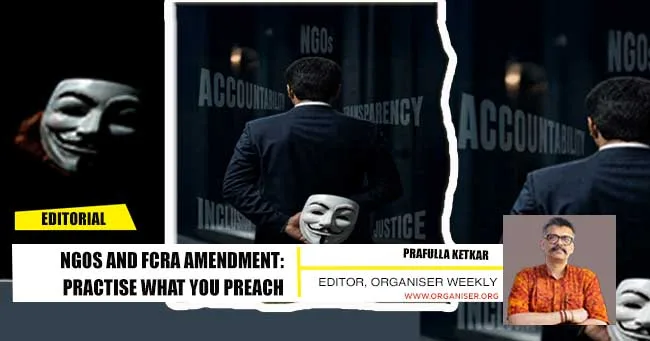
Unfortunately, over a period of time, many entities have developed vested interests in the NGO business. Instead of utilising the funds received, they were spent on administrative heads and personal comforts of the self-proclaimed activists. A vibrant democracy like Bharat has become a playground for foreign actors, both governmental and non-governmental, to pump funds to further their agenda. Organisations like Amnesty International and Greenpeace faced allegations of diverting funds and generating biased reports. In 2015, the Central Bureau of Investigation (CBI) informed the apex court that less than ten per cent of NGOs had submitted their returns, balance sheets, and other financial details to the authorities. On January 10, 2017, the Supreme Court of Bharat ordered a complete audit of nearly 30 lakh NGOs receiving public or foreign funds, directing civil and criminal action against defaulters. Some estimates based on the intelligence report suggest NGO activism causes a 2-3 per cent loss to Bharat’s economy, mainly due to the stalling of development projects. Ironically, these very NGOs advocate accountability and transparency from the government and refuse to comply with the same. They talk about inclusion and human rights of marginalised social groups but divert donations received for them to the personal comforts of the trustees. Misusing funds received for education and healthcare for proselytisation is another grave concern as it tramples the indigenous identity, practices and unique traditions. Ideological overtones and corporate interests define the agenda and advocacy issues of many NGOs, instead of the real requirements of Bharat. Due to this industrial-scale hypocrisy by some, the entire sector is facing a credibility crisis.
Since 2020, a series of reforms in facilitating foreign contributions while ensuring transparency and accountability have been introduced. The 2026 reforms address the specific purpose clause for fund utilisation and asset management-related issues in case the FCRA licence is cancelled. The proposed FCRA Amendments propose a designated authority to safeguard foreign-funded assets when a registration lapses or is cancelled. The notified FCRA Amendment Rules link registration to specified purposes within approved States/UTs’ area of operations and exclude proselytisation from permitted religious activity.
If donations are raised in the name of a specific cause, what is wrong in expecting to utilise it for the same purpose? Is the NGO industry above and beyond the law of the land? If the legal framework is not followed, why should such entities be allowed to amass properties in the name of social service? Can we allow a foreign subversive agenda to penetrate our democracy through these proxies? In a way, this is a question of the country’s sovereignty and security. In fact, CAPART-like agencies should implement these laws more effectively to ensure every penny received is spent for the desired cause.
Bharat also has an age-old tradition of Dana – the donation given with the sense of civic duty with an organic relationship as articulated by Sister Nivedita. Social structures and institutions, including temples, were meant to fulfil these very activities. The state was supposed to be the facilitator of the welfare activities undertaken by the society. The colonisation and Western model of Government-centric welfarism destroyed the Swadeshi autonomous social systems. The service has to be natural, transparent, without any expectations or fraudulent means, has been the Bharatiya concept. The agenda-driven, proselytising act cannot be a service but a profiteering business. The proposed amendments should not be seen as a threat to NGOs, civil society or any particular religious community. Rather, it is an attempt to secure the very foundation of accountability and transparency and restore the credibility of the NGOs that truly want to serve the people with commitment and conviction of volunteers.