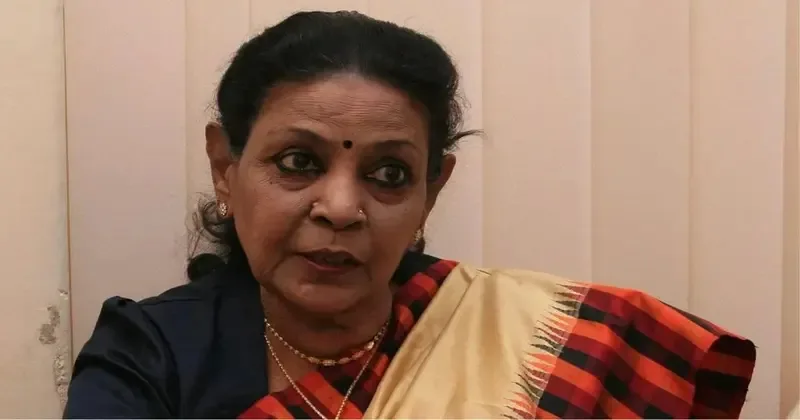
Bengaluru: Veteran South Indian playback singer K. Jamuna Rani, whose distinctive voice captivated audiences across Tamil, Telugu, Kannada, Malayalam and Sinhala cinema for over six decades, passed away at an old-age home in Bengaluru on July 30. She was 88. She was cremated the same day at a crematorium in Jeevanahalli near Cox Town, while news of her demise became public only on July 31.
Born on May 7, 1938, in Andhra Pradesh to K. Varadharajulu and violinist K. Droupathy, Jamuna Rani recorded more than 6,000 songs in Tamil, Telugu, Kannada, Malayalam and Sinhala. She began her playback career at the age of seven with the Telugu film Tyagayya (1946) and went on to become one of South India’s most celebrated playback singers during the 1950s and 1960s.
Her mother’s training enabled her to stand before the microphone and sing from a very young age. By the time she was 13, she had already spent six years as a professional singer. Choosing to remain unmarried throughout her life, Jamuna Rani built a remarkable career spanning more than six decades. She was known for possessing a vocal range that could effortlessly match T.M.
Soundararajan’s in the famous hit Yaaradi Nee Mohini from Sivaji Ganesan-starrer Uthama Puthran. Composed in a Western style, the song showcased her versatility, while her voice also blended folk flavour, native idiom and rhythmic vitality, allowing her to excel in a wide range of compositions. She moved to the Tamil film industry in 1952.
Jamuna Rani worked with eminent music composers, including G. Ramanathan, Viswanathan–Ramamoorthy, V. Kumar and several leading Telugu music directors. Her duet with comedian-singer J.P. Chandrababu, Kungumapoove, Konjum Purave, became a super hit, while Mama Mama Mama remains popular for its infectious rhythm and folk flavour. Though she dominated playback singing during the 1950s and 1960s, she continued to record songs into the 1980s. Ilaiyaraaja later brought her back for Kamal Haasan-starrer Nayakan, where she and M.S. Rajeswari rendered the memorable Naan Sirithal Deepavali.
Jamuna Rani also became a household name in Sri Lanka, where she first sang for Sujatha in 1953 under Ananda Samarakoon, the composer of Sri Lanka’s National Anthem. She went on to sing in several successful Sinhala films. Her debut duet with A.M. Raja in Seda Sulang remains one of the most cherished songs in Sinhala cinema. She earned the rare distinction of remaining one of the most popular Indian playback singers in Sri Lanka, where her voice became deeply embedded in the island’s musical culture.
Among her many memorable songs are O Devadas from Devadas (1953), Aasaiyum Nesamum from Gulebakavali (1955), Yaaradi Nee Mohini, Kungumapoove, Konjum Purave, Mama Mama Mama, and Naan Sirithal Deepavali.
Jamuna Rani made her Tamil playback debut with Onnu Rendu Moonu and Success Success in the 1952 film Kalyani, songs that firmly established her in Tamil cinema. However, changing trends and technological developments reduced playback opportunities from the 1970s onwards. In 1987, music composer Ilaiyaraaja and filmmaker Mani Ratnam selected her for Nayakan, marking a successful return to the recording studio.
She later recorded songs alongside veteran singer Jikki and made two final Telugu playback appearances in Varudu (2010) and Mithunam (2012), when she was 74. With Jamuna Rani’s passing, the South Indian film industry has lost another versatile playback singer following the demise of S. Janaki on July 11. Incidentally, both legendary singers hailed from the erstwhile undivided Andhra Pradesh.