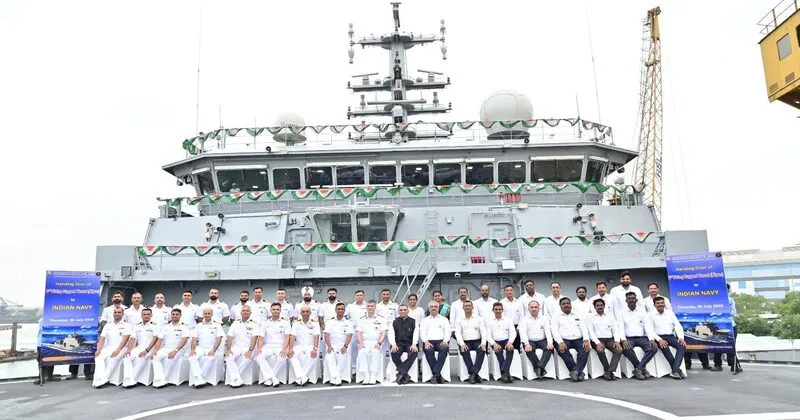
The Indian Navy on July 30, Thursday inducted ‘Nipun’, the second indigenous Diving Support Vessel (DSV) built by Hindustan Shipyard Limited (HSL) in Visakhapatnam. Nipun marks a milestone in strengthening the country’s deep-sea diving, underwater salvage and submarine rescue capabilities in the Indian Ocean Region(IOR) and the Indo-Pacific. It is also another major push to the Aatmanirbhar Bharat and defence indigenisation goal of the country.
The vessel was formally handed over to the Navy at Visakhapatnam following the signing of the Acceptance Document (D448) by Rear Admiral Arvind Rawal, VSM, Chief Staff Officer (Technical), Western Naval Command and Chairman of the D448 Committee and Rear Admiral Chandrasekharan Raghuram, VSM (Retd.), Chairman and Managing Director of HSL.
The delivery comes nearly a year after HSL handed over the class’s lead vessel, INS Nistar, which was commissioned in July 2025. Both Nistar and Nipun were launched together at HSL’s Visakhapatnam yard in September 2022, marking a significant milestone in the development of India’s indigenous underwater support capabilities.
Nipun to bolster deep-sea diving, submarine rescue operations
Named after the Sanskrit word Nipun, meaning one who is adept, capable and well-versed in a particular discipline, the vessel has been designed as a highly specialised platform for deep-sea diving, underwater salvage and has advanced capabilities to swiftly respond to the submarine emergencies in the maritime domain.
Nipun measures around 118 metres and displaces more than 8,560 tonnes. The vessel incorporates a high degree of indigenous content, estimated at nearly 75 per cent, reflecting India’s growing ability to design and build sophisticated naval platforms domestically.
Nipun is equipped with advanced diving systems capable of conducting deep-sea saturation diving, a specialised technique that allows divers to operate at considerable depths for extended periods. A side diving stage further supports underwater diving operations.
The vessel is also fitted with state-of-the-art Remotely Operated Vehicles (ROVs), which extend its operational reach by supporting diver monitoring, underwater inspection and deep-sea salvage missions. Its Dynamic Positioning, saturation diving, submarine rescue and deep-sea intervention systems make it a comprehensive platform for complex underwater operations.
One of its most critical roles of Nipun will be to serve as the mother ship for the Indian Navy’s Deep Submergence Rescue Vessel (DSRV). In the event of a submarine accident or emergency, the platform can facilitate the deployment of rescue assets and enable the evacuation of personnel trapped aboard a disabled submarine.
Diving Support Vessels strengthen India’s underwater rescue architecture
The induction of Nipun assumes greater significance as India continues to expand and modernise its submarine fleet. Submarine rescue is among the most demanding naval operations, requiring specialised platforms capable of reaching considerable depths and supporting rescue teams in difficult underwater conditions.
With two dedicated Diving Support Vessels now available, the Navy’s ability to sustain and coordinate submarine rescue operations across India’s eastern and western seaboards is expected to improve significantly. The capability also reduces dependence on external assistance during underwater emergencies and strengthens the Indian Navy’s operational readiness.
The vessels are particularly important for the Indian Ocean Region(IOR), where India is seeking to expand its role as a reliable maritime security provider. Previously, at the commissioning of INS Nistar, Chief of the Naval Staff Admiral Dinesh K. Tripathi had described the vessel as a “crucial operational enabler” in India’s ambition to emerge as a “Preferred Submarine Rescue Partner” for the region.
The delivery of the second DSV within roughly a year after INS Nistar is therefore more than another addition to the Navy’s fleet. It represents a significant step in India’s efforts to build specialised underwater capabilities domestically, strengthen submarine crew safety and enhance maritime preparedness, in an era where conventional and nuclear-powered submarines are increasing their footprint in the maritime operations to consolidate security architecture.
While maritime domain emerges as increasingly contentious zone in the geopolitical chessboard submarine rescue capabilities are equally vital along with building submarine defence capabilities. In this direction, Nipun, as a Diving Support Vessel(DSV) forms a strategic asset for the Indian Navy and to foster larger maritime security.
The DSV programme also demonstrates India’s ability to execute complex, high-value naval projects. The construction of Nipun also generated significant economic activity across the local industrial ecosystem, with around 120 small and medium enterprises contributing to the project.