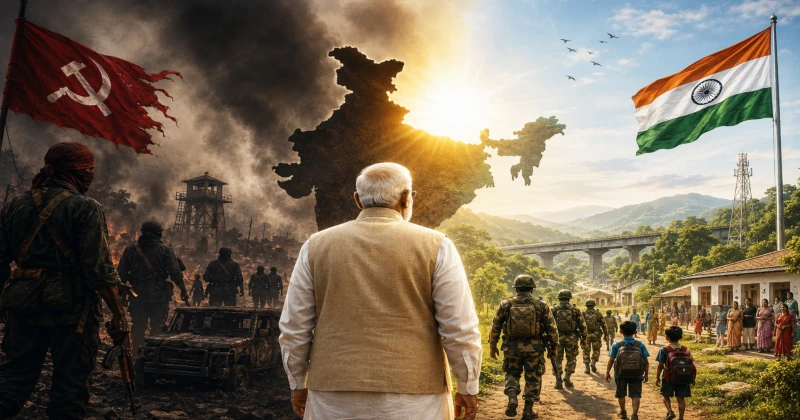
New Delhi: For decades, the spectre of Maoist violence cast a long shadow over India’s internal security. Vast swathes of the country, stretching from Andhra Pradesh to Bihar and from Chhattisgarh to Jharkhand, formed what came to be known as the “Red Corridor” territories where the writ of the Indian State was repeatedly challenged by armed Maoist insurgents. Thousands of civilians and security personnel lost their lives as Maoism emerged as one of independent India’s gravest security crises.
Now, in what the Union Government has described as a historic milestone, the Ministry of Home Affairs (MHA) has announced that India has become effectively free from Maoism, with no district remaining in the official LWE-affected category as of March-April 2026. The announcement, made by Minister of State for Home Affairs Nityanand Rai in the Rajya Sabha, marks the culmination of a twelve-year campaign that the Modi government says combined decisive counter-insurgency operations with development and tribal welfare.
"After nearly six decades of violence, the country became free from Left Wing Extremism, which was once considered one of the biggest threats to the Internal security of this country. This has been achieved with resolute implementation of the "National Policy and Action Plan to… pic.twitter.com/7t6w3iIYCB
— ANI (@ANI) July 29, 2026
For the BJP-led NDA, the declaration is more than a security achievement it is presented as evidence of the difference between what it characterises as the UPA’s reactive approach to Maoist violence and its own doctrine of sustained, intelligence-led action backed by governance and infrastructure.
The roots of the Maoist movement go back to the Naxalbari uprising of 1967, but it was during the first decade of the 21st century that the insurgency reached its most violent phase. After the merger of several extremist groups into the CPI (Maoist) in 2004, the insurgency spread rapidly across central and eastern India. Entire regions became vulnerable to ambushes, extortion, landmine attacks, targeted assassinations, and attacks on police stations, schools, roads, railway infrastructure and government offices.
The numbers cited by the MHA paint a grim picture of the UPA years.
Between 2004 and 2014, India witnessed:
- 17,542 incidents of Maoist violence
- 5,019 civilians killed
- 1,913 security personnel martyred
The insurgency peaked in 2010, recording 1,936 violent incidents and over 1,000 deaths, making it the bloodiest year in the history of Maoism. By 2014, the Red Corridor stretched across 126 districts, while 35 districts were categorised as the most severely affected.
Ironically, it was the Congress-led government itself acknowledged the scale of the crisis. In 2009, then Prime Minister Dr Manmohan Singh described Maoism as India’s “single biggest internal security challenge. “The admission reflected the extraordinary reach of Maoist violence, which at the time eclipsed most other internal security threats in terms of geographic spread.
Yet, according to the MHA’s assessment, despite recognising the danger, the response remained fragmented. Counter-insurgency operations were largely state-driven, coordination between agencies was limited, and there was no unified national doctrine integrating security with governance and development.
The Modi government argues that the turning point came soon after it assumed office in 2014. Instead of viewing Maoist violence solely as a policing challenge, the Centre adopted what it describes as a whole-of-government strategy, integrating security, infrastructure, welfare, technology and rehabilitation into a single national framework.
This approach was institutionalised through the National Policy and Action Plan to Address Maoism (2015).
Unlike previous ad hoc responses, the policy rested on three interconnected pillars:
- Vishwaas: restoring people’s faith in the State through security and governance;
- Nirman: building roads, telecommunications, banking and administrative infrastructure;
- Jan Kalyan: ensuring welfare delivery and tribal empowerment.
The underlying principle was that security operations alone could not permanently defeat Maoism unless governance reached areas where the State had long been absent.
One of the NDA government’s most visible interventions was expanding the security footprint in Maoist strongholds. According to the MHA:
- 597 fortified police stations were built, compared with only 66 before 2014.
- 408 new CAPF camps were established over the past seven years.
- 68 night-landing helipads were created to improve troop mobility and casualty evacuation.
- Security forces received 400 blast-resistant vehicles.
- Dedicated hospitals were established for personnel deployed in anti-Maoist operations.
As security infrastructure expanded, the number of police stations reporting Maoist violence fell dramatically, from 333 to just 16.
Elite formations including CoBRA, CRPF, District Reserve Guards, Greyhounds, Jharkhand Jaguar and various state Special Task Forces were integrated into coordinated operations supported by better intelligence-sharing and joint training.
The MHA identifies technology as one of the defining differences in the NDA’s approach. Instead of relying primarily on conventional jungle warfare, security agencies increasingly employed:
- drones and UAVs,
- satellite imagery,
- AI-assisted intelligence analysis,
- digital communication interception,
- mobile data analytics,
- scientific call-record analysis,
- geo-location technologies.
These tools enabled security forces to identify Maoist movements with greater accuracy and launch intelligence-based operations deep inside forested terrain. The government’s strategy shifted from defensive deployment to sustained offensive operations aimed at dismantling Maoist leadership and infrastructure.
Operations such as Black Forest, Octopus, Double Bull, Thunderstorm, Bhimbarg and Chakrabandha targeted long-standing Maoist bases. Among them, Operation Black Forest emerged as a major breakthrough, resulting in the elimination of more than thirty Maoists and accelerating arrests and surrenders.
Operation Double Bull significantly weakened Maoist influence across Jharkhand, helping Gumla, Lohardaga and Latehar emerge from decades of insurgency. According to the MHA, these operations steadily dismantled what had once been considered impregnable Maoist strongholds.
The government also expanded the battlefield beyond the forests. The MHA says the Centre adopted an all-agency approach targeting Maoist finances, logistics and support networks. A dedicated NIA division investigated extremist funding.
By the end of 2025:
- the NIA had seized assets worth more than Rs 40 crore,
- the Enforcement Directorate attached assets worth Rs 12 crore,
- state agencies confiscated an additional Rs 40 crore.
The objective was to ensure that Maoist organisations lost not only territory but also the financial capacity to sustain prolonged insurgency.
While security forces intensified operations against armed cadres, the government simultaneously offered an exit route. The rehabilitation policy promised financial assistance, housing, skill development and livelihood opportunities to those who surrendered.
Senior Maoist leaders became eligible for assistance of Rs 5 lakh, while other cadres received Rs 2.5 lakh, monthly stipends, incentives for surrendering weapons and support for reintegration into civilian life. The results, according to the MHA, were striking.
2,337 Maoists surrendered in 2025 alone, while 3,927 surrendered between 2024 and March 2026.
The government argues that the policy weakened recruitment while encouraging cadres disillusioned with armed struggle to rejoin mainstream society.
The NDA maintains that the campaign against Maoism was never intended to be won through bullets alone. As security forces regained territory, the government expanded infrastructure across tribal regions.
Since 2014:
- more than 12,249 km of roads have been constructed,
- over 9,600 mobile towers installed,
- 96 per cent of villages in formerly LWE-affected regions now have mobile connectivity,
- 1,804 bank branches, 1,321 ATMs,74,720 banking correspondents, and 6,025 post offices have expanded financial access.
Education also became a major focus, with 259 Eklavya Model Residential Schools sanctioned, along with ITIs, Skill Development Centres and training programmes for more than 90,000 tribal youth and women. The government argues that these interventions addressed long-standing developmental deficits that Maoists had historically exploited for recruitment.
Perhaps nowhere is the transformation more symbolic than Bastar. Once regarded as the ideological and operational headquarters of Maoist violence, the region has undergone a dramatic shift over the past decade.
The Bastariya Battalion recruited local tribal youth into security forces, roads and mobile connectivity expanded rapidly, surrendered cadres entered rehabilitation programmes, and initiatives such as the Bastar Olympics and Bastar Pandum sought to replace insurgent mobilisation with community participation and cultural revival.
The MHA cites Bastar as an example of how security gains were consolidated through governance rather than temporary military presence. The statistics underscore the scale of the reported turnaround. The number of Maoist-affected districts declined from:
- 126 in 2014
- 90 in 2018
- 70 in 2021
- 38 in 2024
- 8 in December 2025
- Zero officially LWE-affected districts by March-April 2026
Similarly:
- Maoist incidents declined from 870 in 2014 to 234 in 2025.
- Fatalities dropped from 310 to 100 over the same period.
While 37 Legacy & Thrust districts and one District of Concern continue to receive enhanced security and developmental support to prevent any resurgence, the MHA says the organisational backbone of the insurgency has been dismantled.
The announcement carries significance beyond security statistics.
For years, successive governments had accepted Maoist violence as a chronic challenge to be managed rather than decisively defeated. The Modi government has consistently rejected that premise, setting an explicit target in August 2024 to make India free from Maoism by March 31 2026.
The MHA says that target has been achieved on schedule.