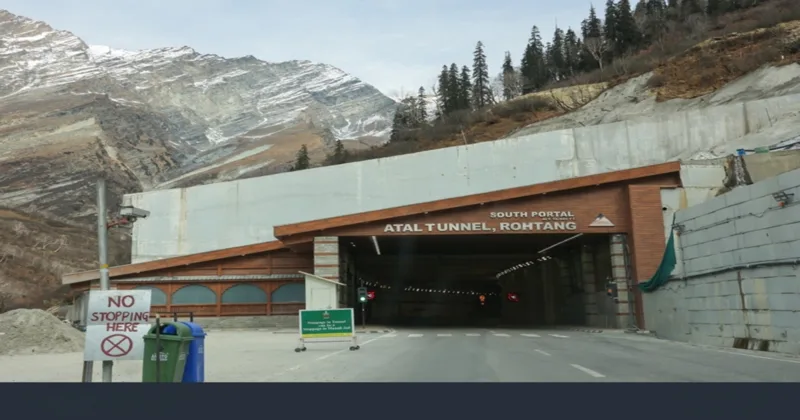
For decades, India’s mountainous and border regions stayed hostage to geography, snow-bound passes, landslide-prone highways and railway lines that took generations to complete. Since 2014, tunnel construction has moved from being an occasional engineering feat to a central pillar of India’s transport, tourism and border-security strategy, with the Himalayas, the Western Ghats and even the seabed beneath Mumbai and Kolkata now part of an expanding underground network. What was once treated as an exceptional, decades-long undertaking reserved for a handful of strategic corridors has become a routine instrument of national infrastructure policy, executed at a pace and scale that has no real precedent in India’s post-Independence history.
The deference of Two Eras
The UPA government (2004–2014) did sanction or initiate several significant tunnel projects, including the Rohtang (later Atal) Tunnel, the Chenani–Nashri Tunnel and early stretches of the Udhampur–Srinagar–Baramulla Rail Link (USBRL). Execution, however, remained slow, weighed down by land acquisition disputes, financing constraints and the sheer difficulty of Himalayan geology. The USBRL project itself, first conceived in the 1990s and formally sanctioned in the years that followed, saw individual tunnel sections take the better part of a decade each to complete, with the broader 272-km project routinely missing its own revised deadlines.
After 2014, the emphasis shifted from sanctioning projects to finishing them. Higher capital expenditure, faster environmental and statutory clearances, integrated planning under the PM Gati Shakti framework and closer coordination between the Ministry of Road Transport and Highways, the Border Roads Organisation, the National Highways Authority of India and Indian Railways together compressed timelines that had earlier stretched across decades. Advanced construction methods including New Austrian Tunnelling and for the first time on Indian Railways, Tunnel Boring Machines deployed in Himalayan geology have further cut both construction time and ecological disruption, allowing tunnels to be built through terrain that engineers had previously written off as unworkable within a reasonable timeframe.
Landmark Tunnels Completed Since 2014
Dr Syama Prasad Mookerjee (Chenani–Nashri) Tunnel, 2017 India’s first fully integrated smart highway tunnel, cutting the Jammu–Srinagar distance by about 30 km and travel time by nearly two hours.
Atal Tunnel, 2020 A 9.02-km all-weather tunnel beneath Rohtang Pass, officially recognised as the world’s longest highway tunnel above 10,000 feet, cutting the Manali–Sarchu distance by 46 km.
Kuthiran Tunnel, 2021 Kerala’s first highway tunnel, easing traffic flow on NH-544.
Banihal–Qazigund Road Tunnel, 2022 An all-weather alternative on NH-44 in Jammu & Kashmir.
Kolkata Underwater Metro Tunnel, 2024 India’s first underwater metro tunnel, linking Esplanade and Howrah Maidan beneath the Hooghly River.
Sela Tunnel, 2024 Year-round connectivity to Tawang, Arunachal Pradesh, with direct benefits for military logistics near the Line of Actual Control.
Z-Morh Tunnel, 2025 Year-round access to Sonamarg, supporting both tourism and strategic mobility in Kashmir.
USBRL Tunnel T-50, 2025 At 12.77 km, among India’s longest railway tunnels, forming part of the historic Kashmir rail-connectivity project.
Railway Tunnelling at an Unprecedented Scale
The most dramatic shift has come underground, on the railway network. India’s operational rail-tunnel length stood at roughly 125 km in 2014, by early 2025 it had grown to approximately 585 km, an addition of nearly 460 km in a decade, close to four times the pace achieved in the preceding sixty-odd years.
Much of this has been driven by the USBRL project, which alone comprises 36 tunnels along with major structures such as the Chenab Rail Bridge the world’s highest railway bridge, standing taller than the Eiffel Tower above the riverbed and the Anji Khad Bridge, India’s first cable-stayed rail bridge, finally delivering an all-weather rail link to the Kashmir Valley. Alongside it, the Rishikesh–Karnaprayag Railway is emerging as one of the most tunnel-intensive lines ever built in India, with over 80 per cent of its roughly 125-km alignment running underground including deployment of a Tunnel Boring Machine in Himalayan geology for the first time in Indian Railways’ history.
Strategic and Economic Significance
Unlike conventional highways, many of these tunnels serve overlapping national objectives. In border states such as Jammu & Kashmir, Ladakh, Himachal Pradesh and Arunachal Pradesh all-weather tunnels bypass snow-bound passes that once cut off entire regions for months, enabling uninterrupted troop movement and supply chains and materially strengthening forward defence preparedness. Where a single closed pass could once isolate a border district for half the year, all-weather tunnels now guarantee continuous logistics for the armed forces stationed along sensitive stretches of the Line of Actual Control and the Line of Control alike.
The economic dividend is just as significant. Reduced travel time, lower fuel consumption and year-round accessibility connect remote regions to tourism and commercial markets that were previously reachable only in summer. Farmers, transporters and small businesses in the hill states are among the most direct beneficiaries of this new, weather-proof connectivity, with regions like Lahaul-Spiti and Sonamarg already reporting extended tourist seasons and steadier local incomes since their respective tunnels opened.
India’s First Undersea Rail Tunnel
The Mumbai–Ahmedabad High-Speed Rail (bullet train) corridor has added an entirely new dimension to India’s tunnelling story. The 508-km project includes a 27.4-km tunnel section with 21 km of it underground, including India’s first undersea tunnel, running beneath Thane Creek between Bandra-Kurla Complex and Thane, with the remainder built as surface tunnels. The corridor also includes eight mountain tunnels, seven of them in Maharashtra with a combined length of about 6 km, and one in Gujarat. Built with Japanese technical and financial assistance, the project has already recorded successive breakthroughs, including the completion of a 5-km underground tunnel section between Thane and BKC and a mountain tunnel near Palghar excavated in just 18 months using drill-and-blast methods. Once operational, it will be India’s only high-speed rail corridor, running bullet trains at 320 km/h and cutting the Mumbai–Ahmedabad journey to under two hours.
Under Construction: The Next Wave
India’s tunnel-building programme is far from complete. Among the most consequential projects currently under way:
Zoji La Tunnel which will provide the first all-weather road link between Kashmir and Ladakh and is expected to become India’s longest road tunnel and Asia’s longest bi-directional tunnel. More than 12 km of the tunnel had already been excavated as of recent progress reviews, with modern construction techniques reported to be saving the exchequer over Rs 5,000 crore compared to earlier cost estimates.
Shinku La Tunnel offering a second all-weather route to Ladakh, reducing India’s strategic dependence on the single Zoji La axis.
Mumbai–Ahmedabad High-Speed Rail Tunnel including India’s first undersea bullet-train tunnel between Thane and Bandra-Kurla Complex, described above.
Thane–Borivali Twin Tunnel and Goregaon–Mulund Tunnel, aimed at decongesting Mumbai’s road network and cutting travel time across the city’s northern suburbs.
Continued tunnelling on the Rishikesh–Karnaprayag and Sivok–Rangpo railway projects, both designed to open up pilgrimage and border-adjacent regions that have historically depended on vulnerable, landslide-prone road links.
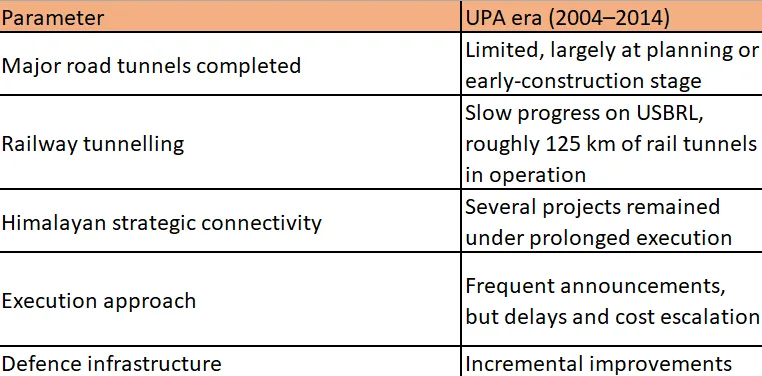
It is worth noting that some tunnels commissioned after 2014, the Atal Tunnel and Chenani–Nashri among them were originally conceived or begun under earlier governments. Their completion reflects continuity in long-gestation infrastructure planning what has changed is the rate at which such projects are actually finished and opened to the public.
Indian planners increasingly treat tunnels not as isolated engineering projects but as strategic national assets instruments that erase the disadvantage of geography for border security, tourism and everyday commerce alike. Whether it is an all-weather rail link to Kashmir, uninterrupted road access to Ladakh, better mobility in the Northeast, or decongesting India’s largest cities, tunnels are becoming a defining feature of the country’s infrastructure story, one that increasingly doubles as a statement of engineering self-reliance.
With Zoji La, the Mumbai–Ahmedabad bullet-train corridor and several other mega-projects still under construction, India’s underground network is set to expand further still deepening connectivity, economic resilience and national security through the rest of this decade, as a nation that once measured mountain crossings in years now measures them in mere months.