Bharat is the land of seekers. Long before international universities, student exchange programmes and global academic networks became features of the modern world, monks, scholars and seekers were already crossing mountains, deserts and seas in pursuit of knowledge. Some travelled from Bharat to distant lands carrying teachings, manuscripts and philosophical traditions. Others undertook difficult journeys from different parts of Asia to Bharat, seeking knowledge at celebrated centres of learning.
At the heart of this extraordinary movement was one of Bharat’s most enduring civilisational traditions, the Guru Shishya Parampara. In the Bharatiya worldview, knowledge has never been regarded merely as information or as an instrument of material advancement. It is a means of transforming human consciousness, character and conduct, which is to be acquired with humility, realised through experience and ultimately shared for the welfare of humanity.
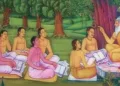
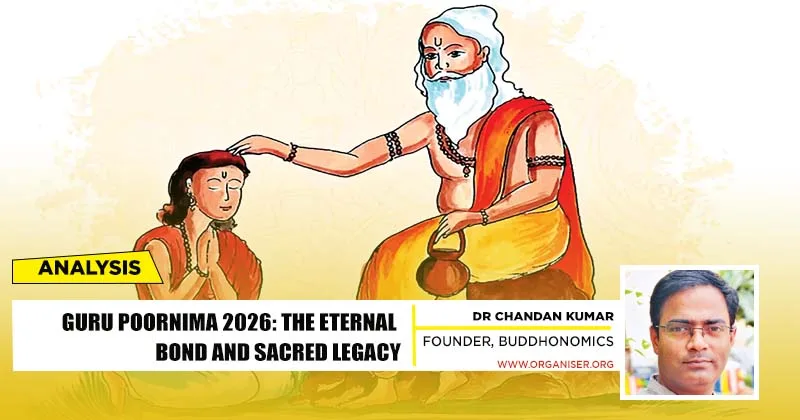
The Guru, therefore, was an ācārya, guide and living link in a lineage of knowledge. The Shishya was a seeker committed to inquiry, discipline, reflection and self-development. The celebrated invocation “Gururbrahmā gururviṣṇuḥ” expresses the profound place of the Guru in Bharatiya consciousness. The Upanishadic tradition demonstrates that learning in Bharat was founded on dialogue, questioning and contemplation. The Gurukula gave this relationship an institutional form, while Buddhism later expanded it into a vast monastic and scholastic network. Knowledge was not to remain confined within geographical boundaries. And so, the monks travelled.
Takshashila was the earliest centre for learning and later Bharatiya traditions remember the journey of monks to different regions to share the ethics and culture. Over succeeding centuries, Gangasagar (the Bay of Bengal) and Hind Mahasagar (the Indian Ocean) became highways not only of commerce but also of knowledge. Ships sailing between the ports of Bharat and far East carried monks, teachers, merchants, manuscripts, languages, philosophical ideas, artistic traditions and systems of learning. This movement extended across Asia. One of its most celebrated figures was Bodhidharma, traditionally remembered as a Bharatiya monk who travelled to China and became associated with the dissemination lineage that later developed into the Chan tradition. His enduring place in East Asian Buddhist memory illustrates the importance attached to transmission from master to disciple across geographical frontiers.
Knowledge Without Borders
In Korea, another remarkable example is Mālānanda, also known as Marananta, a Bharatiya monk traditionally credited with bringing Buddhist teaching to the kingdom of Baekje in 384 CE. Korean historical memory associates him with the early establishment of Buddhism in the peninsula. Centuries later, Korean monks such as Gyeomik journeyed to Bharat to study Sanskrit and Vinaya, demonstrating that the intellectual traffic between Bharat and East Asia was not one-way.
The enduring message of the Guru Shishya Parampara in Bharatiya tradition is knowledge, when shared, does not diminish but grows. The journey began centuries ago, and it continues today
The same pattern can be seen in the Himalayan world. Atiśa Dīpaṃkara Śrījñāna, one of the great Buddhist masters associated with the scholastic tradition of Eastern Bharat and Vikramaśīla, undertook an extraordinary intellectual journey. Before his famous mission to Tibet, Atiśa travelled to Suvarṇadvīpa in Sumatra, in present-day Indonesia, where tradition remembers his extended study under the renowned master Dharmakīrti, often known as Serlingpa. He later travelled to Tibet, where his teachings became deeply influential in the renewal and reorganisation of Buddhist learning.
This was the true strength of the Bharatiya knowledge tradition. Bharat was an important source and intellectual hub, but the relationship that emerged across Asia. Nowhere was this more visible than at Nalanda Mahavihara. Nalanda attracted knowledge seekers from across Asia who came to study Buddhist philosophy, logic, grammar, medicine, meditation and monastic discipline. The Chinese monk Xuanzang travelled thousands of kilometres to Bharat in the seventh century CE and studied at Nalanda under the renowned master Śīlabhadra. Xuanzang came not merely as a pilgrim but as a Shishya. When he returned, he carried manuscripts, philosophical knowledge and memories of his teachers, helping transmit Bharatiya intellectual traditions to East Asia.
Another great monk, Yijing, reveals the close connection between Bharat and maritime far East. On his journey towards Bharat, he spent considerable time in Śrīvijaya, centred in Sumatra, which he regarded as an important place of Buddhist learning. The educational world he encountered shows how interconnected Asian centres of knowledge had already become. A seeker could travel through far East, prepare himself linguistically and intellectually, continue towards the great centres of Bharat and then carry the knowledge onward. In modern terminology, we might call it international academic mobility. In the Bharatiya civilisational tradition, it was the Guru Shishya Parampara in motion. The relationship even acquired an institutional character. The Nalanda copper-plate inscription of the Pāla ruler Devapāla records the connection of Balaputradeva of Suvarṇadvīpa with the support of a monastery at Nalanda for monks associated with his realm. It represents an extraordinary example of an international educational relationship linking Bharat and far East centuries before modern university partnerships.
The influence of Bharatiya knowledge traditions went beyond Buddhism. Sanskrit, Pāli, philosophical concepts, literature, political ideas, architecture and ritual traditions travelled across far East and interacted with local cultures. They were not simply copied. They were adapted, transformed and given distinctive local expressions.
A Living Legacy Across Asia
Thailand provides a striking example of this civilisational continuity. Although overwhelmingly shaped by Theravāda, the Thai monarchy continues to preserve important ritual traditions involving Royal Court Brahmins, whose ceremonial functions remain connected with Hindu traditions. Court Brahmins associated with Bangkok’s Devasthan perform important royal ceremonies, reflecting a remarkable continuity of Indic ritual traditions within a far Eastern Buddhist monarchy. Accounts of the Royal Brahmin institution particularly associate its priestly lineage with Southern part of Bharat, including Rameswaram in Tamil Nadu.
This is precisely what makes the Bharatiya Guru Shishya tradition so fascinating. It did not produce cultural uniformity. It created connected diversity. Sri Lanka became a major centre of Theravāda scholarship. Myanmar, Thailand, Cambodia and Laos developed powerful monastic educational traditions. Śrīvijaya emerged as a maritime centre of Buddhist learning. China developed Chan, which later influenced Zen traditions in Japan and Korea. Tibet preserved vast bodies of Bharatiya Buddhist philosophy, logic, epistemology and tantra through generations of teachers and disciples.