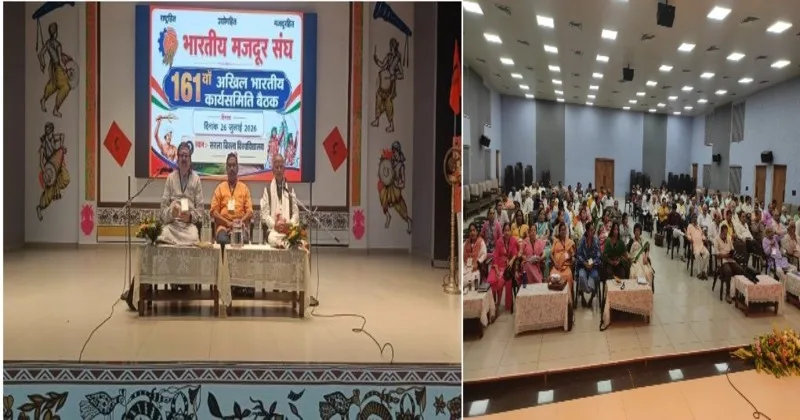
Three-day All India Working Committee meeting of the Bharatiya Mazdoor Sangh (BMS) at the auditorium of Sarala Birla University, Ranchi
RANCHI: The three-day All India Working Committee meeting of the Bharatiya Mazdoor Sangh (BMS) began on Sunday at the auditorium of Sarala Birla University in Namkum, Ranchi, the capital of Jharkhand. On the first day of the meeting, detailed deliberations were held on the four labour codes implemented by the Central Government. While BMS extended its support to two of the codes, it expressed serious objections to several provisions in the other two.
BMS endorsed the Code on Wages, 2019 and the Code on Social Security, 2020, describing them as significant steps in the interest of workers. According to the organisation, these codes represent a positive initiative aimed at ensuring better wage structures and expanding social security coverage for workers.
The organisation believes that these codes will help streamline wage-related provisions and bring greater transparency, while also extending benefits such as social protection to a wider section of the workforce, including those in unorganised sectors.
At the same time, BMS raised serious concerns regarding several provisions of the Industrial Relations Code, 2020. The organisation recorded objections on 13 key points and called for necessary amendments.
The issues highlighted include definitions of “industry,” “wages,” and “worker,” recognition of negotiating unions, and provisions related to annual returns. BMS emphasised that these aspects need to be revised in a manner that safeguards the interests of workers and strengthens the role of trade unions.
According to BMS, the current provisions could potentially weaken trade unions and undermine the effectiveness of collective bargaining mechanisms. The organisation stressed that any reform must ensure that workers’ representation remains strong and meaningful.
Similarly, BMS expressed objections to 15 provisions of the Occupational Safety, Health and Working Conditions Code, 2020. These concerns relate to definitions such as “factory” and “work activity,” as well as regulations governing workplace safety, health standards, and working conditions.
The organisation made it clear that there can be no compromise on issues concerning workers’ safety and health. It stated that the law must not leave any scope for employer convenience to override workers’ rights or safety standards.
BMS warned that any ambiguity or relaxation in these provisions could adversely impact workers’ welfare and expose them to unsafe working environments.
BMS clarified that its position is not one of outright opposition to the labour codes but rather a constructive effort to seek necessary amendments. The organisation stated that its primary objective is to ensure that the codes effectively protect workers’ rights, guarantee job security, and uphold dignity at the workplace.
It is important to note that the Central Government has consolidated 29 existing central labour laws into these four labour codes, presenting them as a major reform initiative aimed at simplifying labour regulations.
BMS reiterated its demand that labour laws must be implemented uniformly across all sectors and categories of workers. The organisation emphasised that protecting workers’ interests should remain the top priority, and the enforcement of laws should reflect this principle.
The meeting is being chaired by BMS National President S Mallesham, while the proceedings are being conducted by National General Secretary Surendra Kumar Pandey. Both leaders have been elected to the organisation’s national leadership for the 2026–29 term.
Approximately 150 representatives from various states and affiliated federations across the country are participating in the three-day meeting, which will continue from July 26 to July 28.
During the inaugural session, President S Mallesham highlighted the rapidly evolving nature of the global labour landscape. He pointed out that advancements in artificial intelligence (AI), increasing digitisation, the expansion of gig and platform economies, changes in production systems, and global economic challenges are creating new complexities for workers.
He emphasised that in such a scenario, the role of labour organisations becomes even more crucial to ensure that workers’ rights are protected in a changing economic environment.
Addressing the gathering, General Secretary Surendra Kumar Pandey stated that the core mission of BMS is to ensure justice, security, and dignity for the last worker in society. Referring to the philosophy of BMS founder Dattopant Thengadi, he said that helping the person standing at the last line represents the true essence of “Antyodaya.”
He stressed that this principle is not merely theoretical but serves as the foundation of BMS’s approach and functioning.
Around 150 representatives from across the country are attending the meeting. During the sessions, proposals related to the current condition of workers, the impact of the new labour codes, and other contemporary labour issues will be presented and discussed.
After detailed deliberations, decisions will be taken on these proposals, and future strategies will be formulated to address key labour concerns.
