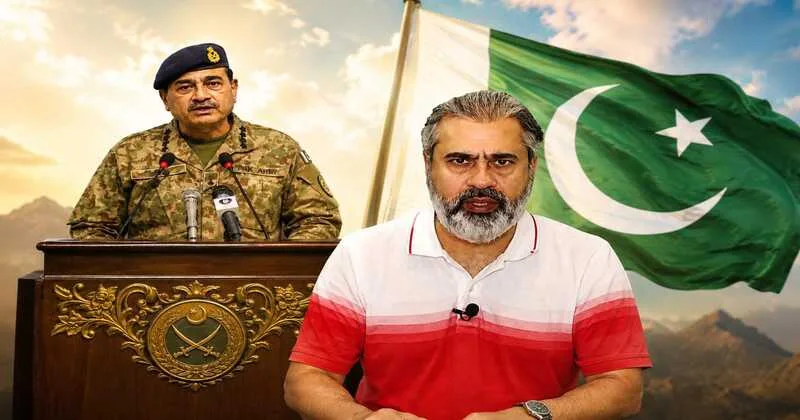
In a glaring exposure of Rawalpindi’s propaganda apparatus, Pakistani journalist Imran Riaz disclosed that the Director General of Inter-Services Public Relations (DG ISPR) convened an exclusive closed-door meeting with top media executives and journalists. During this secret briefing, the military spokesperson explicitly directed Pakistani media personnel to amplify aggressive, hostile coverage of India.
The core directive given to media houses was to repeatedly churn out and push a fabricated narrative claiming that India is on the verge of imminent disintegration.
This dramatic revelation firmly establishes the deep-seated obsession of Pakistan’s military establishment with orchestrating state-sponsored information warfare against India. Rather than adhering to journalistic ethics or objective news reporting, Pakistan’s military media wing systematically manipulated domestic discourse to manufacture a false sense of vulnerability regarding its neighbour.
For decades, Pakistan’s military apparatus has relied on strategic communication campaigns to distract its citizens from profound domestic failures, utilizing state-controlled media vectors to project imagined fractures within India. This systematic effort to alter perceptions underlines how deep information operations run within Pakistan’s security apparatus.
Propaganda Machine Exposed: Unmasking Rawalpindi’s information warfare
The disclosures made by Imran Riaz pull back the curtain on the covert mechanics of the DG ISPR, which acts as the undisputed chief architect of Pakistan’s state propaganda. Serving as the official media and communications arm of the Pakistani armed forces, the DG ISPR has expanded its mandate far beyond routine defense updates, transforming into a dominant institution that dictates national media narratives during geopolitical standoffs, security crises, and internal political turmoils.
Press freedom organisations and global observers have long pointed out the severe grip the security establishment holds over newsrooms across Pakistan. Media outlets that refuse to conform face severe censorship, state-sponsored pressure, and violent intimidation. Imran Riaz said that during the closed-door meeting, media executives were explicitly instructed to prioritize anti-India rhetoric over genuine, balanced reporting on Pakistan’s own deteriorating domestic landscape.
https://twitter.com/i/status/2076651688950366618
This systemic suppression of independent journalism ensures that state-approved propaganda dominates television broadcasts, digital outlets, and social media platforms.
From India’s perspective, these state-backed campaigns represent nothing more than desperate, recycled propaganda. Pakistani state actors have persistently spun doom-laden theories predicting the imminent breakup of India for over seven decades, yet every single prediction has crumbled against the bedrock of Indian democracy.
While India navigates complex political, social, and regional dynamics inherent to a massive and diverse democratic nation, its constitutional institutions, sovereign federal setup, and robust electoral mechanisms consistently display extraordinary stability. India’s enduring unity amidst diversity completely shatters the hollow narratives generated by its neighbor.
Today, India’s strategic community recognises information warfare as an active dimension of modern warfare. As a result, India successfully counters foreign disinformation across TV, digital networks, and global platforms, ensuring its diplomatic clout and national resilience remain unquestioned worldwide.
Pakistan’s internal crumbling vs India’s unshakeable democratic resilience
The aggressive push by Rawalpindi to project turmoil inside India stands in stark contrast to Pakistan’s own compounding domestic vulnerabilities. Critics and geopolitical analysts emphasize that the military’s fixation on orchestrating anti-India propaganda is a calculated maneuver to divert public attention from the severe turmoil plaguing Pakistan itself. While state institutions expend vast resources manufacturing falsehoods about India, Pakistan faces multi-dimensional security, political, and economic crises that threaten its core stability.
In Balochistan, a long-running and violent insurgency continues to escalate, marked by frequent, devastating attacks on Pakistani security personnel and vital infrastructure. The military establishment has failed to contain separatist militant movements, leaving the region in persistent chaos. Concurrently, political volatility in Pakistan has reached unprecedented heights, characterized by bitter, ongoing confrontations between the military brass, opposition political parties, and civil society advocates.
Furthermore, Pakistan-administered Kashmir has erupted into massive public unrest, with citizens taking to the streets to protest severe economic distress, administrative corruption, and authoritarian governance.
Despite these burning domestic emergencies, the DG ISPR prioritised pressuring media houses to peddle fantasy narratives about India’s internal collapse.
By choosing external propaganda over genuine problem-solving, Pakistan’s state institutions remain fundamentally disconnected from the harsh realities confronting their own populace. Imran Riaz’s revelation confirms that while India continues to thrive as a global economic powerhouse and resilient democracy, Pakistan’s military media machine remains trapped in a futile cycle of anti-India obsession, attempting to conceal domestic ruin behind artificial media noise.
Ultimately, Rawalpindi’s propaganda tactics fail to diminish India’s undeniable global prestige. For analysts, the crucial takeaway is not merely the promotion of anti-India rhetoric, but the tragic reality that state institutions intentionally compel media houses to prioritize foreign propaganda over truth.