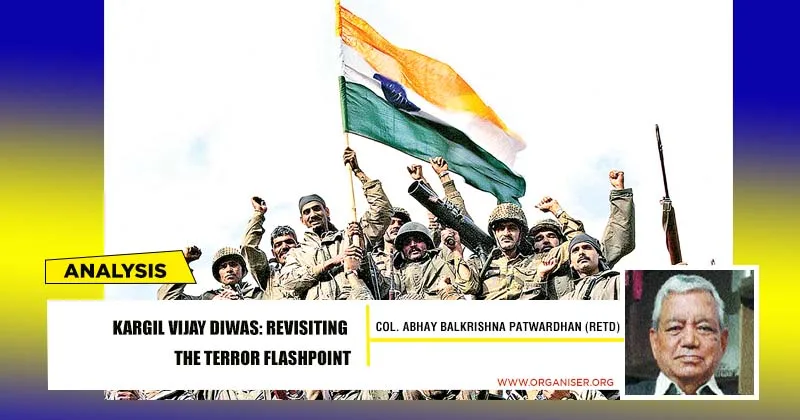
Bharatiya soldiers celebrating victory during Kargil War
The 1999 Kargil War was the first direct conventional war/conflict between two nuclear states. It altered the geopolitical dynamics of International Intervention and accelerated the “Realignment of Global Powers” towards India. Since I was actively involved in this war, I can now clearly visualise the evolving geopolitical and nuclear dynamics shaping it and its aftermath. Many stories have been written about Kargil. This is my endeavour to pay tribute, at different levels, to all Heroes of Kargil on Kargil Vijay Din, falling on July 26.
India and Pakistan, both went nuclear in 1998. Subsequently, Pakistani perceptions underwent drastic changes. Pakistan was under the impression that mutual nuclear deterrence provided it a shield to adopt any course of action with impunity. Nuclear Arsenal would deter any full-scale attack/war by India. Even if it happens, Super Powers would step in and mediate. This would test the “Stability Instability Paradox” wherein nuclears ensure peace but allow lower-level conventional forces.
Pakistan thought that it had achieved a strategic balance with India and that it was time to acquire the remaining portion of Kashmir to alter the regional boundaries. She refuted the logic that with the nuclearisation of both India and Pakistan, there is no possibility of war between them. But India perceived that, though prevailing concepts of nuclear deterrence ensured NIL possibility of any nuclear conflict, the option of Conventional War was always open in case of any Pak Mischief/ Aggression. However, since Pakistan had a different perception of using nuclear weapons at will, especially in reference to India, it refused to have “No First Nuclear Strike Agreement” with India.
Nuclear Brinkmanship
Pakistan perceived that nuclear deterrence gave it an opportunity to realise its long-standing desire to annex Kashmir by force and initiated a surprise military attack. It shook India to the core, as Indo-Pak relations were on an upward diplomatic swing with Indian Prime Minister Atal Bihari Bajpai and Pakistani Prime Minister Mian Muhammad Nawaz Sharif making strong moves to improve inter-se relations. So, when we launched targeted airstrikes and ground offensives to throw it out, Pakistan got scared of India crossing the international boundary and taking back its territory. So, Pakistan quickly upped its nuclear ante. Indo-Pak clashes had reached a height by then, and all-out war seemed to be a real possibility as the number of Indian casualties was on the rise. At that point, India started preparing to escalate the conflict to subdue Pakistan. Pakistan threatened to use nuclear weapons if India initiated an attack against Pakistan.
The whole world was on tenterhooks as to whether these local engagements were on the verge of escalating into a catastrophic nuclear exchange. Nuclear threat by Pakistan and intelligence reports about suitable but fierce Indian retaliation established Kashmir as a nuclear flashpoint. This nuclear coercion by Pakistan resulted in India laying down clear parameters for its strategic defences, revising/formalising its nuclear doctrine of “Credible Minimum Deterrence” and a “Strict No First Use (NFU) of Nuclear Weapons Policy”. Threats issued by Pakistan led India to take nuclear issues seriously, and across multiple committees were appointed to look into the shortcomings during war, and finally, the recommendations of the Subramanian Committee and General Shekatkar Committee were put to use by 2023. The geopolitical perception of nuclear deterrence, established by America and the Soviet Union during the Cold War, stipulated that nuclear opponents do not wage war against each other. This concept was negated by the Kargil War. On the other hand, as per some defence experts, nuclear deterrence could avert a full-scale war over Kargil. International pressure forced India and Pakistan to return their forces to normal positions. This war resulted in more than 1500 casualties, both combined, falsifying global perceptions of nuclear deterrence theory.
Pakistan’s Backstabs Bharat
Buoyed by this theory, Pakistan launched a military operation, entered Indian territory and took control of all mountainous heights located in a 160-kilometre stretch in the Kargil sector. India accused Pakistan of forcible occupation of the Indian position. Pakistan, in turn, flatly refuted, claiming that it was Kashmiri Mujahedin who were fighting at Kargil and not it. India responded in strength and inducted the Indian Air Force to bomb positions occupied by Pakistani soldiers, implying widening the scope of war, if Pakistan fails to take corrective measures. An already sensitive situation was worsening with the passage of time. The International community wanted an immediate reduction of tension between these two nuclear nations. America managed to convince Pakistan regarding the perils of nuclear confrontation and the ensuing disastrous results. Pakistan, under extreme pressure from the international community, vacated Indian positions and withdrew from Kargil, and tension started to reduce.
Return to Normalcy
Kargil proved that nuclear deterrence supported by nuclear weapons cannot be solely relied upon for peace. America and the international community were closely monitoring the progress of this conflict, the fate of the diplomatic process to stop this war, and the subsequent reduction of tensions in a developing war-like situation. The Kargil War lasted less than two months, leaving behind a legacy. De-escalation and prevention of a nuclear war were not because of Nuclear deterrence. A combination of American diplomacy, political pressure, and personal input by then American President Bill Clinton to Pakistan for withdrawal was responsible for the end/conclusion of the Kargil War.
Kargil conflict is a grim reminder that nuclear deterrence need not necessarily terminate the potential for a spill over of conventional hostilities into a nuclear exchange. Nuclear deterrence only works when Nuclear States/Supporters give it due weightage. Russia in Ukraine and America/Israel in Iran are aware of this fact/reality. That, to my mind, is the contribution of the Kargil war to the strategic community, worldwide.

