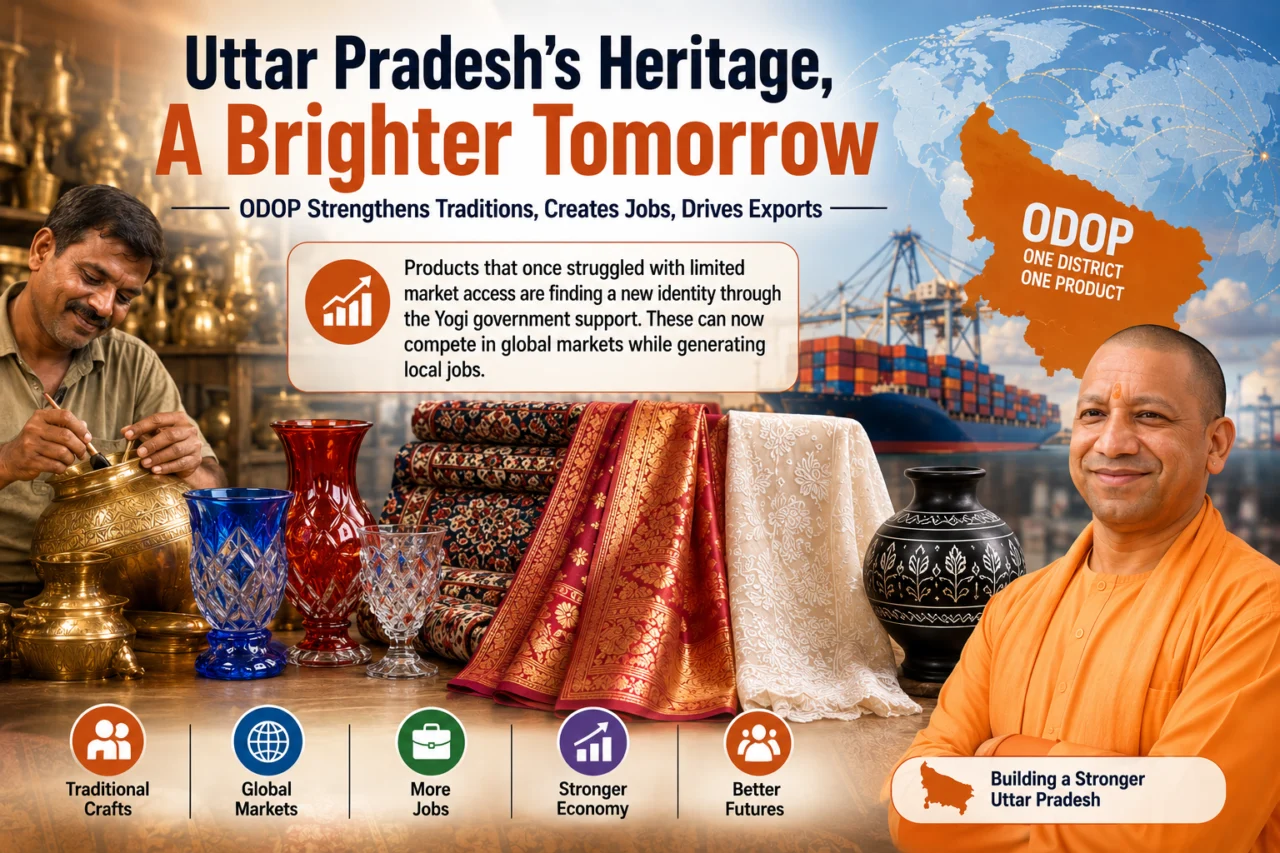
Lucknow – Uttar Pradesh’s famous traditional products, which were once known mainly through generations of artisans but are now struggling to compete in modern markets, are witnessing renewed growth under UP’s One District One Product (ODOP) initiative. Industries such as Moradabad’s brassware, Firozabad’s glassware, Bhadohi’s carpets, Banarasi sarees, Lucknow’s chikankari and Azamgarh’s black pottery are finding new markets, creating employment and contributing to the economy. These products are not new. They have been part of Uttar Pradesh’s cultural and economic identity for decades. However, artisans and industry experts have often pointed out that while these crafts continued to exist, they received limited institutional support in terms of branding, marketing, design development and access to larger domestic and international markets.
Unlike creating new industries, ODOP focuses on strengthening those that are already existing but have not received the policy attention which was needed for expansion. The ODOP scheme has attempted to address these gaps by identifying a signature product from every district and providing support through skill development, packaging, quality improvement, financial assistance, exhibitions and export promotion. The idea is to preserve traditional craftsmanship while making it commercially competitive in today’s economy.
The impact is visible across several sectors. Moradabad’s brass industry, known for its handcrafted brass products, has received renewed attention through export promotion and product diversification. Firozabad’s glass manufacturers are expanding beyond traditional decorative items, while Bhadohi’s carpet industry continues to strengthen its position in international markets. Similarly, Banarasi sarees, Lucknow’s chikankari and Azamgarh’s black pottery have gained wider visibility through exhibitions, e-commerce platforms and government-backed promotional campaigns.
Officials say the programme has helped artisans in accessing better market linkages, modern packaging, quality certification, easier credit and participation in trade fairs. A support that was often unavailable earlier. This has enabled many traditional businesses to expand their production, generate higher incomes and create more employment within their local communities.
The initiative has also become an important pillar of Uttar Pradesh’s growing MSME ecosystem. Today, Uttar Pradesh has more than 96 lakh MSME units, many of which are linked to district-specific traditional industries. By strengthening these local manufacturing clusters, the government is trying to generate employment for people closer to their home. This will also reduce migration and encourage entrepreneurship in smaller towns and rural areas.
Along with promoting traditional industries, the state has also focused on skill development to improve employment opportunities. On World Youth Skills Day, Chief Minister Yogi Adityanath said that over 3.25 crore youth and artisans have found employment or self-employment over the last nine years, while more than nine lakh people have secured government jobs through transparent recruitment.
At the same time, Industrial Training Institutes (ITIs) and skill development centres are equipping young people with training in emerging fields such as artificial intelligence, robotics, drone technology, 3D printing and semiconductor manufacturing. According to the Yogi government, this dual approach will preserve the traditional craftsmanship alongside preparing the next generation for technology-driven industries.
To make skill training more accessible, the government has launched digital platforms such as Kaushal Setu and Kaushal Sarathi. They allow young people to register for training, explore courses and find skill centres more easily. The impact of these programmes is already visible. Many trained youth have secured jobs or started their own ventures, while artisans working with ODOP products are reaching more customers and earning better incomes through improved market access.
Uttar Pradesh’s traditional products were never lost, instead they have been around for generations. What has changed is the support they are now receiving. With the Yogi government backing, better market access and skill development, these traditional industries are creating more jobs, increasing exports and contributing to the state’s economy, while helping preserve age-old craftsmanship for future generations. As Uttar Pradesh continues to position itself as a manufacturing and investment destination, the revival of its traditional products under ODOP is increasingly being seen as an example of how cultural heritage can be combined with modern economic policy.