
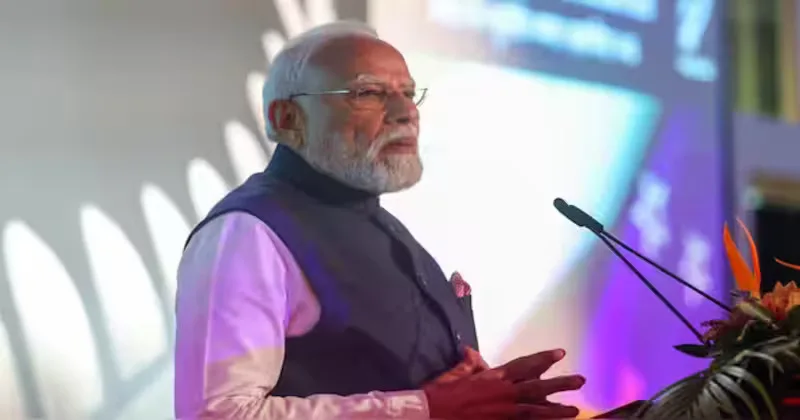
Across Seychelles, Japan, Indonesia, Australia and New Zealand, Prime Minister Narendra Modi has pursued a consistent foreign policy template helping like-minded democracies reduce strategic dependence while expanding India’s own geopolitical influence without entering formal alliances.
Prime Minister Narendra Modi’s aircraft touched down in Auckland on July 10, bringing to a close an unusually concentrated diplomatic campaign that began in Victoria, Seychelles, on June 27. Between those two destinations lay a carefully sequenced set of engagements that included hosting Japan’s Sanae Takaichi in New Delhi, followed by state visits to Indonesia and Australia before concluding in New Zealand.
On paper, these were separate diplomatic events with different agendas, joint statements and bilateral outcomes. Viewed together, however, they reveal something more significant: the deliberate application of a single foreign policy strategy across four democratic partners facing the same strategic dilemma. That dilemma is dependence.
Each of these countries has found itself navigating the uncomfortable reality of excessive reliance on a single major power whether China as a trading partner or the United States as a security guarantor. Their circumstances differ, but the underlying concern is remarkably similar: how to preserve strategic autonomy in an increasingly polarised Indo-Pacific.
India has positioned itself not as a replacement for either Washington or Beijing, but as an additional pillar upon which these nations can diversify their economic and strategic relationships. In doing so, New Delhi is simultaneously expanding its own influence without surrendering its cherished doctrine of strategic autonomy.
The pattern first emerged in Seychelles. During his landmark visit marking fifty years of diplomatic ties, Modi resisted the temptation to frame the relationship through ideological language or geopolitical rhetoric. Instead, India delivered practical capability. A fast patrol vessel strengthened the Seychelles Coast Guard, a $175 million package of grants and concessional credit reinforced development cooperation, and the island nation was fully integrated into Vision MAHASAGAR.
Equally significant was Seychelles’ elevation as a full member of the Colombo Security Conclave and the decision to expand the annual Lamitye military exercise into a tri-service engagement. These measures reflected India’s growing appreciation that influence in the Indian Ocean cannot be sustained through speeches about democratic solidarity alone.
Seychelles has accepted infrastructure investments from both China and India over the past decade. Rather than demanding exclusive loyalty, New Delhi offered tangible security benefits and a larger regional role. It was diplomacy rooted in utility rather than ideology. Only days later, attention shifted to New Delhi, where Japan’s Sanae Takaichi participated in the sixteenth India-Japan Annual Summit. Here the currency was not maritime security but investment, technology and industrial resilience.
Approximately $10 billion in new Japanese investments advanced the broader target of 10 trillion yen in economic cooperation. Joint declarations covered semiconductors, critical minerals, artificial intelligence and energy security, while the two countries also announced their first defence co-development project.
Japan’s calculations are no less strategic than those of Seychelles. Tokyo continues to rely heavily on its alliance with the United States, yet recent geopolitical uncertainties have reinforced the importance of diversifying economic and technological partnerships. India offers Japan what few other economies can—a vast market, a growing manufacturing ecosystem and a politically stable democratic partner capable of balancing regional supply chains. Once again, India responded to its partner’s specific strategic concern instead of attempting to fit the relationship into an ideological template.
Indonesia represented perhaps the most visible demonstration of India’s growing confidence as both a security provider and an economic partner. Prime Minister Modi’s bilateral summit with President Prabowo Subianto produced sixteen agreements, including Indonesia’s purchase of the BrahMos supersonic cruise missile, making Jakarta the third international customer after the Philippines and Vietnam. Indonesia also became the first foreign buyer of India’s Astra air-to-air missile, underlining the maturation of India’s defence manufacturing capabilities.
Yet the truly strategic outcome lay beyond defence exports. The agreement concerning Sabang Port, located at the northern tip of Sumatra overlooking the entrance to the Strait of Malacca, carries implications that extend well beyond bilateral commerce. Positioned barely 160 kilometres from India’s Great Nicobar development project, Sabang offers opportunities for maritime coordination in one of the world’s most critical shipping corridors. Combined with agreements on space cooperation, educational partnerships and digital payment connectivity between India’s UPI and Indonesia’s QRIS system, the visit underscored India’s intention to build comprehensive relationships that extend far beyond military cooperation.
Australia formed the fourth pillar of this diplomatic sequence. Modi’s meeting with Prime Minister Anthony Albanese in Melbourne yielded eighteen agreements, including a Joint Declaration on Defence and Security Cooperation, a Maritime Security Collaboration Roadmap and the operationalisation of the long-delayed civil nuclear agreement that will facilitate Australian uranium exports to India.
These developments build upon the Comprehensive Strategic Partnership established in 2022 and reflect the remarkable expansion of bilateral trade, now exceeding $50 billion. Australia’s own economic experience has shaped this partnership. Decades of dependence on Chinese demand for iron ore and critical minerals have encouraged Canberra to cultivate alternative markets and strategic relationships. India, meanwhile, gains access to critical energy resources while deepening defence cooperation with another major Indo-Pacific democracy. Again, the relationship is driven not by alliance politics but by mutual diversification.
Against this backdrop, New Zealand appears less like a standalone visit and more like the logical culmination of an established diplomatic pattern.
No developed economy illustrates the challenge of dependence more clearly than New Zealand. China has remained Wellington’s largest trading partner for over a decade, absorbing roughly one-quarter of the country’s goods exports and underpinning significant portions of its dairy industry. Yet the very scale of that dependence has generated growing discomfort. Export concentration creates vulnerability, particularly when geopolitical tensions threaten commercial relationships.
Successive New Zealand governments have therefore sought greater diversification, with India emerging as an increasingly attractive destination. The recently concluded India-New Zealand Free Trade Agreement is the principal instrument of this strategy. Revived during Prime Minister Christopher Luxon’s visit to New Delhi in 2025, finalised later that year and formally signed this April, the agreement eliminates tariffs on virtually all Indian exports entering New Zealand immediately while progressively liberalising access for New Zealand products into India’s vast consumer market.
Its significance lies less in headline trade volumes than in structural diversification. Dairy products, sheep meat, forestry, wine, wool and horticultural exports all sectors traditionally dependent upon Chinese demand now possess a credible long-term alternative. Wellington’s commitment to invest tens of billions of dollars in India over the coming decade, alongside expanded aviation connectivity, demonstrates that both governments view the agreement as the beginning rather than the culmination of a broader partnership.
The Auckland visit itself was notably understated: a bilateral meeting with Prime Minister Luxon and an enthusiastic diaspora gathering at Spark Arena attended by members of New Zealand’s 400,000-strong Indian community. Yet this understated character reflected the broader philosophy behind India’s diplomacy. The objective is not dramatic geopolitical realignment but patient accumulation of influence through practical cooperation.
Collectively, these five engagements reveal a coherent strategic framework. Seychelles strengthens India’s maritime reach across the Indian Ocean. Japan contributes investment, advanced technology and supply-chain resilience. Indonesia expands India’s defence exports while enhancing its presence near one of the world’s most vital maritime chokepoints. Australia provides critical minerals, uranium and a deeper strategic partnership across the Indo-Pacific. New Zealand extends India’s economic footprint into the South Pacific while reinforcing diversification within a key member of the Western alliance system.
None of these relationships obliges India to enter formal alliances or abandon its commitment to multi-alignment. On the contrary, each new partnership enhances India’s own diplomatic flexibility by expanding the number of countries with a vested interest in New Delhi’s success.
There are, of course, limitations. None of these agreements alone fundamentally alters regional power balances. New Zealand will remain economically intertwined with China for years to come. Indonesia’s defence purchases, while symbolically significant, remain modest compared to China’s broader economic engagement with Southeast Asia. Even Japanese investments and Australian strategic cooperation cannot substitute entirely for the existing architecture of American security guarantees.
But judging India’s diplomacy solely by immediate transformations misunderstands its method. Rather than pursuing dramatic breakthroughs, New Delhi is steadily building an architecture of overlapping partnerships based on shared interests rather than shared enemies. It offers markets instead of military blocs, infrastructure instead of ideological prescriptions, and practical cooperation instead of binary choices.
The diplomatic journey from Victoria through New Delhi, Jakarta, Melbourne and finally Auckland represents the emergence of India as a confident power that understands the anxieties of other middle powers and responds with solutions tailored to their circumstances. In an era increasingly defined by great-power rivalry, India’s greatest diplomatic innovation may be its refusal to force others into choosing sides.
That patient strategy may not generate dramatic headlines. But over time, it could prove to be one of the most durable foundations of India’s rise as a leading power in the Indo-Pacific.