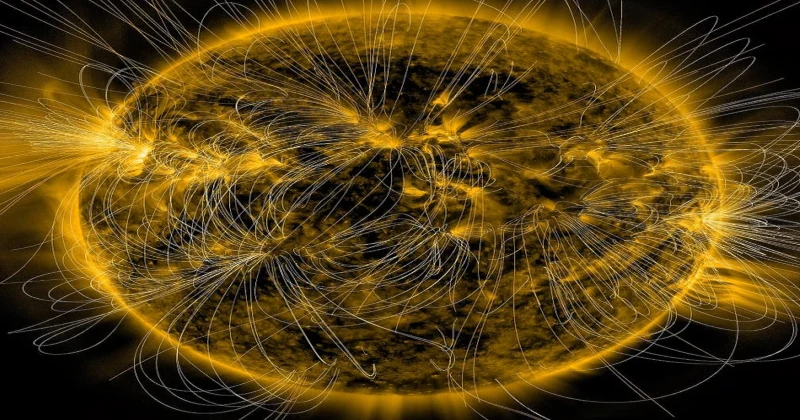
Indian scientists have uncovered a hidden plasma flow extending deep into the Sun’s upper atmosphere, providing the first direct observational evidence for the long-theorised “magnetic tree” model of the Sun.
The landmark discovery, published in The Astrophysical Journal, reveals that the Sun’s slow poleward movement of hot plasma known as the meridional flow extends nearly 3,000 kilometres above the Sun’s visible surface into the upper chromosphere. The finding establishes a previously unknown connection between the Sun’s surface and its upper atmosphere, offering fresh insights into the mechanisms that drive solar storms capable of disrupting satellites, GPS navigation, communication systems and even power grids on Earth.
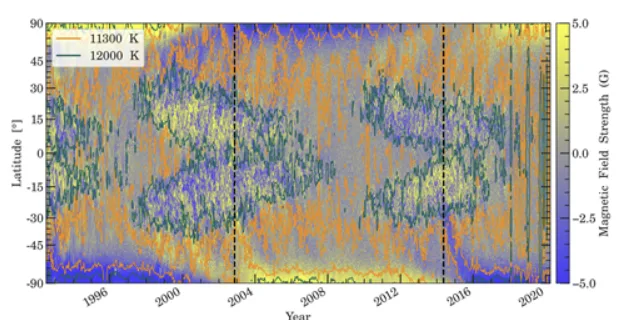
The research was led by Aryabhatta Research Institute of Observational Sciences (ARIES), an autonomous institute under the Department of Science and Technology (DST), in collaboration with the Physical Research Laboratory (PRL), IIT Delhi, Indian Institute of Space Science and Technology (IIST) and NASA’s Goddard Space Flight Center.
For decades, solar physicists have known that hot plasma slowly travels from the Sun’s equator towards its poles. This large-scale movement, called the meridional flow, acts like a giant conveyor belt that transports magnetic fields across the solar surface and plays a central role in regulating the Sun’s 11-year solar cycle, including the formation of sunspots and solar eruptions.
Until now, however, scientists believed this flow could only be observed in the Sun’s lower atmospheric layers. The new study overturns that assumption.
Researchers have now shown that the same poleward plasma flow continues far into the Sun’s upper chromosphere, a region where magnetic fields exert a much stronger influence over plasma motion. The discovery provides the first clear evidence that the Sun’s atmospheric layers remain dynamically connected rather than functioning as isolated regions.
The breakthrough came after researchers analysed an extraordinary 27 years of radio observations collected by the Nobeyama Radioheliograph in Japan. Rather than tracking individual sunspots or magnetic regions a conventional approach in solar physics the research team developed an innovative image-correlation technique.
Thousands of full-disk radio images taken one day apart were compared to detect minute shifts in brightness patterns over nearly three decades. This enabled scientists to accurately map the large-scale movement of plasma across the Sun’s upper atmosphere.
Their analysis revealed plasma travelling toward the poles at speeds between 5 and 15 metres per second, remarkably similar to velocities measured much deeper inside the Sun.
The researchers also observed that the plasma flow varies throughout the solar cycle, with the northern and southern hemispheres often behaving differently depending on which hemisphere is magnetically more active.
Perhaps the most significant outcome of the study is the strong observational support it provides for the long-standing “magnetic tree” hypothesis.
According to this theory, magnetic structures extending high above the Sun’s surface remain connected to magnetic fields rooted deep inside the Sun much like the branches of a tree remain attached to its trunk and roots.
By comparing decades of radio observations with long-term maps of the Sun’s magnetic field, researchers found that bright radio features migrated toward the poles in near-perfect synchronisation with magnetic field transport.
This close correspondence demonstrates that the Sun’s upper atmosphere continues to carry the signature of processes occurring deep within its interior. The discovery fundamentally changes scientists’ understanding of how different layers of the Sun communicate with each other.
Understanding the movement of plasma and magnetic fields inside the Sun is not merely an academic pursuit. These processes are responsible for powering solar flares, coronal mass ejections and other space weather events that can have serious consequences for modern technological infrastructure.
Severe solar storms can interfere with satellite operations, radio communications, aviation systems, GPS navigation, military infrastructure and electricity transmission networks across the globe. Improving knowledge of the Sun’s internal dynamics is therefore essential for developing more accurate space weather prediction models.
The newly discovered plasma flow provides scientists with a powerful observational tool to better understand the solar dynamo the mechanism responsible for generating the Sun’s magnetic field and driving its activity cycle. The study highlights India’s growing contribution to cutting-edge solar physics and international space research.
The research was spearheaded by Srinjana Routh of ARIES, alongside scientists from PRL, IIT Delhi, IIST and NASA’s Goddard Space Flight Center. Published in one of the world’s leading astrophysics journals, the findings mark a major advance in radio astronomy and solar science.
By demonstrating that the Sun’s upper atmosphere mirrors the large-scale flows occurring deep beneath its surface, the study opens an entirely new window into understanding our nearest star bringing scientists one step closer to predicting the powerful solar events that can shape life and technology on Earth.